Loading...
Done
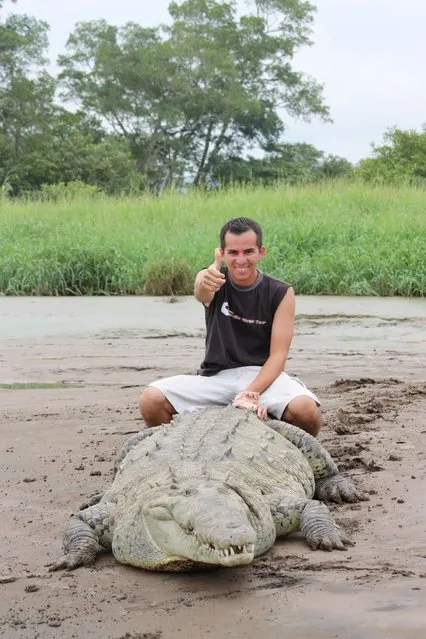
A tour guide shows a thumbs up as he sits on top of a crocodile on the Tarcoles river in Tarcoles, Costa Rica. (Photo and caption by Barcroft Media)

To most of us, hand-feeding crocodiles might sound like a one-way ticket to a watery grave. But for Jose Eduardo Chaves Salas, 32, coming within inches of the fearsome creatures’ razor-sharp teeth is all in a day’s work. He runs Jose's Crocodile River Tour on the Tarcoles River in Costa Rica, where tourists can watch him feed crocs up to 17 feet long. Photo: A tour guide shows a thumbs up as he sits on top of a crocodile on the Tarcoles river in Tarcoles, Costa Rica. (Photo and caption by Barcroft Media)
Details
20 Oct 2013 09:06:00
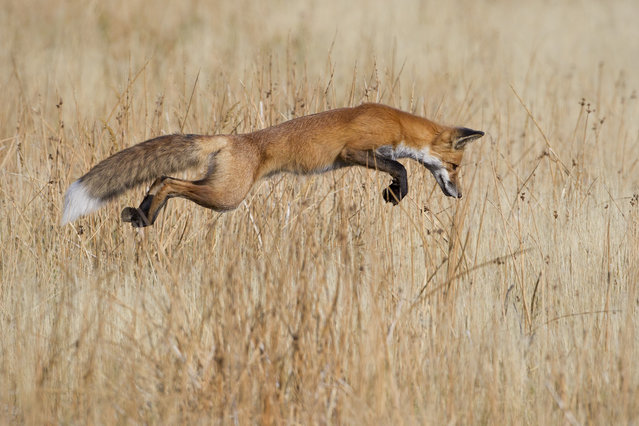
Canada: “Lucky pounce”. (Photo by Connor Stefanison/Wildlife Photographer of the Year 2013)

The winners of The London’s Natural History Museum's prestigious Wildlife Photographer of the Year for 2013 have finally been unveiled. Selected from almost 43,000 entries from 96 countries, the winners offer a glimpse of the stunning array of natural beauty on our planet. Photo: Canada: “Lucky pounce”. “Anticipating the pounce – that was the hardest part”, says Connor, who had come to Yellowstone National Park, Wyoming, USA, in search of wildlife as much as the spectacular landscape. He had found this fox, his first ever, on his last day in the park. It was so absorbed in hunting that Connor had plenty of time to get out of the car and settle behind a rock. It quartered the grassland, back and forth, and then started staring intently at a patch of ground, giving Connor just enough warning of the action to come. When it sprung up, Connor got his shot. And when it landed, the fox got his mouse. (Photo by Connor Stefanison/Wildlife Photographer of the Year 2013)
Details
17 Oct 2013 08:12:00
A young couple leave the Alem Entertainment Center in Ashgabat. The current president has a history of breaking obscure records. In 2012 the wheel atop this complex was entered into the Guinness Book of World Records as the world's largest enclosed Ferris wheel. The structure was built at a cost of $90m. (Photo by Amos Chapple via The Atlantic)

Travel photographer Amos Chapple recently crossed into Turkmenistan on a three-day transit visa and was able to photograph many of the sights and monuments in Ashgabat, the capital and largest city. Turkmenistan is a single-party country, a former Soviet state, run by a president at the center of a cult of personality.

Photo: A young couple leave the Alem Entertainment Center in Ashgabat. The current president has a history of breaking obscure records. In 2012 the wheel atop this complex was entered into the Guinness Book of World Records as the world's largest enclosed Ferris wheel. The structure was built at a cost of $90m. (Photo by Amos Chapple via The Atlantic)
Details
09 Jun 2013 07:24:00
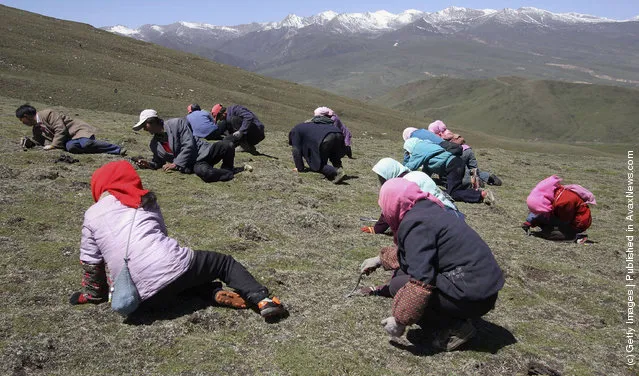
Ophiocordyceps Sinensis A.K.A. Caterpillar Fungus

“There are over 680 documented species of the sac fungus genus Ophiocordyceps, and one of the best known of these is Ophiocordyceps sinensis, colloquially known as caterpillar fungus. The fungus is known in Tibetan as yartsa gunbu or yatsa gunbu. O. sinensis is known in the West as a medicinal mushroom and its use has a long history in Traditional Chinese medicine as well as Traditional Tibetan medicine. The highly valuable fungus-caterpillar combination is hand-collected and is used as an aphrodisiac and as a treatment for a variety of ailments from fatigue to cancer”. – Wikipedia

Photo: Nomads dig for Chinese caterpillar fungus from a mountain May 25, 2007 in Guide County, Hainan Prefecture, Qinghai Province, China. Nomads can earn about 2,000 yuan to 5,000 yuan (about U.S. $260 to $653 ) through their work during the fifty-day Chinese caterpillar fungus gathering season. (Photo by China Photos/Getty Images)
Details
26 Sep 2011 10:47:00
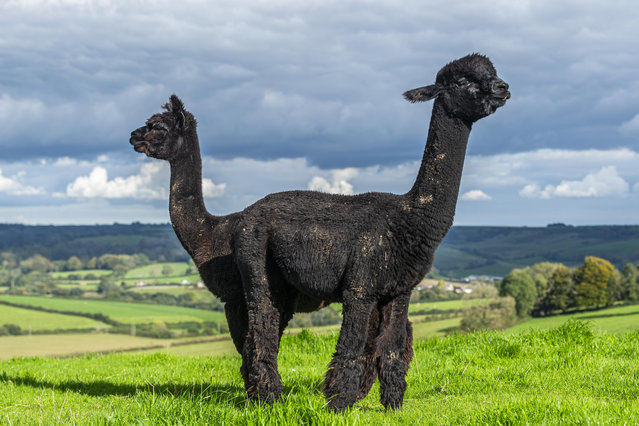
A pair of alpacas at a British farm in Dorchester, Dorset on October 9, 2024 pose together at the perfect time to conjure up a creature straight out of Dr Dolittle's imagination. (Phoot by MaxWillcock/Bournemouth News)

A pair of alpacas at a British farm in Dorchester, Dorset on October 9, 2024 pose together at the perfect time to conjure up a creature straight out of Dr Dolittle's imagination. (Phoot by MaxWillcock/Bournemouth News)
Details
13 Oct 2024 03:25:00


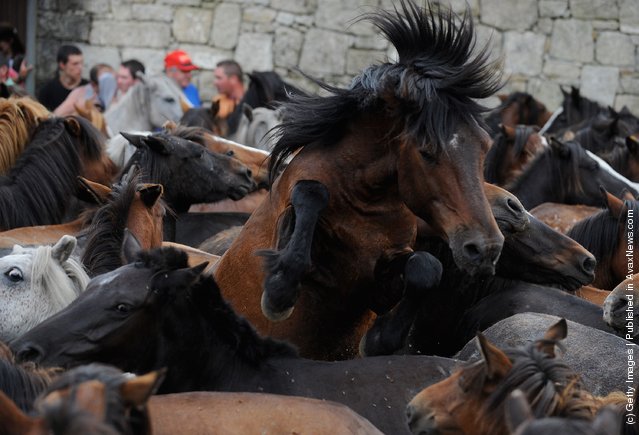
“Rapa das Bestas is the name of an operation that involves cutting the manes of the horses that are performed in the curros (enclosed which retain the horses) held in various locations in Galicia (Spain).

The best known is the Rapa das Bestas of Sabucedo, in the city hall of A Estrada, which lasts three days: the First Saturday, Sunday and Monday in July. In fact, the name given to the celebration (Rapa das Bestas of Sabucedo), while in most places speaking about curros, including curros de Valga, etc”. – Wikipedia

Photo: A wild horse leaps up during the Rapa das Bestas (shearing of the beasts) festival on July 2, 2011 in Sabucedo, Spain. Hundreds of wild horses are rounded up from the mountains and trimmed and marked in the corral. (Photo by Denis Doyle/Getty Images)
Details
03 Jul 2011 12:30:00
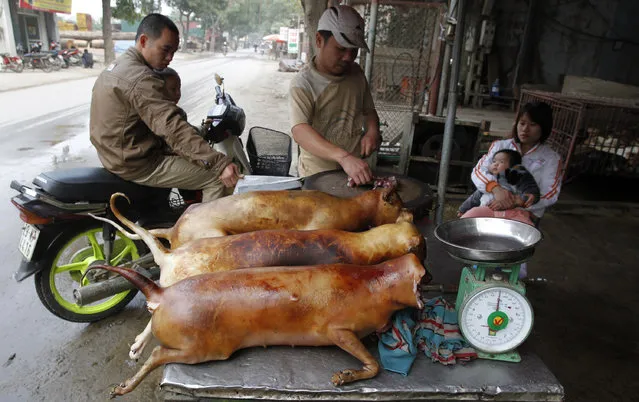
A vendor (C) cuts slaughtered dogs for sale at his roadside stall in Duong Noi village, outside Hanoi December 16, 2011. While animal rights activists have condemned eating dog meat as cruel treatment of the animals, it is still an accepted popular delicacy for some Vietnamese, as well in some other Asian countries. (Photo by Reuters/Kham)

A vendor (C) cuts slaughtered dogs for sale at his roadside stall in Duong Noi village, outside Hanoi December 16, 2011. While animal rights activists have condemned eating dog meat as cruel treatment of the animals, it is still an accepted popular delicacy for some Vietnamese, as well in some other Asian countries. Duong Noi is well-known as a dog-meat village, where hundreds of dogs are killed each day for sale as popular traditional food. Dog-eating as a custom is rooted in Vietnam and was developed as a result of poverty. One kilogram of dog meat costs about 130,000 dongs ($6.2). (Photo by Reuters/Kham)
Details
16 Jul 2013 11:40:00
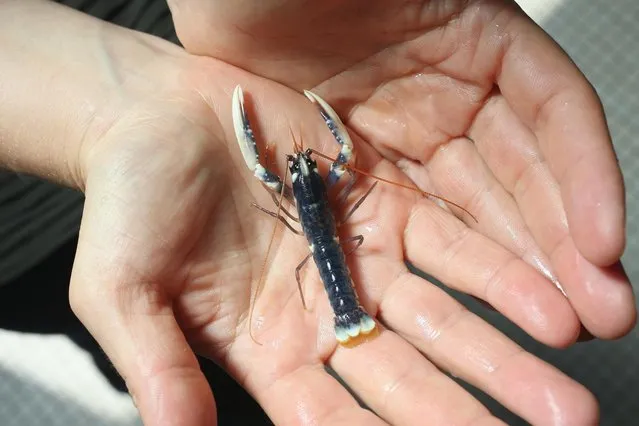
Isabel Schmalenbach, an environmental scientist with the Helgoland Biological Institute (Biologische Anstalt Helgoland), part of the Alfred Wegener Institute for Polar and Marine Research, holds a one-year old baby European lobster (Homarus gammarus) raised at the institute on August 3, 2013 on Helgoland Island, Germany. (Photo by Sean Gallup/Getty Images)

Isabel Schmalenbach, an environmental scientist with the Helgoland Biological Institute (Biologische Anstalt Helgoland), part of the Alfred Wegener Institute for Polar and Marine Research, holds a one-year old baby European lobster (Homarus gammarus) raised at the institute on August 3, 2013 on Helgoland Island, Germany. Later in the day Schmalenbach and her colleagues released a total of 415 one-year old lobsters into the North Sea as part of an effort to repopulate the lobster population around Helgoland (also called Heligoland). In the 19th century local fishermen caught up to 80,000 lobsters a year in the surrounding waters, combined with the heavy allied bombing of the island during and after World War II, as well as other environmental factors, decimated the lobster population. (Photo by Sean Gallup)
Details
05 Aug 2013 08:39:00