Loading...
Done
Tridacna Gigas, or Giant Clams

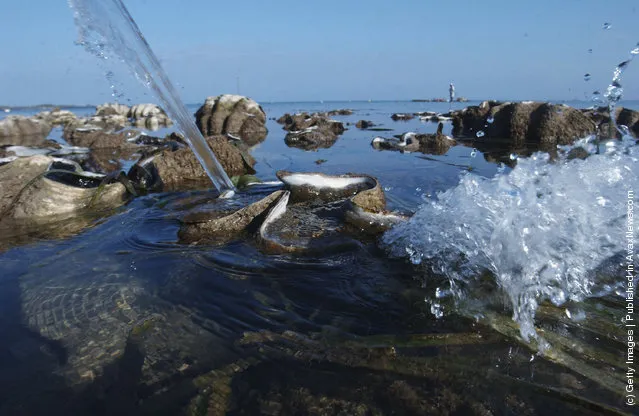
“The giant clam, Tridacna gigas (known as pā’ua in Cook Islands Māori), is the largest living bivalve mollusc. T. gigas is one of the most endangered clam species. It was mentioned as early as 1825 in scientific reports. One of a number of large clam species native to the shallow coral reefs of the South Pacific and Indian oceans, they can weigh more than 200 kilograms (440 lb) measure as much as 120 cm (47 in) across, and have an average lifespan in the wild of 100 years or more”. – Wikipedia

Photo: Tridacna Gigas, or Giant Clams spew water as a traditional fisherman passes by a small sanctuary on January 23, 2004 near Bolinao in the Northern Philippines. The clams, prime builders for coral reefs and providing shelter for spawning fish and other marine life, are exposed by low tides in the sanctuary. Overfishing and pollution throughout the country are not only threatening food security, but are also starting to choke one of the few working clam sanctuaries in the world. (Photo by David Greedy/Getty Images)
Details
01 Oct 2011 13:10:00
A Cat As Model By Joann Biondi

For 20 years, Joann Biondi worked as a freelance writer. Then one day she adopted a kitten that had been tossed in a garbage can and left for dead. That kitten had an unusual quirk; he liked to wear clothes and pose for the camera. So Joann started shooting, and then she got serious about photography. Fast forward four years and that kitten is now Lorenzo the Cat, a feline art photography project that has gotten both the cat and the photographer a lot of attention; gallery shows, museum exhibits, and stories in major media outlets throughout the world. Amid it all Lorenzo has remained a mellow dude who still likes to roll around in the dirt, chase lizards, and knock things off the kitchen counter when his food bowl is empty.
Details
21 Jun 2014 10:13:00
Kawakanih Yawalapiti, 9, Upper Xingu region of Mato Grosso, Brazil, 2018: Kawakanih lives with her tribe, the Yawalapiti, in Xingu national park, a preserve in the Amazon basin of Brazil. The Yawalapiti collect seeds to preserve species unique to their ecosystem, which lies between the rain forest and savannah. Kawakanih’s diet is simple, consisting mainly of fish, cassava, porridge, fruit and nuts. “It takes five minutes to catch dinner”, says Kawakanih. “When you’re hungry, you just go to the river with your net”. (Photo by Gregg Segal/The Guardian)

Photographer Gregg Segal travelled the world to document children and the food they eat in a week. Partly inspired by the increasing problems of childhood obesity, he tracked traditional regional diets as yet unaffected by globalisation, and ironically, found that the healthiest diets were often eaten by the least well off. (Photo by Gregg Segal/The Guardian)
Details
03 Jul 2019 00:03:00
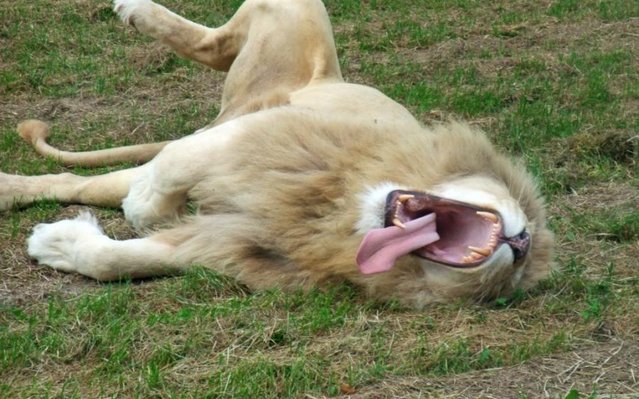
Animals Yawning

In animals, yawning can serve as a warning signal. For example, Charles Darwin, in his book The Expression of the Emotions in Man and Animals, mentioned that baboons yawn to threaten their enemies, possibly by displaying large canine teeth. Similarly, Siamese fighting fish yawn only when they see a conspecific (same species) or their own mirror-image, and their yawn often accompanies aggressive attack. Guinea pigs also yawn in a display of dominance or anger, displaying their impressive incisor teeth. This is often accompanied by teeth chattering, purring and scent marking.

Details
11 Aug 2012 09:12:00
A Felix Airways plane is seen after it was destroyed by an airstrike at the international airport of Yemen's capital Sanaa, April 29, 2015. (Photo by Khaled Abdullah/Reuters)

A Felix Airways plane is seen after it was destroyed by an airstrike at the international airport of Yemen's capital Sanaa, April 29, 2015. Jets from a Saudi-led alliance destroyed the runway of Yemen's Sanaa airport on Tuesday to prevent an Iranian plane from landing there, Saudi Arabia said, as fighting across the country killed at least 30 people. Airport officials said the strikes set a civilian aircraft operated by Yemeni Felix Airways ablaze. (Photo by Khaled Abdullah/Reuters)
Details
30 Apr 2015 10:26:00


“Actor and director Mel Gibson has pleaded no contest to a “misdemeanour” battery charge after a fight with then-girlfriend Oksana Grigorieva in 2010. Gibson, 55, was placed on probation for 36 months and ordered to attend a year of domestic violence counselling. The complaint accuses Gibson of “wilfully and unlawfully” using force and violence against Ms Grigorieva. A misdemeanour charge is generally considered a lesser criminal act than a felony charge in the US”. – BBC News

Photo: Oksana Grigorieva arrives at the premiere Of Warner Bros. “The Edge Of Darkness” held at Grauman's Chinese Theatre on January 26, 2010 in Los Angeles, California. (Photo by Kevin Winter/Getty Images)
Details
14 Mar 2011 08:25:00


United States Marines perform a fighting demonstration in Times Square as part of Fleet Week festivities May 27, 2011 in New York City. Fleet Week, which has been held in New York since 1984, brings thousands of military members to the city where they engage the public with numerous activities, demonstrations, tours and contests. Fleet Week concludes on Memorial Day with a military flyover to honor those killed while serving in the military. (Photo by Spencer Platt/Getty Images)
Details
28 May 2011 09:03:00
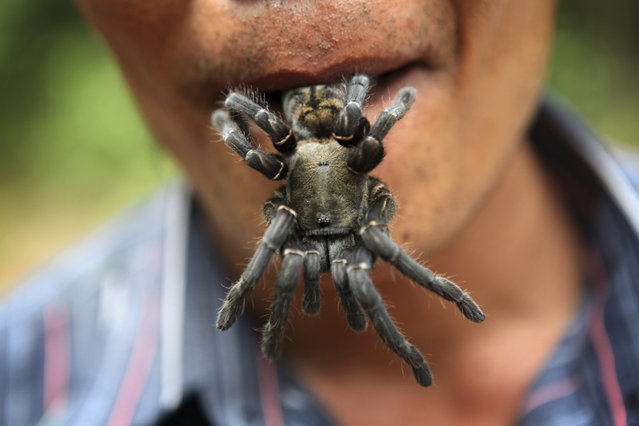
A Cambodian tuk tuk driver and guide with a tarantula in his mouth shortly after is was dug from the ground on June 7, 2010 in Skuon, Kampong Cham Province, Cambodia. The trade for spiders and other insects as food and for medicinal purposes has been in effect since the 1970's in Cambodia but only very recently have tourists been finding a way to see where the spiders are hunted in the nearby countryside. One guide, who can be found in Kampong Cham Town has started offering tours to tourists who can find him. (Photo by Tim Whitby/Getty Images)

A Cambodian tuk tuk driver and guide with a tarantula in his mouth shortly after is was dug from the ground on June 7, 2010 in Skuon, Kampong Cham Province, Cambodia. The trade for spiders and other insects as food and for medicinal purposes has been in effect since the 1970's in Cambodia but only very recently have tourists been finding a way to see where the spiders are hunted in the nearby countryside. One guide, who can be found in Kampong Cham Town has started offering tours to tourists who can find him. (Photo by Tim Whitby/Getty Images)
Details
04 Sep 2016 09:27:00