Loading...
Done
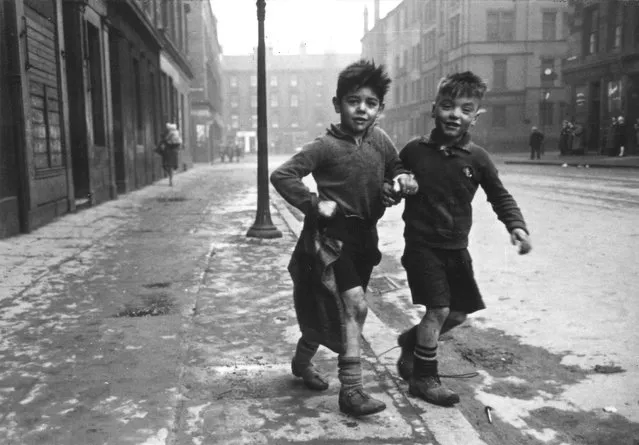
Two boys in the Gorbals area of Glasgow, UK on January 31, 1948. The Gorbals tenements were built quickly and cheaply in the 1840s, providing housing for Glasgow's burgeoning population of industrial workers. Conditions were appalling; overcrowding was standard and sewage and water facilities inadequate. The tenements housed about 40,000 people with up to eight family members sharing a single room, 30 residents sharing a toilet and 40 sharing a tap. By the time this photograph was taken 850 tenements had been demolished since 1920. Redevelopment of the area began in the late 1950s and the tenements were replaced with a modern tower block complex in the sixties. (Photo by Bert Hardy/Getty Images)

Two boys in the Gorbals area of Glasgow, UK on January 31, 1948. The Gorbals tenements were built quickly and cheaply in the 1840s, providing housing for Glasgow's burgeoning population of industrial workers. Conditions were appalling; overcrowding was standard and sewage and water facilities inadequate. The tenements housed about 40,000 people with up to eight family members sharing a single room, 30 residents sharing a toilet and 40 sharing a tap. By the time this photograph was taken 850 tenements had been demolished since 1920. Redevelopment of the area began in the late 1950s and the tenements were replaced with a modern tower block complex in the sixties. (Photo by Bert Hardy/Getty Images)
Details
09 Mar 2017 00:03:00
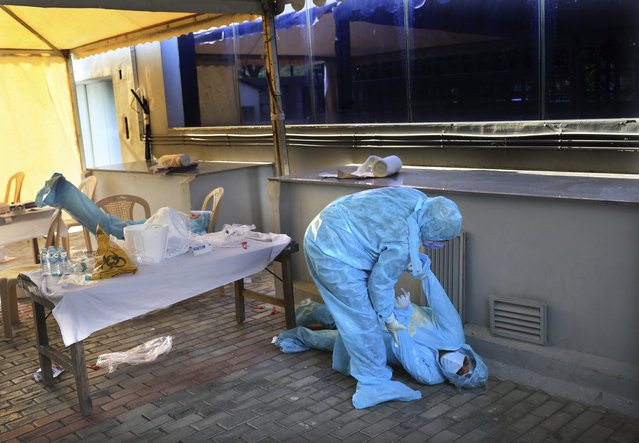
In this April 27, 2020 photo, a health worker helps another as she fainted because of exhaustion and long working hours during a swab test drive for COVID 19, in New Delhi, India. Two and a half months of nationwide lockdown kept numbers of infections relatively low in India. But with restrictions easing in recent weeks, cases have shot up, raising questions about whether authorities have done enough to avert catastrophe. Half of Delhi’s 8,200 hospital beds dedicated to COVID-19 patients are already full and officials are projecting more than half a million cases in the city alone by July 31. (Photo by Manish Swarup/AP Photo)

In this April 27, 2020 photo, a health worker helps another as she fainted because of exhaustion and long working hours during a swab test drive for COVID 19, in New Delhi, India. Two and a half months of nationwide lockdown kept numbers of infections relatively low in India. But with restrictions easing in recent weeks, cases have shot up, raising questions about whether authorities have done enough to avert catastrophe. Half of Delhi’s 8,200 hospital beds dedicated to COVID-19 patients are already full and officials are projecting more than half a million cases in the city alone by July 31. (Photo by Manish Swarup/AP Photo)
Details
08 Jan 2021 00:01:00
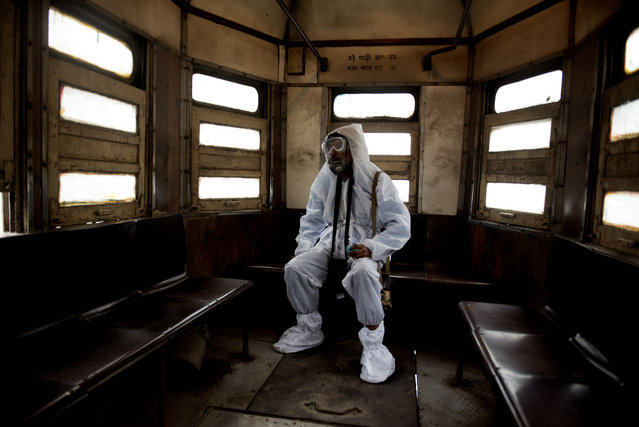
Fighting Infections (single image) | Fighting Pandemic by Sudipto Das. “It’s exhausting. A tram conductor in Kolkata, India, wears protective clothing from head to toe even in the heat of a summer afternoon. This was when restrictions were easing after India’s first Covid-19 lockdown – public transport was running, but staff were advised to suit up like this. We’ve all grown used to saluting the efforts of healthcare workers, but plenty of other people in public-facing jobs have performed gruelling duties too to keep people safe”. (Photo by Sudipto Das/Wellcome Photography Prize 2021)

Fighting Infections (single image) | Fighting Pandemic by Sudipto Das. “It’s exhausting. A tram conductor in Kolkata, India, wears protective clothing from head to toe even in the heat of a summer afternoon. This was when restrictions were easing after India’s first Covid-19 lockdown – public transport was running, but staff were advised to suit up like this. We’ve all grown used to saluting the efforts of healthcare workers, but plenty of other people in public-facing jobs have performed gruelling duties too to keep people safe”. (Photo by Sudipto Das/Wellcome Photography Prize 2021)
Details
29 Jun 2021 09:49:00
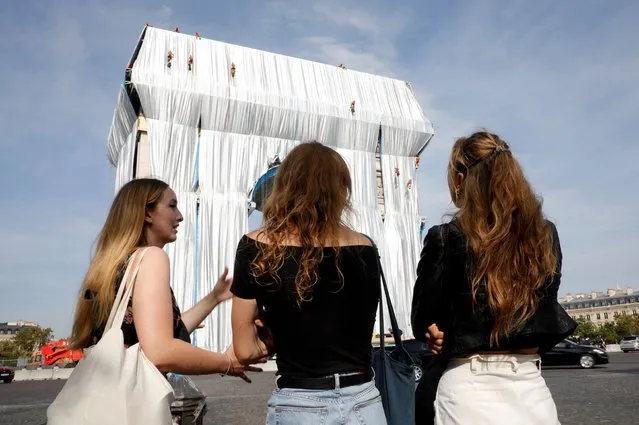
Bystanders look on as workers arrange silver blue fabric, part of the process of wrapping L'Arc de Triomphe in Paris on September 13, 2021, designed by the late artist Christo. Work has begun on wrapping the Arc de Triomphe in Paris in silvery-blue fabric as a posthumous tribute to the artist Christo, who had dreamt of the project for decades. Bulgarian-born Christo, a longtime Paris resident, had plans for sheathing the imposing war memorial at the top of the Champs-Elysees while renting an apartment near it in the 1960s (Photo by Geoffroy Van der Hasselt/AFP Photo)

Bystanders look on as workers arrange silver blue fabric, part of the process of wrapping L'Arc de Triomphe in Paris on September 13, 2021, designed by the late artist Christo. Work has begun on wrapping the Arc de Triomphe in Paris in silvery-blue fabric as a posthumous tribute to the artist Christo, who had dreamt of the project for decades. Bulgarian-born Christo, a longtime Paris resident, had plans for sheathing the imposing war memorial at the top of the Champs-Elysees while renting an apartment near it in the 1960s (Photo by Geoffroy Van der Hasselt/AFP Photo)
Details
01 May 2022 04:48:00
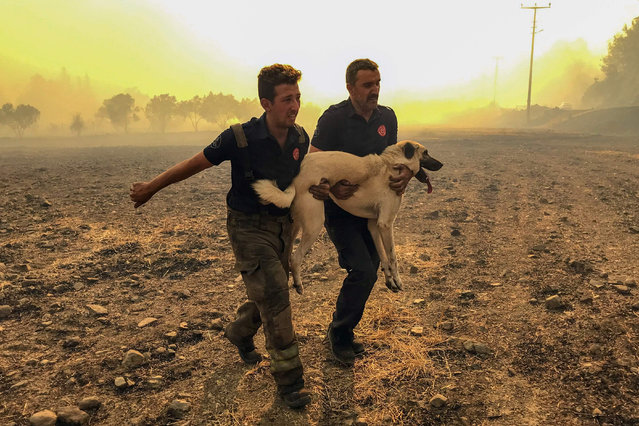
Emergency workers save a shepherd dog from a beach during a forest fire on August 2, 2021 in Mugla, a Marmaris' district, as Turkey struggles against its deadliest wildfires in decades. A roaring blaze raced toward a Turkish thermal power plant and farmers herded panicked cattle toward the sea as wildfires that have killed eight people raged on for a seventh day. The nation of 84 million has been transfixed in horror as the most destructive wildfires in generations erase pristine forests and rich farmland across swaths of Turkey's Mediterranean and Aegean coasts. (Photo by AFP Photo/Stringer)

Emergency workers save a shepherd dog from a beach during a forest fire on August 2, 2021 in Mugla, a Marmaris' district, as Turkey struggles against its deadliest wildfires in decades. A roaring blaze raced toward a Turkish thermal power plant and farmers herded panicked cattle toward the sea as wildfires that have killed eight people raged on for a seventh day. The nation of 84 million has been transfixed in horror as the most destructive wildfires in generations erase pristine forests and rich farmland across swaths of Turkey's Mediterranean and Aegean coasts. (Photo by AFP Photo/Stringer)
Details
05 Aug 2021 08:36:00
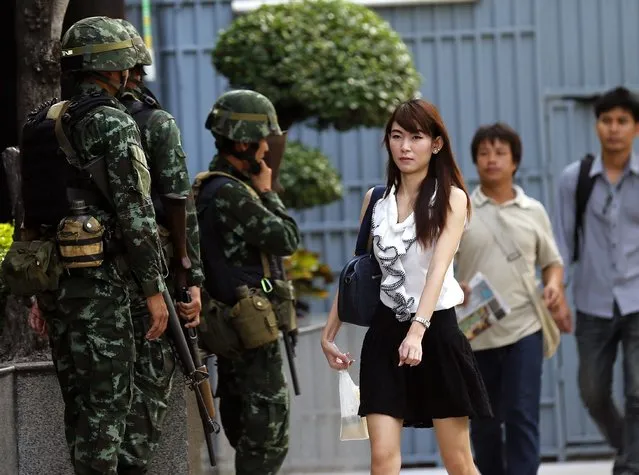
Thai office workers walk past armed soldiers standing guard outside the Shinawatra Tower Two in Bangkok, Thailand, 20 May 2014. Thai army Chief Prayuth Chan-ocha early on 20 May 2014, declared martial law giving the military full control to prevent further protest-related violence in the country. (Photo by Narong Sangnak/EPA)

Thai office workers walk past armed soldiers standing guard outside the Shinawatra Tower Two in Bangkok, Thailand, 20 May 2014. Thai army Chief Prayuth Chan-ocha early on 20 May 2014, declared martial law giving the military full control to prevent further protest-related violence in the country. The statement was issued about 3 am on 20 May (2000 GMT), according to local media reports. Prayuth has the authority to declare martial law without the consent of the government, which has had caretaker status since 09 December 2013. Thailand has been wracked by six months of non-stop protests seeking to topple the government. At least 25 people have died in political-related violence and more than 700 injured. (Photo by Narong Sangnak/EPA)
Details
21 May 2014 10:09:00
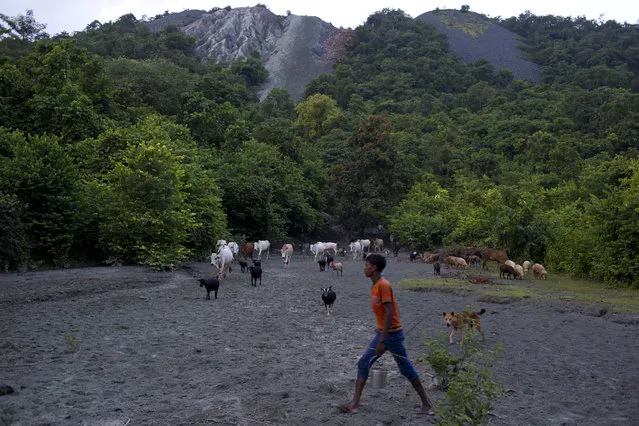
In this September 11, 2014 photo, villagers climb down the side of a hill used earlier as a dumping ground of asbestos waste on Roro hills in Roro, India. (Photo by Saurabh Das/AP Photo)

In this September 11, 2014 photo, villagers climb down the side of a hill used earlier as a dumping ground of asbestos waste on Roro hills in Roro, India. An asbestos mine, abandoned nearly three decades ago still affects the people around it and 18 along with Jema were diagnosed with asbestosis in 2012. Tens of thousands more, some former mine workers, remain untested and at risk. (Photo by Saurabh Das/AP Photo)
Details
26 Dec 2014 14:44:00


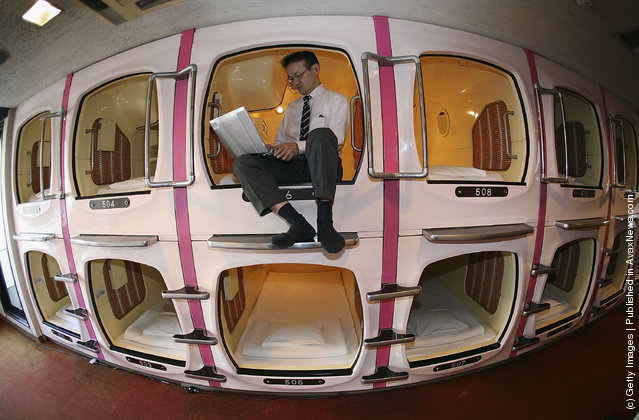
A visitor relaxes in a sleeping module at Tokyo's tube Hotel “Capsule Inn Akihabara” on February 6, 2007 in Tokyo, Japan. The two-square-meter sleep modules are equipped with a TV, Radio and Wireless LAN and are priced at 3500 yen per night. Uptil recently it has mainly been the office workers who stay at such tube hotels when they cannot go home, but recently they are attracting many foreign travellers due to their Japanese style. (Photo by Koichi Kamoshida/Getty Images)
Details
20 May 2011 08:50:00