Loading...
Done
A health official checks the body temperature of a burqa-clad woman passenger amid concerns over the spread of the COVID-19 novel coronavirus at the Lahore Railway station in Lahore on March 19, 2020. (Photo by Arif Ali/AFP Photo)

A health official checks the body temperature of a burqa-clad woman passenger amid concerns over the spread of the COVID-19 novel coronavirus at the Lahore Railway station in Lahore on March 19, 2020. (Photo by Arif Ali/AFP Photo)
Details
22 Apr 2020 00:03:00
Workers fold up a billboard to prepare for the coming of typhoon Vongfong, in Manila, Philippines on Thursday May, 14, 2020. The first typhoon to hit the country this year roared toward the eastern Philippines on Thursday as authorities work to evacuate tens of thousands of people while avoiding overcrowding in shelters that could spread the coronavirus. (Photo by Aaron Favila/AP Photo)

Workers fold up a billboard to prepare for the coming of typhoon Vongfong, in Manila, Philippines on Thursday May, 14, 2020. The first typhoon to hit the country this year roared toward the eastern Philippines on Thursday as authorities work to evacuate tens of thousands of people while avoiding overcrowding in shelters that could spread the coronavirus. (Photo by Aaron Favila/AP Photo)
Details
15 May 2020 00:07:00
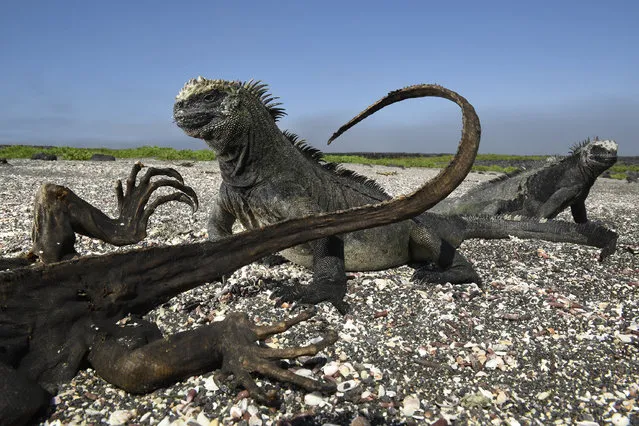
Galapagos – Rocking the Cradle: Four major ocean currents converge along the Galapagos archipelago, creating the conditions for an extraordinary diversity of animal life, April 25, 2016. The islands are home to at least 7,000 flora and fauna species, of which 97 percent of the reptiles, 80 percent of the land birds, 50 percent of the insects and 30 percent of the plants are endemic. The local ecosystem is highly sensitive to the changes in temperature, rainfall and ocean currents that characterize the climatic events known as El Niño and La Niña. These changes cause marked fluctuations in weather and food availability. Many scientists expect the frequency of El Niño and La Niña to increase as a result of climate change, making the Galapagos a possible early-warning location for its effects. (Photo by Thomas P. Peschak for National Geographic/World Press Photo)

Galapagos – Rocking the Cradle: Four major ocean currents converge along the Galapagos archipelago, creating the conditions for an extraordinary diversity of animal life, April 25, 2016. The islands are home to at least 7,000 flora and fauna species, of which 97 percent of the reptiles, 80 percent of the land birds, 50 percent of the insects and 30 percent of the plants are endemic. (Photo by Thomas P. Peschak for National Geographic/World Press Photo)
Details
16 Apr 2018 00:01:00
Dozens of people practice martial arts before the regional Government's headquarters in Barcelona, Spain, 27 July 2020, as a protest against the closure of gyms and martial arts centers in the region imposed by the Catalan Government due to a surge in coronavirus cases. (Photo by Enric Fontcuberta/EPA/EFE)

Dozens of people practice martial arts before the regional Government's headquarters in Barcelona, Spain, 27 July 2020, as a protest against the closure of gyms and martial arts centers in the region imposed by the Catalan Government due to a surge in coronavirus cases. (Photo by Enric Fontcuberta/EPA/EFE)
Details
29 Jul 2020 00:07:00
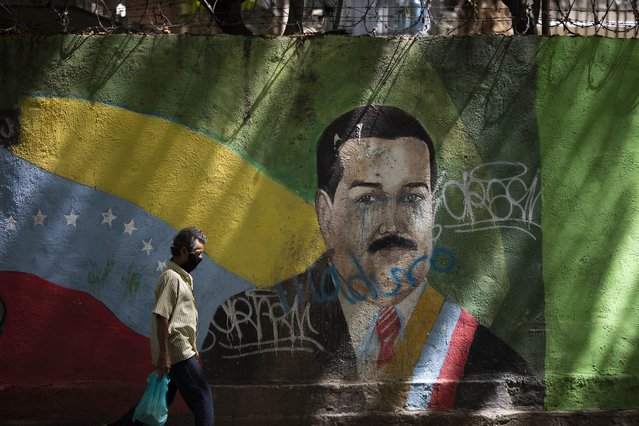
A man wearing a face mask amid the COVID-19 pandemic passes a mural of Venezuelan President Nicolas Maduro in Caracas, Venezuela, Wednesday, July 22, 2020. Analysts say that in recent months the pandemic has helped suck away the opposition’s scanty momentum and bolster Maduro’s already strong hand. (Photo by Ariana Cubillos/AP Photo)

A man wearing a face mask amid the COVID-19 pandemic passes a mural of Venezuelan President Nicolas Maduro in Caracas, Venezuela, Wednesday, July 22, 2020. Analysts say that in recent months the pandemic has helped suck away the opposition’s scanty momentum and bolster Maduro’s already strong hand. (Photo by Ariana Cubillos/AP Photo)
Details
12 Aug 2020 00:01:00
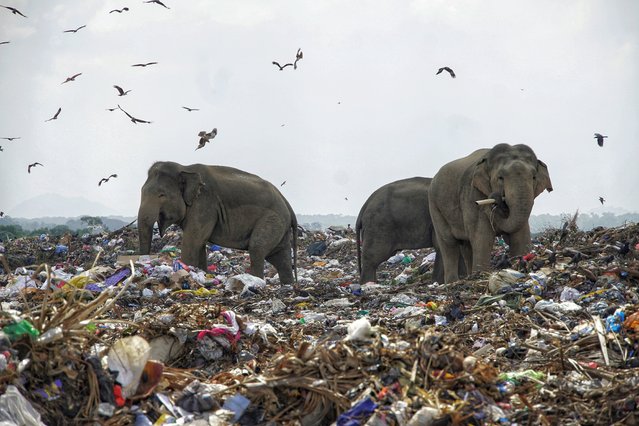
Elephants forage for food at a rubbish dump encroaching on their jungle habitat in Oluvil, Sri Lanka in September 2020. Examination of dead elephants has revealed undigested polythene and other plastic waste. (Photo by Tharmaplan Tilaxan/Cover Images)

Elephants forage for food at a rubbish dump encroaching on their jungle habitat in Oluvil, Sri Lanka in September 2020. Examination of dead elephants has revealed undigested polythene and other plastic waste. (Photo by Tharmaplan Tilaxan/Cover Images)
Details
11 Nov 2020 00:05:00
A young female demonstrator is arrested by police during clashes in the Causeway Bay area of Hong Kong, China on October 6, 2019. Hundreds of thousands of protesters marched through the city's streets in defiance of the new “no-mask” law, which was introduced two days ago as demonstrations roll into a 14th week. (Photo by Rick Findler/EPA/EFE/Rex Features/Shutterstock)

A young female demonstrator is arrested by police during clashes in the Causeway Bay area of Hong Kong, China on October 6, 2019. Hundreds of thousands of protesters marched through the city's streets in defiance of the new “no-mask” law, which was introduced two days ago as demonstrations roll into a 14th week. (Photo by Rick Findler/EPA/EFE/Rex Features/Shutterstock)
Details
09 Oct 2019 00:05:00
Palestinian groom Mohamed abu Daga and his bride Israa wear face masks amid the COVID-19 epidemic, during a photoshoot at a studio before their wedding ceremony in Khan Yunis in the southern Gaza Strip, on March 23, 2020. Authorities in Gaza confirmed on March 22 the first two cases of novel coronavirus, identifying them as Palestinians who had travelled to Pakistan and were being held in quarantine since their return, as the United Nations warned of potential disastrous outcomes to an outbreak given the high poverty rates and weak health system in the coastal strip, under Israeli blockade since 2007. (Photo by Said Khatib/AFP Photo)

Palestinian groom Mohamed abu Daga and his bride Israa wear face masks amid the COVID-19 epidemic, during a photoshoot at a studio before their wedding ceremony in Khan Yunis in the southern Gaza Strip, on March 23, 2020. Authorities in Gaza confirmed on March 22 the first two cases of novel coronavirus, identifying them as Palestinians who had travelled to Pakistan and were being held in quarantine since their return, as the United Nations warned of potential disastrous outcomes to an outbreak given the high poverty rates and weak health system in the coastal strip, under Israeli blockade since 2007. (Photo by Said Khatib/AFP Photo)
Details
27 Mar 2020 00:07:00