Loading...
Done
A small section of the expanding remains of the Veil Nebula, a massive star that exploded about 8,000 years ago. The entire nebula is 110 light-years across, covering six full moons on the sky as seen from Earth, and resides about 2,100 light-years away in the constellation Cygnus, the Swan. (Photo by Reuters/NASA/ESA/Hubble)

A small section of the expanding remains of the Veil Nebula, a massive star that exploded about 8,000 years ago. The entire nebula is 110 light-years across, covering six full moons on the sky as seen from Earth, and resides about 2,100 light-years away in the constellation Cygnus, the Swan. (Photo by Reuters/NASA/ESA/Hubble)
Details
29 Feb 2016 11:30:00
Apollo 9 Command/Service Modules (CSM) nicknamed “Gumdrop” and Lunar Module (LM), nicknamed “Spider” are shown docked together as Command Module pilot David R. Scott stands in the open hatch. Astronaut Russell L. Schweickart, Lunar Module pilot, took this photograph of Scott during his EVA as he stood on the porch outside the Lunar Module. Apollo 9 was an Earth orbital mission designed to test docking procedures between the CSM and LM as well as test fly the Lunar Module in the relative safe confines of Earth orbit. (Photo by NASA)

Apollo 9 Command/Service Modules (CSM) nicknamed “Gumdrop” and Lunar Module (LM), nicknamed “Spider” are shown docked together as Command Module pilot David R. Scott stands in the open hatch. Astronaut Russell L. Schweickart, Lunar Module pilot, took this photograph of Scott during his EVA as he stood on the porch outside the Lunar Module. Apollo 9 was an Earth orbital mission designed to test docking procedures between the CSM and LM as well as test fly the Lunar Module in the relative safe confines of Earth orbit. (Photo by NASA)
Details
20 Jul 2014 11:47:00
On August 31, 2012, a long filament of solar material that had been hovering in the sun's atmosphere, the corona, erupted out into space at 4:36 p.m. EDT. The coronal mass ejection, or CME, traveled at over 900 miles per second. The CME did not travel directly toward Earth, but did connect with Earth's magnetic environment, or magnetosphere, causing aurora to appear on the night of Monday, September 3. (Photo by NASA/GSFC/SDO)

On August 31, 2012, a long filament of solar material that had been hovering in the sun's atmosphere, the corona, erupted out into space at 4:36 p.m. EDT. The coronal mass ejection, or CME, traveled at over 900 miles per second. The CME did not travel directly toward Earth, but did connect with Earth's magnetic environment, or magnetosphere, causing aurora to appear on the night of Monday, September 3. (Photo by NASA/GSFC/SDO via The Atlantic)
Details
14 Sep 2012 09:01:00
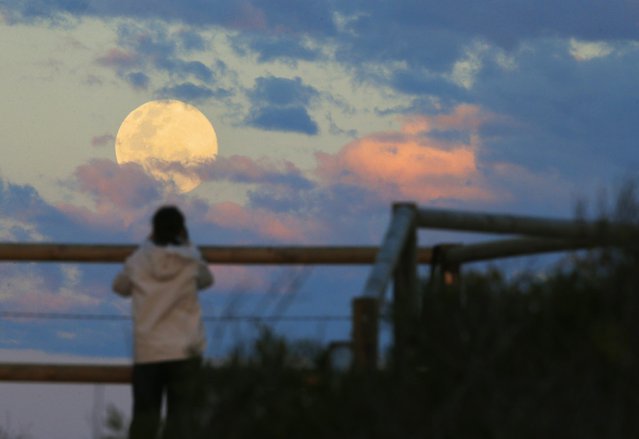
Sydney resident Virginia Maddock watches the supermoon rise off the Sydney beachside suburb of Wanda, August 10, 2014. The astronomical event occurs when the moon is closest to the Earth in its orbit, making it appear much larger and brighter than usual. (Photo by Jason Reed/Reuters)

Sydney resident Virginia Maddock watches the supermoon rise off the Sydney beachside suburb of Wanda, August 10, 2014. Sunday’s moon was at its closest approach to Earth, appearing bigger and brighter than any other moon this year. The moon was 221,765 miles away and looked 16 percent larger and 30 percent brighter than usual. (Photo by Jason Reed/Reuters)
Details
11 Aug 2014 11:50:00
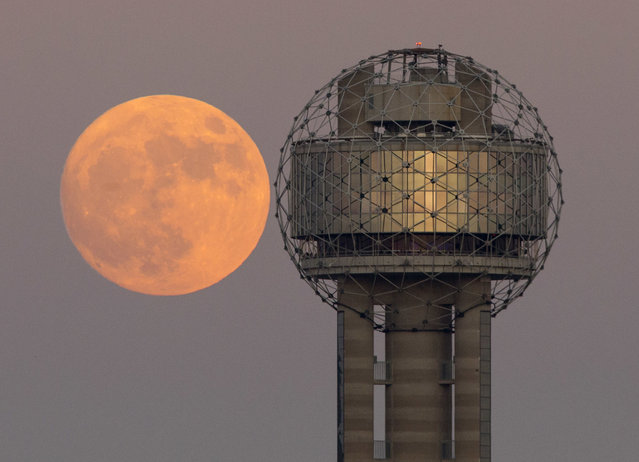
The moon rises behind Reunion Tower in downtown Dallas, Sunday evening, November 13, 2016. On Monday the supermoon will be the closest full moon to earth since 1948, and it won't be as close again until 2034. (Photo by Tom Fox/The Dallas Morning News via AP Photo)

The moon rises behind Reunion Tower in downtown Dallas, Sunday evening, November 13, 2016. On Monday the supermoon will be the closest full moon to earth since 1948, and it won't be as close again until 2034. (Photo by Tom Fox/The Dallas Morning News via AP Photo)
Details
14 Nov 2016 09:49:00
People exercise in Primrose Hill in London, Britain, 20 March 2025. The first day of spring in the UK astronomically occurs on the vernal equinox where earth's axis is not tilted towards or away from the sun, resulting in an equal amount of day and night on all latitudes. (Photo by Neil Hall/EPA/EFE)

People exercise in Primrose Hill in London, Britain, 20 March 2025. The first day of spring in the UK astronomically occurs on the vernal equinox where earth's axis is not tilted towards or away from the sun, resulting in an equal amount of day and night on all latitudes. (Photo by Neil Hall/EPA/EFE)
Details
10 Apr 2025 03:03:00
A performer takes part in the opening of the Temple Fair, part of Chinese New Year celebrations at Ditan Park, also known as the Temple of Earth, in Beijing, February 18, 2015. (Photo by Kim Kyung-Hoon/Reuters)

A performer takes part in the opening of the Temple Fair, part of Chinese New Year celebrations at Ditan Park, also known as the Temple of Earth, in Beijing, February 18, 2015. (Photo by Kim Kyung-Hoon/Reuters)
Details
19 Feb 2015 15:03:00
Yakutsk, with a population of around 270,000, holds its own title: that of the coldest city on Earth. Here: Frost-encrusted house in the city centre. (Photo by Amos Chapple/Courtesy Images/RFE/RL)

Yakutsk, with a population of around 270,000, holds its own title: that of the coldest city on Earth. Here: Frost-encrusted house in the city centre. (Photo by Amos Chapple/Courtesy Images/RFE/RL)
Details
23 Jan 2018 06:52:00