Loading...
Done
An actor carries a cross as he plays the role of Jesus Christ in a re-enactment of the Via Crucis (Way of the Cross) during a Holy Week procession, in preparation for Good Friday celebrations, in Luque, Paraguay, on March 27, 2013. Holy Week is celebrated in many Christian traditions during the week before Easter. (Photo by Jorge Adorno/Reuters)

An actor carries a cross as he plays the role of Jesus Christ in a re-enactment of the Via Crucis (Way of the Cross) during a Holy Week procession, in preparation for Good Friday celebrations, in Luque, Paraguay, on March 27, 2013. Holy Week is celebrated in many Christian traditions during the week before Easter. (Photo by Jorge Adorno/Reuters)
Details
28 Mar 2013 12:06:00
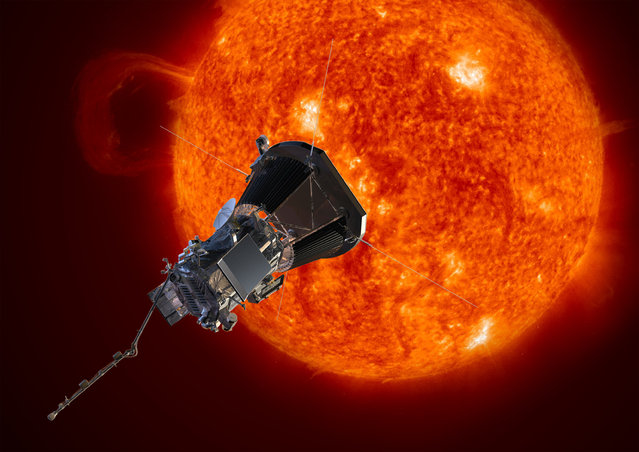
This image made available by the Johns Hopkins University Applied Physics Laboratory on Wednesday, May 31, 2017 depicts NASA's Solar Probe Plus spacecraft approaching the sun. On Wednesday, NASA announced it will launch the probe in summer 2018 to explore the solar atmosphere. It will be subjected to brutal heat and radiation like no other man-made structure before. (Photo by Johns Hopkins University Applied Physics Laboratory via AP Photo)

This image made available by the Johns Hopkins University Applied Physics Laboratory on Wednesday, May 31, 2017 depicts NASA's Solar Probe Plus spacecraft approaching the sun. On Wednesday, NASA announced it will launch the probe in summer 2018 to explore the solar atmosphere. It will be subjected to brutal heat and radiation like no other man-made structure before. (Photo by Johns Hopkins University Applied Physics Laboratory via AP Photo)
Details
08 Sep 2017 09:42:00
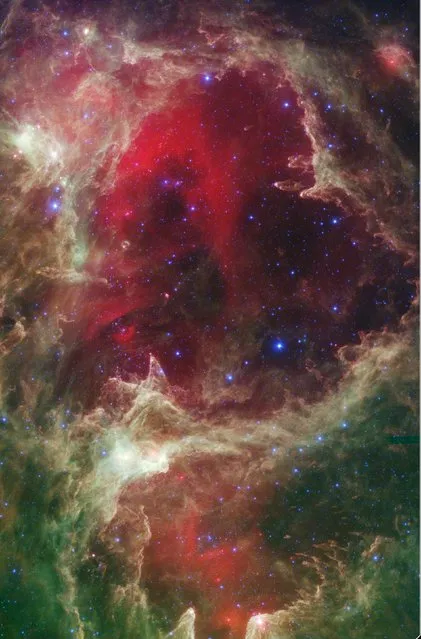
An infrared portrait from NASA's Spitzer Space Telescope which shows generations of stars is seen in this undated NASA handout image released February 14, 2013. In this wispy star-forming region, called W5, the oldest stars can be seen as blue dots in the centers of the two hollow cavities (other blue dots are background and foreground stars not associated with the region). Red shows heated dust that pervades the region's cavities, while green highlights dense clouds. (Photo by NASA/Reuters/JPL-Caltech/Harvard-Smithsonian/Handout)

An infrared portrait from NASA's Spitzer Space Telescope which shows generations of stars is seen in this undated NASA handout image released February 14, 2013. In this wispy star-forming region, called W5, the oldest stars can be seen as blue dots in the centers of the two hollow cavities (other blue dots are background and foreground stars not associated with the region). Red shows heated dust that pervades the region's cavities, while green highlights dense clouds. (Photo by NASA/Reuters/JPL-Caltech/Harvard-Smithsonian/Handout)
Details
03 Mar 2013 08:44:00
An Iraq fan poses before the World Cup 2022 Qualifier 2nd round Group C football match between Iraq and Iran at Amman International Stadium in Amman, Jordan on  November 14, 2019. (Photo by Muhammad Hamed/Reuters)

An Iraq fan poses before the World Cup 2022 Qualifier 2nd round Group C football match between Iraq and Iran at Amman International Stadium in Amman, Jordan on November 14, 2019. (Photo by Muhammad Hamed/Reuters)
Details
18 Nov 2019 00:03:00
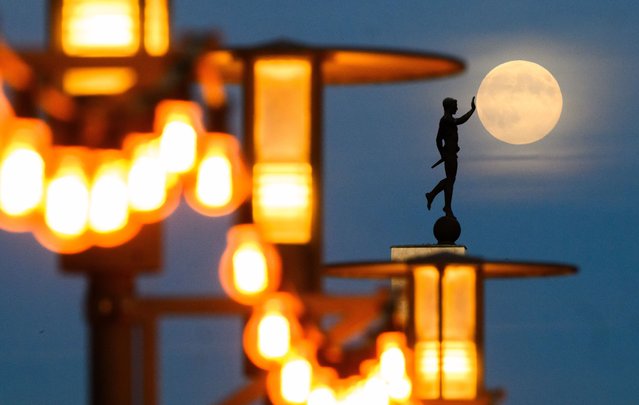
The moon rises on the behind the “Torchbearer” statue in Hannover, Germany, Wednesday, November 5, 2025. (Photo by Julian Stratenschulte/dpa via AP Photo)

The moon rises on the behind the “Torchbearer” statue in Hannover, Germany, Wednesday, November 5, 2025. (Photo by Julian Stratenschulte/dpa via AP Photo)
Details
19 Nov 2025 05:11:00
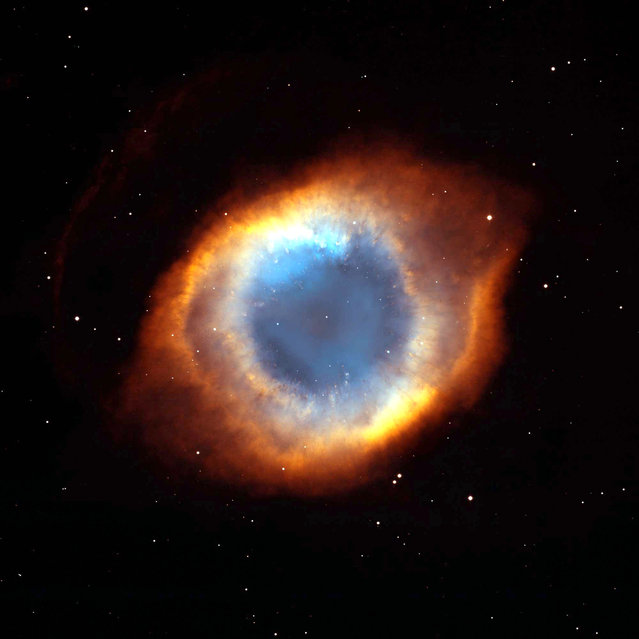
A coil-shaped Helix Nebula showing a fine web of filamentary “bicycle-spoke” features embedded in the colorful red and blue ring of gas. At 650 light-years away, the Helix is one of the nearest planetary nebulae to Earth. A planetary nebula is the glowing gas around a dying, Sun-like star. (Photo by Reuters/NASA)

A coil-shaped Helix Nebula showing a fine web of filamentary “bicycle-spoke” features embedded in the colorful red and blue ring of gas. At 650 light-years away, the Helix is one of the nearest planetary nebulae to Earth. A planetary nebula is the glowing gas around a dying, Sun-like star. (Photo by Reuters/NASA)
Details
22 Oct 2014 14:01:00
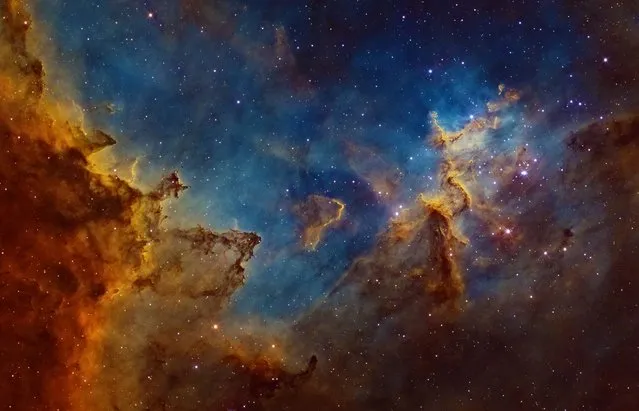
Centre of the Heart Nebula by Ivan Eder (Hungary). Situated 7500 light years away in the ‘W’-shaped constellation of Cassiopeia, the Heart Nebula is a vast region of glowing gas, energized by a cluster of young stars at its centre. The image depicts the central region, where dust clouds are being eroded and moulded into rugged shapes by the searing cosmic radiation. (Photo by Ivan Eder)

The competition, which is run by the Royal Observatory Greenwich in association with BBC Sky at Night Magazine, is now in its sixth year and has received over 2,500 entries. Photo: Centre of the Heart Nebula by Ivan Eder (Hungary). Situated 7500 light years away in the “W”-shaped constellation of Cassiopeia, the Heart Nebula is a vast region of glowing gas, energized by a cluster of young stars at its centre. The image depicts the central region, where dust clouds are being eroded and moulded into rugged shapes by the searing cosmic radiation. (Photo by Ivan Eder)
Details
03 Jul 2014 11:59:00
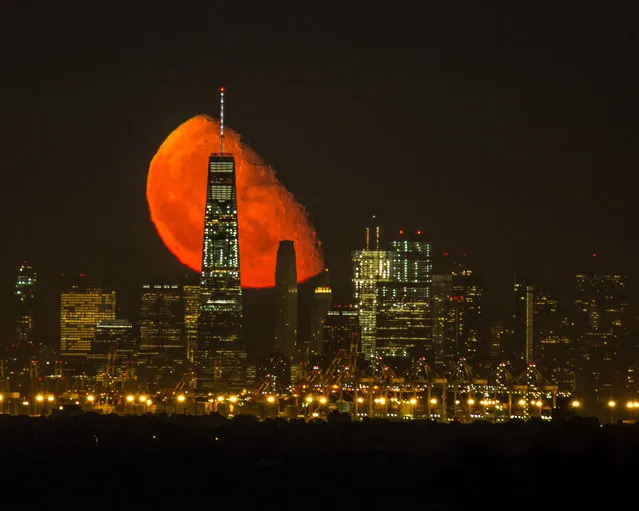
An incredible moon rise behind the World Trade Center, Manhattan, New York on August 23, 2016. The breath-taking photo was taken by photographer Jennifer Khordi. She said: it was just absolutely amazing to see this. (Photo by Jennifer Khordi/Caters News Agency)

An incredible moon rise behind the World Trade Center, Manhattan, New York on August 23, 2016. The breath-taking photo was taken by photographer Jennifer Khordi. She said: it was just absolutely amazing to see this. (Photo by Jennifer Khordi/Caters News Agency)
Details
25 Aug 2016 09:45:00