Loading...
Done
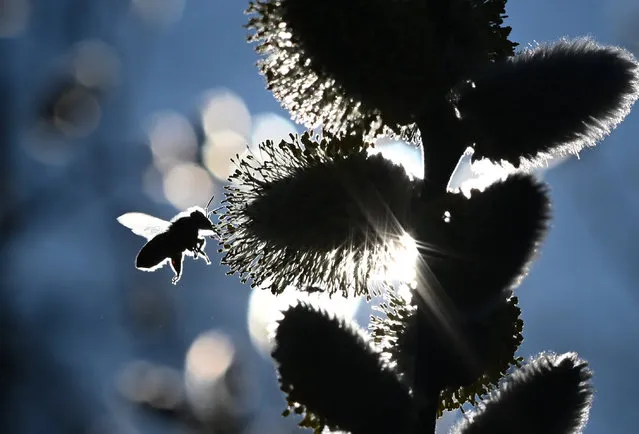
A bee approaching the flowers of a willow in Otzberg, Germany on February 28, 2021. Willow catkins are a protected species and one of the first sources of food for insects in early spring. (Photo by Arne Dedert/DPA)

A bee approaching the flowers of a willow in Otzberg, Germany on February 28, 2021. Willow catkins are a protected species and one of the first sources of food for insects in early spring. (Photo by Arne Dedert/DPA)
Details
10 Apr 2021 05:48:00
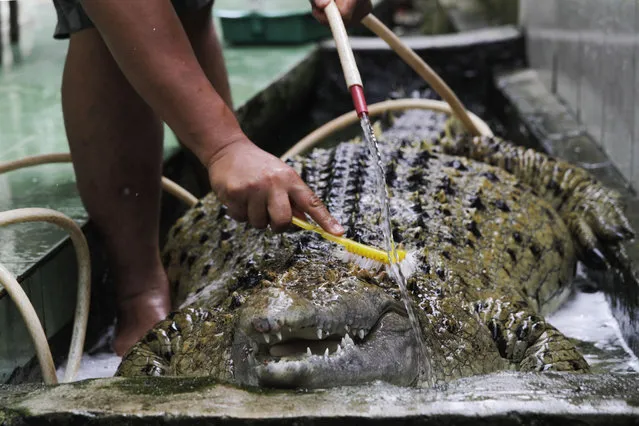
Irwan bathes a domesticated crocodile at his house in Bogor, Indonesia on January 22, 2018. Irwan found it as a baby and now it has been living with Irwans family for 20 years. Indonesia is known as a hotbed of exotic pet domestication and trade. People have been known to keep endangered animals such as slow lorises, eagles and pangolins, angering conservationists and animal rights activists. (Photo by Eko Siswono Toyudho/Anadolu Agency/Getty Images)

Irwan bathes a domesticated crocodile at his house in Bogor, Indonesia on January 22, 2018. Irwan found it as a baby and now it has been living with Irwans family for 20 years. Indonesia is known as a hotbed of exotic pet domestication and trade. People have been known to keep endangered animals such as slow lorises, eagles and pangolins, angering conservationists and animal rights activists. (Photo by Eko Siswono Toyudho/Anadolu Agency/Getty Images)
Details
28 Jan 2018 07:57:00
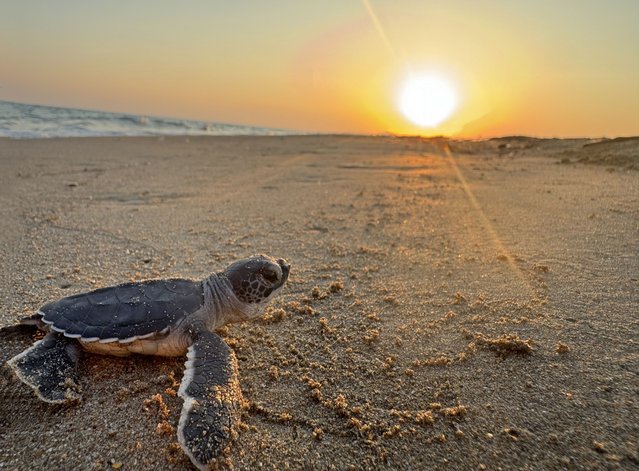
An endangered baby turtle hatched from its egg in its nest on the Belek coast, is trying to reach the open sea by walking along the beach in Antalya, Turkiye on August 05, 2025. In the Belek and Kizilot region, one of the largest nesting areas in the Mediterranean, many baby turtles continue to meet the sea. (Photo by Tahsin Ceylan/Anadolu via Getty Images)

An endangered baby turtle hatched from its egg in its nest on the Belek coast, is trying to reach the open sea by walking along the beach in Antalya, Turkiye on August 05, 2025. In the Belek and Kizilot region, one of the largest nesting areas in the Mediterranean, many baby turtles continue to meet the sea. (Photo by Tahsin Ceylan/Anadolu via Getty Images)
Details
25 Sep 2025 03:59:00
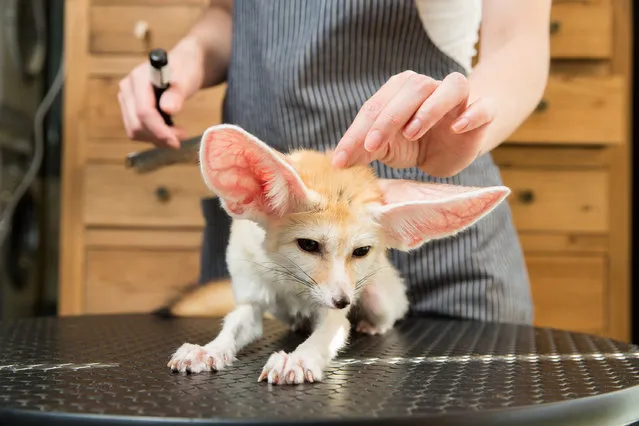
A fennec fox (Vulpes zerda) is groomed in a pet store in central Beijing. Native to the Sahara in North Africa, the species became a popular pet after being depicted as a character in Disney’s 2016 animated movie Zootopia. Individuals can cost between $2,000–$3,000. (Photo by Sean Gallagher/The Guardian)

A dramatic rise in owning exotic pets in China is fuelling global demand for threatened species. The growing trade in alligators, snakes, monkeys, crocodiles and spiders is directly linked to species loss in some of the world’s most threatened ecosystems. Here: A fennec fox (Vulpes zerda) is groomed in a pet store in central Beijing. Native to the Sahara in North Africa, the species became a popular pet after being depicted as a character in Disney’s 2016 animated movie Zootopia. Individuals can cost between $2,000–$3,000. (Photo by Sean Gallagher/The Guardian)
Details
23 Sep 2017 08:04:00
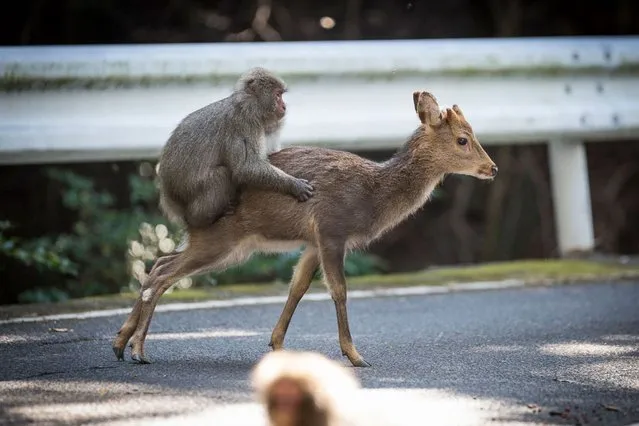
An undated handout picture released on January 10, 2017 by the Issekinicho publishing house shows an inter- species sexual behaviour between a male Japanese macaque and female sika deer, in Yakushima Scientists revealed on January 10, 2017 the “highly unusual” behaviour of a male monkey filmed trying to have s*x with female deer in Japan – a rare case of inter- species nookie. (Photo by Editions Issekinicho/AFP Photo)

An undated handout picture released on January 10, 2017 by the Issekinicho publishing house shows an inter- species sexual behaviour between a male Japanese macaque and female sika deer, in Yakushima Scientists revealed on January 10, 2017 the “highly unusual” behaviour of a male monkey filmed trying to have sеx with female deer in Japan – a rare case of inter- species nookie. (Photo by Editions Issekinicho/AFP Photo)
Details
15 Jan 2017 11:00:00
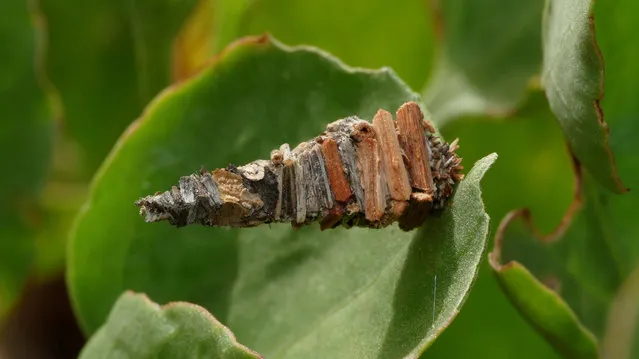
An undated handout photo made available by the Zerynthia Association shows the pupa of an amicta moneiba, a recently discovered species of moth endemic to La Gomera and El Hierro islands in the Canary Islands, Spain (issued 01 July 2020), as those two islands pulled apart from the rest of the Canary Islands 2.5 million years ago. The Institute of Evolutionary Biology of the Spanish National Research Council (CSIC) and the Zerynthia Association have recently discovered two new moth species in El Hierro and La Gomera. (Photo by Yeray Monasterio/Zerynthia/EPA/EFE)

An undated handout photo made available by the Zerynthia Association shows the pupa of an amicta moneiba, a recently discovered species of moth endemic to La Gomera and El Hierro islands in the Canary Islands, Spain (issued 01 July 2020), as those two islands pulled apart from the rest of the Canary Islands 2.5 million years ago. The Institute of Evolutionary Biology of the Spanish National Research Council (CSIC) and the Zerynthia Association have recently discovered two new moth species in El Hierro and La Gomera. (Photo by Yeray Monasterio/Zerynthia/EPA/EFE)
Details
11 Oct 2020 00:01:00
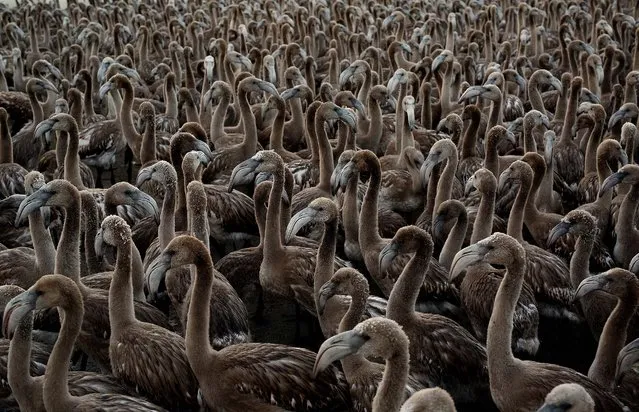
Flamingo chicks walk in an enclosure before they are tagged in Fuente de Piedra, Spain, on Jule 19, 2014. Fuente de Piedra lagoon is a natural reserve with more than 170 different species recorded and one of the main breeding grounds for flamingos in the Iberian Peninsule. Hundreds of flamingo chicks are tagged and checked annually to record the evolution of the species. (Photo by Pablo Blazquez Dominguez/Getty Images)

Flamingo chicks walk in an enclosure before they are tagged in Fuente de Piedra, Spain, on Jule 19, 2014. Fuente de Piedra lagoon is a natural reserve with more than 170 different species recorded and one of the main breeding grounds for flamingos in the Iberian Peninsule. Hundreds of flamingo chicks are tagged and checked annually to record the evolution of the species. (Photo by Pablo Blazquez Dominguez/Getty Images)
Details
21 Jul 2014 10:51:00
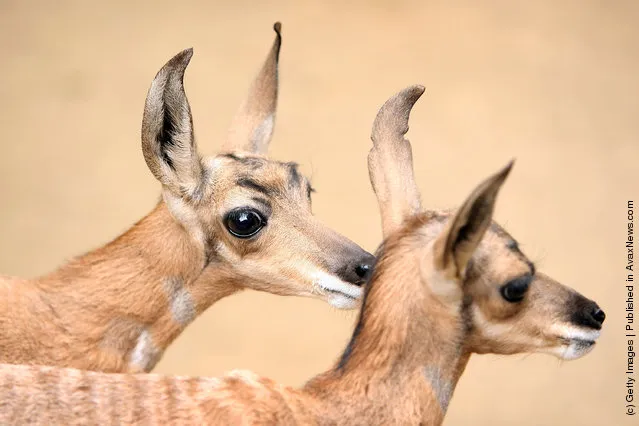
Two rare Peninsular pronghorns

“The Baja California Pronghorn or Peninsular Pronghorn (Antilocapra americana peninsularis) is a critically endangered pronghorn, endemic to Mexico. The wild population is estimated at 200”. – Wikipedia

Photo: Two rare Peninsular pronghorns, male twins was born at the Los Angeles Zoo on April 24, 2009 in Los Angeles, California. Only 250 antelope-like Peninsular pronghorns are believed to exist in the wild. (Photo by David McNew/Getty Images)
Details
07 Nov 2011 11:18:00