Loading...
Done
How To Pass Time On Your Commute To Work

We all have our own ways of passing time on our daily commutes. Some people read, others try to sleep, and many listen to music or play on their phones. But one creative commuter has a simple and highly entertaining way that hopefully more people will embrace. By placing a face from a newspaper in front of a person at just the right angle, they transform other commuters into recognizable celebrities while keeping the unbeknownst participant obscured.
Details
02 Jul 2013 10:46:00
Palestinian boy Mohammad al-Bana, 10, sells mints at a market in Gaza City March 29, 2016. Bana, whose father is unemployed, earns around 10 Shekels ($2.5) per day. The boy starts working after finishing school. He hopes to continue education and become an engineer in the future. (Photo by Mohammed Salem/Reuters)

Palestinian boy Mohammad al-Bana, 10, sells mints at a market in Gaza City March 29, 2016. Bana, whose father is unemployed, earns around 10 Shekels ($2.5) per day. The boy starts working after finishing school. He hopes to continue education and become an engineer in the future. (Photo by Mohammed Salem/Reuters)
Details
31 Mar 2016 11:06:00
Employee Victoria Livesey walks past Banksy's 'Kate Moss 2005' on display at Bonhams

Employee Victoria Livesey walks past Banksy's “Kate Moss 2005” on display at Bonhams on March 23, 2012 in London, England. The painting, estimated at GBP 30,000 – 50,000, USD 48,000 – 79,000 and 35,000 – 59,000 euros forms part of the Urban Art Sale, which takes place at Bonhams on March 29, 2012. (Photo by Peter Macdiarmid/Getty Images)
Details
24 Mar 2012 11:00:00
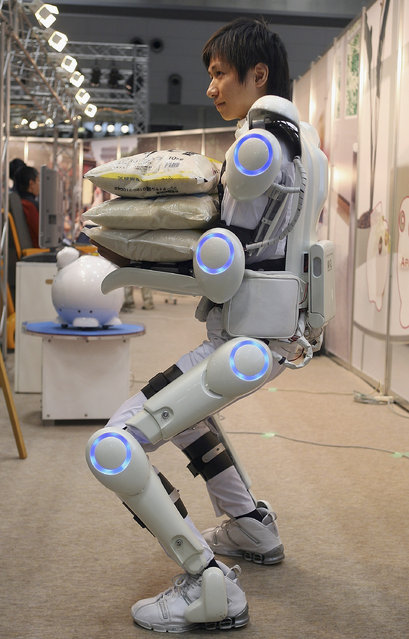
Robot suit "Hybrid Assistive Limb (HAL)" worn by a man developed by University of Tsukuba is seen lifting a 30kg weight during 2005 International Robot Exhibition on November 30, 2005 in Tokyo, Japan. By wearing the power suit, it makes it easier to move and lift heavy things. The Exhibition is on until December 3. (Photo by Koichi Kamoshida)

“A robot suit that can help the elderly or disabled get around was given its global safety certificate in Japan on February 27, 2013, paving the way for its worldwide roll-out”. Photo: Robot suit “Hybrid Assistive Limb (HAL)” worn by a man developed by University of Tsukuba is seen lifting a 30kg weight during 2005 International Robot Exhibition on November 30, 2005 in Tokyo, Japan. By wearing the power suit, it makes it easier to move and lift heavy things. (Photo by Koichi Kamoshida)
Details
11 Mar 2013 11:15:00
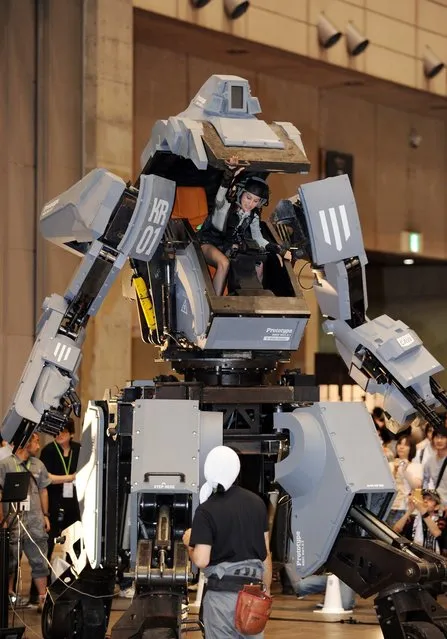
Female “pilot” Anna (C) climbs out the cockpit of Japanese electronics company Suidobashi Heavy Industry's newly unveiled robot “Kuratas” at the Wonder Festival in Chiba, suburban Tokyo on July 29, 2012. The Kuratas robot, which will go on sale with a price tag of one million USD, measures four meters in height, weighs four tons and has four wheeled legs that can either be controlled remotely through the 3G network or by a human seated within the cockpit.

Female pilot Anna climbs out the cockpit of Japanese electronics company Suidobashi Heavy Industry's newly unveiled robot “Kuratas” at the Wonder Festival in Chiba, suburban Tokyo on July 29, 2012. The “Kuratas” robot, which will go on sale with a price tag of one million USD, measures four meters in height, weighs four tons and has four wheeled legs that can either be controlled remotely through the 3G network or by a human seated within the cockpit. (Photo by Yoshikazu Tsuno/AFP Photo)
Details
30 Jul 2012 09:26:00
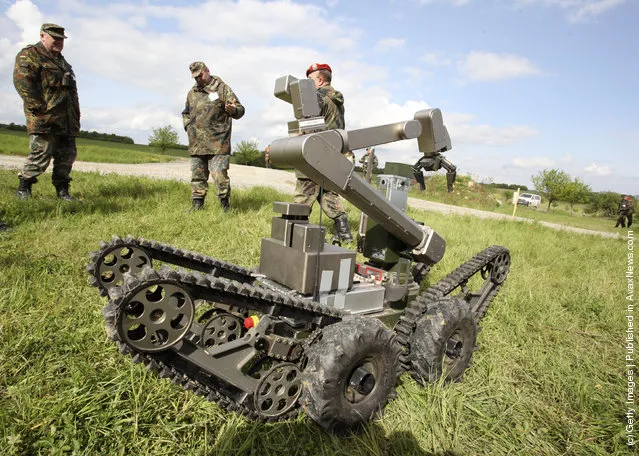
European Land-Robot Trial (ELROB), Military robot, teleMAX

The land-robot “teleMAX” of German company telerob stands next to soldiers during a trial at the German army base on May 18, 2010 in Hammelburg, Germany. ELROB provides an overview of the current state of affairs in European unmanned system technology and to evaluate commercial off-the-shelf products for military use. It is to show what is feasible in robotics, to support technological developments in Europe, and to find solutions for the current military challenges. (Photo by Ralph Orlowski/Getty Images)
Details
16 Aug 2011 11:47:00
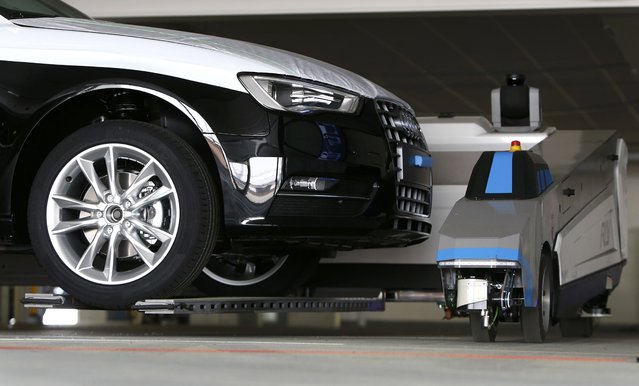
Automated guided vehicle robot “Ray” lifts up an Audi car during a pilot project at the parking area of the Audi plant in Ingolstadt, Germany, May 13, 2015. (Photo by Michaela Rehle/Reuters)

Automated guided vehicle robot “Ray” lifts up an Audi car during a pilot project at the parking area of the Audi plant in Ingolstadt, Germany, May 13, 2015. The robot has been designed to help make work more efficient and more comfortable for employees, some whom walk up to eight kilometres a day, while coordinating the finished cars for the subsequent train transportation. “Robot Ray” technology, currently being used at Dusseldorf International Airport in Germany, claims to be able to park 60 per cent more vehicles in one area compared with a human driver. (Photo by Michaela Rehle/Reuters)
Details
14 May 2015 12:04:00


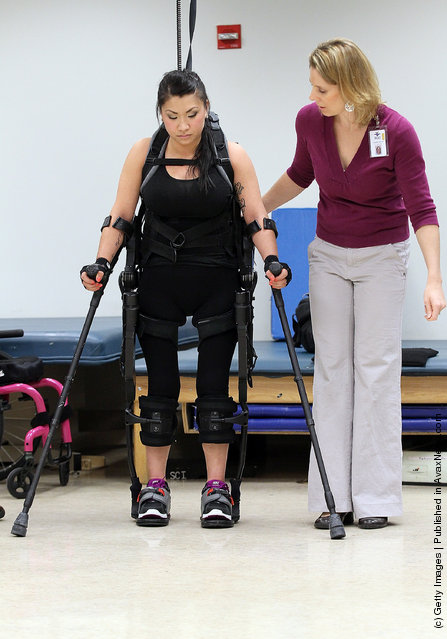
“eLEGS is a wearable, artificially intelligent, bionic device that enables people with paralysis to stand up and walk again. The exoskeleton is battery-powered and rechargeable, fitting comfortably and securely over clothing. Initially, eLEGS will be used under medical supervision for rehabilitation and training”. – BerkeleyBionics.com

Photo: Paralysis victim Stephanie Sablan (L) is helped by physical therapist Shonna Moran as she walks using eLEGS robotic legs at Santa Clara Valley Medical Center on May 25, 2011 in San Jose, California. Sablan, 24, was paralyzed from the waist down earlier this year when she was in a car accident and has begun using the newly developed eLEGS made by Berkeley Bionics. The robot-like battery powered eLEGS fit over clothing and enables people with paralysis to stand up and walk again. (Photo by Justin Sullivan/Getty Images)
Details
26 May 2011 09:56:00