Shi'ite Muslim girls take part in a mourning procession to mark Ashura, the holiest day on the Shi'ite Muslim calendar, in Istanbul, Turkey, on July 16, 2024. (Photo by Dilara Senkaya/Reuters)
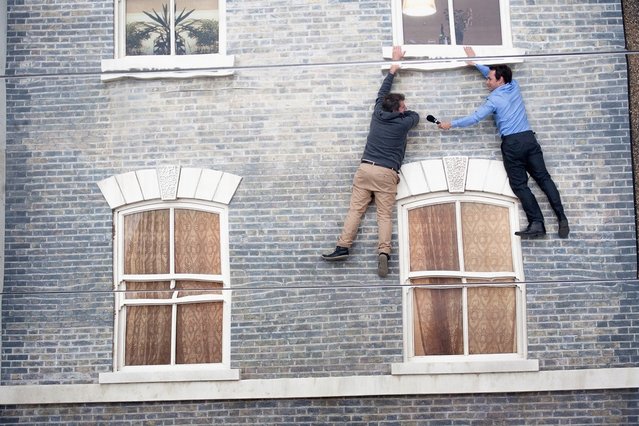
People appear dangling as a large-scale installation art piece by Leandro Erlich, named “Dalston House”, in London, England. Part of the “Beyond Barbican” summer series of events, the interactive installation is a full facade of a late nineteenth-century Victorian terraced house built on the ground with a large mirror above it to reflect people as to appear dangling from the structure. (Photo by Dan Dennison)
Revellers attend the Victorian Picnic during the Wave and Goth festival in Leipzig, Germany, May 22, 2015. The annual festival, known in Germany as Wave-Gotik Treffen (WGT), features over 100 bands and artists in venues all over the city playing Gothic rock and other styles of the dark wave music subculture. One of the biggest of its kind, the event attracts a regular audience of up to 20,000, the organisers said. (Photo by Hannibal Hanschke/Reuters)
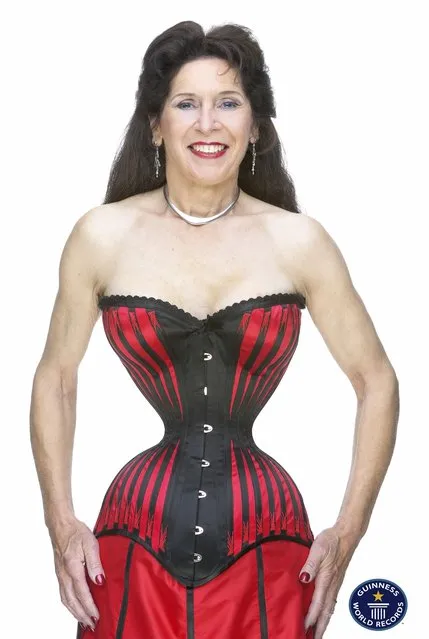
Cathie Jung (born 1937) is an American Victorian dress and corset enthusiast residing in Old Mystic, Connecticut, United States, who currently holds the Guinness World Record for the smallest waist on a living person. Jung, who is 1.65 m (5 ft 6 in) tall, has a waist that measures 38.1 cm (15 inches).
Four men ride a motorbike past sacrificial animals displayed for sale ahead of the Eid al-Adha festival at a livestock market in Sana'a, Yemen, 08 August 2019. Eid al-Adha is the holiest of the two Muslims holidays celebrated each year; it marks the yearly Muslim pilgrimage (Hajj) to visit Mecca, Islam's holiest place. Muslims slaughter a sacrificial animal and split the meat into three parts: one for family, one for friends and relatives, and one for the poor and needy. (Photo by Yahya Arhab/EPA/EFE)
A young Muslim girl looks on as an elder helps her tie her hijab before the Eid al-Fitr prayer at Masjid Jamek Cina Muslim Klang on March 31, 2025, in Selangor, Malaysia. The mosque, inspired by the Great Mosque of Xi’an, blends Chinese and Islamic architectural influences, reflecting the nation’s rich cultural harmony. Eid al-Fitr, marking the end of Ramadan, is a time of prayers, family reunions, and celebration for Muslims worldwide. (Photo by Annice Lyn/Getty Images)
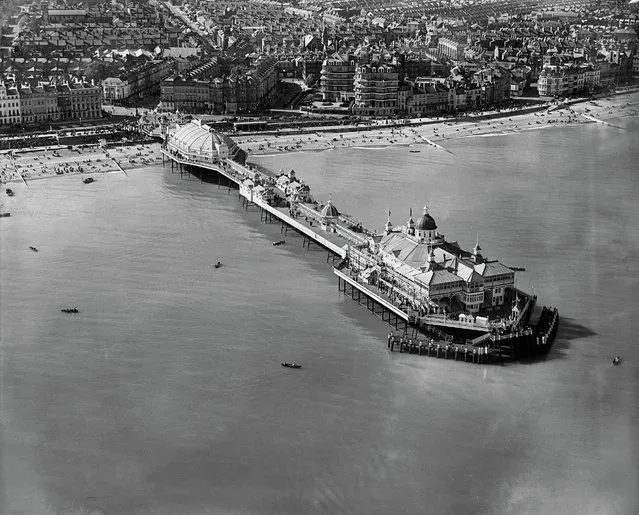
While the lido was described as bringing “modernism to the masses” on the British coast it was just the latest example of a trend that had been developing since Victorian times – transforming seaside towns into resorts for leisure and entertainment. In the latter half of the nineteenth century, the fashion was for local authorities to build great piers stretching from the promenade out into the sea. The Eastbourne Pier, pictured here in May 1931, was erected between 1866 and 1870 to an ingenious design by Eugenius Birch, which saw the structure sitting on special cups allowing the supporting struts to “move” in bad weather. Arranged on the pier's 1,000-foot length were kiosks, a theatre, a ballroom and a camera obscura. 1931. (Photo by Aerofilms Collection via “A History of Britain From Above”)
Indian Muslim children hold anti-US placards as they participate in a protest meeting against the film “Innocence of Muslims” in Kolkata on October 5, 2012. A low-budget, US-produced “Innocence of Muslims” movie has incited a wave of bloody anti-US violence in Libya, Egypt, Sudan, Tunisia, Yemen and in several other countries across the Muslim world. (Photo by Dibyangshu Sarkar/AFP/AFP Photo)