Loading...
Done
A restaurant in Chelsea is giving customers the ultimate post-pub treat – by selling a burger for £1,100. The world's most expensive burger, dubbed the “Glamburger”, is stuffed with a burger patty made from 220 grams of Kobe Wagyu beef minced with 60 grams of New Zealand venison and seasoned with smoked Himalayan salt. (Photo by Groupon)

A restaurant in Chelsea is giving customers the ultimate post-pub treat – by selling a burger for £1,100. The world's most expensive burger, dubbed the “Glamburger”, is stuffed with a burger patty made from 220 grams of Kobe Wagyu beef minced with 60 grams of New Zealand venison and seasoned with smoked Himalayan salt. (Photo by Groupon)
Details
15 Oct 2014 13:27:00
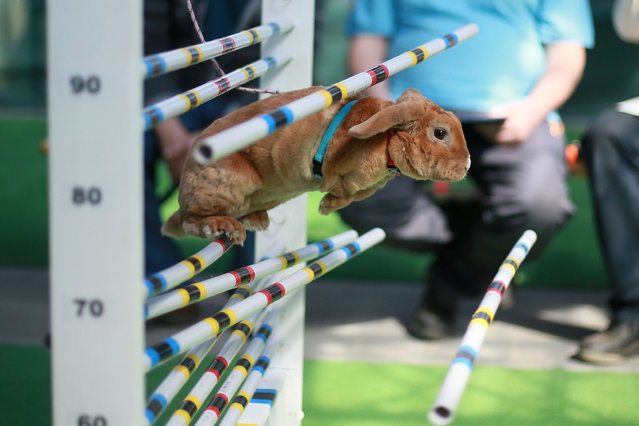
A rabbit fails to jump over an obstacle during a rabbit track and field competition on the sidelines of a hunting exhibition in Kromeriz, about 60 km east of Prague, on April 1, 2017. Circa 100 rabbits took part in the competition, including disciplines as long jump, high jump and running on a flat track. (Photo by  Radek Mica/AFP Photo)

A rabbit fails to jump over an obstacle during a rabbit track and field competition on the sidelines of a hunting exhibition in Kromeriz, about 60 km east of Prague, on April 1, 2017. Circa 100 rabbits took part in the competition, including disciplines as long jump, high jump and running on a flat track. (Photo by Radek Mica/AFP Photo)
Details
09 Apr 2017 09:49:00
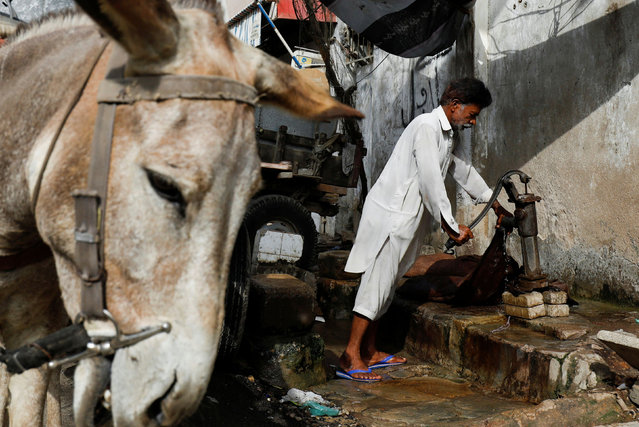
Mohammad Ramzan, 60, a traditional goatskin water carrier also known as a mashki, fills a bag with water from a handpump to deliver to nearby homes during the fasting month of Ramadan, as the outbreak of the coronavirus disease (COVID-19) continues, in Karachi, Pakistan on April 23, 2021. (Photo by Akhtar Soomro/Reuters)

Mohammad Ramzan, 60, a traditional goatskin water carrier also known as a mashki, fills a bag with water from a handpump to deliver to nearby homes during the fasting month of Ramadan, as the outbreak of the coronavirus disease (COVID-19) continues, in Karachi, Pakistan on April 23, 2021. (Photo by Akhtar Soomro/Reuters)
Details
29 May 2021 09:06:00
Gold medalist Mujinga Kambundji, of Switzerland, left, and silver medalist Ewa Swoboda, of Poland, celebrate after finishing the Women 60 meters final at the European Athletics Indoor Championships at Atakoy Arena in Istanbul, Turkey, Friday, March 3, 2023. (Photo by AP Photo/Stringer)

Gold medalist Mujinga Kambundji, of Switzerland, left, and silver medalist Ewa Swoboda, of Poland, celebrate after finishing the Women 60 meters final at the European Athletics Indoor Championships at Atakoy Arena in Istanbul, Turkey, Friday, March 3, 2023. (Photo by AP Photo/Stringer)
Details
13 Mar 2023 05:18:00
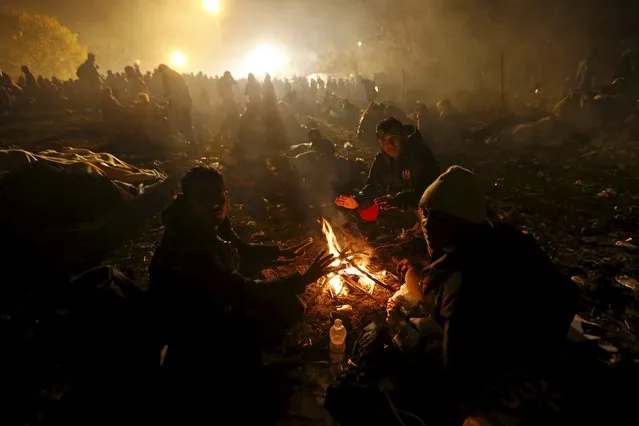
Migrants wait to cross the Slovenia-Austria border in Sentilj, Slovenia, October 27, 2015. The first five border guards – all German – of 400 promised to Slovenia by fellow EU countries are expected to arrive on Wednesday to help channel a huge flow of migrants through the tiny Alpine state, its government said. (Photo by Srdjan Zivulovic/Reuters)

Migrants wait to cross the Slovenia-Austria border in Sentilj, Slovenia, October 27, 2015. The first five border guards – all German – of 400 promised to Slovenia by fellow EU countries are expected to arrive on Wednesday to help channel a huge flow of migrants through the tiny Alpine state, its government said. Interior Ministry state secretary Bostjan Sefic also said 100-120 customs police would join Slovenian soldiers, regular police and private security firms in dealing with an influx that has strapped the country's limited resources. (Photo by Srdjan Zivulovic/Reuters)
Details
30 Oct 2015 08:03:00
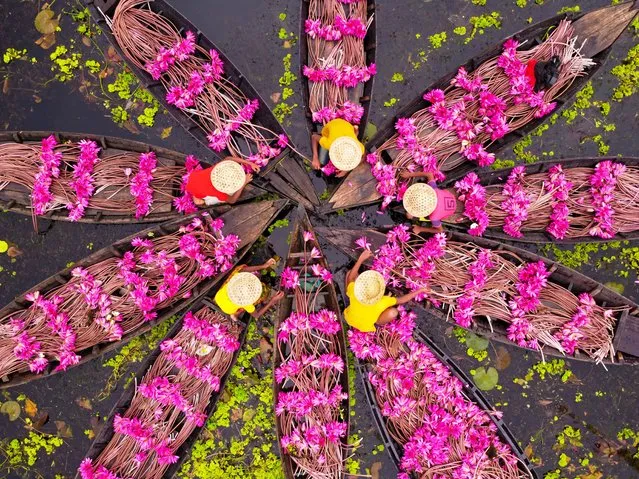
Farmers arrange bunches of water lilies after harvesting them from the wetlands in Barishal, Bangladesh on March 21, 2023. Floating through 10,000 acres of canal, farmers use their little boats to fetch the flowers. They break through the layer of water lilies on the surface of the water as they practice the traditional craft of picking water lilies by hand. Every flower is carefully hand-picked, collected inside the farmers' little wooden boat, tied in bundles, and sold to markets. After working for an entire day, a farmer can pick around 80 to 120 bundles of water lilies. Water lily harvesting is a major source of income for more than 250 families in the area. (Photo by Joy Saha/Cover Images)

Farmers arrange bunches of water lilies after harvesting them from the wetlands in Barishal, Bangladesh on March 21, 2023. Floating through 10,000 acres of canal, farmers use their little boats to fetch the flowers. (Photo by Joy Saha/Cover Images)
Details
01 May 2023 04:00:00
Art by Christian Faur

Christian Faur is an artist based in Granville, Ohio. Looking for a new technique, he experimented with painting with wax, but he didn’t feel the results were satisfactory.Then, at Christmas in 2005, his young daughter opened a box of 120 Crayola crayons he’d bought her, and everything clicked into place. Faur decided he would create pictures out of the crayons themselves, packing thousands of them together so they become like the colored pixels on a TV screen. He starts each work by scanning a photo into a computer and breaking the image down into colored blocks He then draws a grid that shows him exactly where to place each crayon The finished artworks are packed tightly into wooden frames. He actually makes the crayons himself, hand-casting each one in a mould.
Details
28 Jul 2012 10:03:00
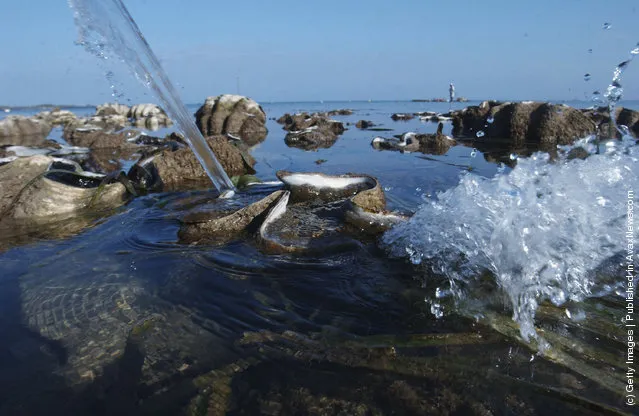
Tridacna Gigas, or Giant Clams

“The giant clam, Tridacna gigas (known as pā’ua in Cook Islands Māori), is the largest living bivalve mollusc. T. gigas is one of the most endangered clam species. It was mentioned as early as 1825 in scientific reports. One of a number of large clam species native to the shallow coral reefs of the South Pacific and Indian oceans, they can weigh more than 200 kilograms (440 lb) measure as much as 120 cm (47 in) across, and have an average lifespan in the wild of 100 years or more”. – Wikipedia

Photo: Tridacna Gigas, or Giant Clams spew water as a traditional fisherman passes by a small sanctuary on January 23, 2004 near Bolinao in the Northern Philippines. The clams, prime builders for coral reefs and providing shelter for spawning fish and other marine life, are exposed by low tides in the sanctuary. Overfishing and pollution throughout the country are not only threatening food security, but are also starting to choke one of the few working clam sanctuaries in the world. (Photo by David Greedy/Getty Images)

Details
01 Oct 2011 13:10:00