Loading...
Done
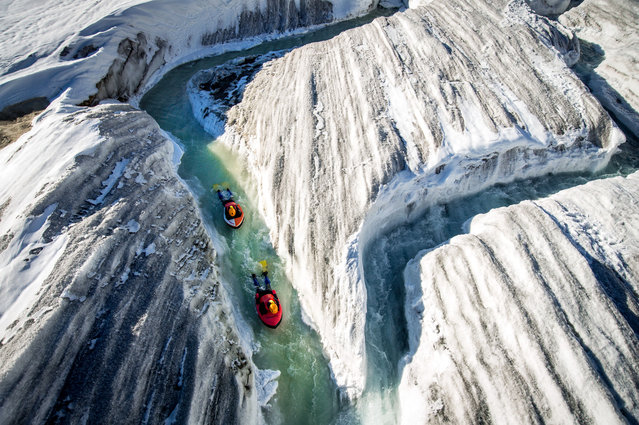
Water way to go. These incredible images show the moment two brave adventurers decided to body board down Europes longest glacier. Seen carving their way through the icy rivers of the Aletsch Glacier in Switzerland, the pair are seen risking their lives for an adrenalin rush of a whole new kind. (Photo by David Carlier/Caters News)

Water way to go. These incredible images show the moment two brave adventurers decided to body board down Europes longest glacier. Seen carving their way through the icy rivers of the Aletsch Glacier in Switzerland, the pair are seen risking their lives for an adrenalin rush of a whole new kind. Pictured mounted on their body boards as part of a sport known as hydrospeeding, the daredevils risked being carried away by strong currents and even drowning in hidden crevices to complete the winding seven mile journey. But if that wasnt dangerous enough, the duo also ran the risk of being overwhelmed by collapsing glacial lakes that could be released into the river at any moment. (Photo by David Carlier/Caters News)
Details
17 Dec 2014 11:36:00
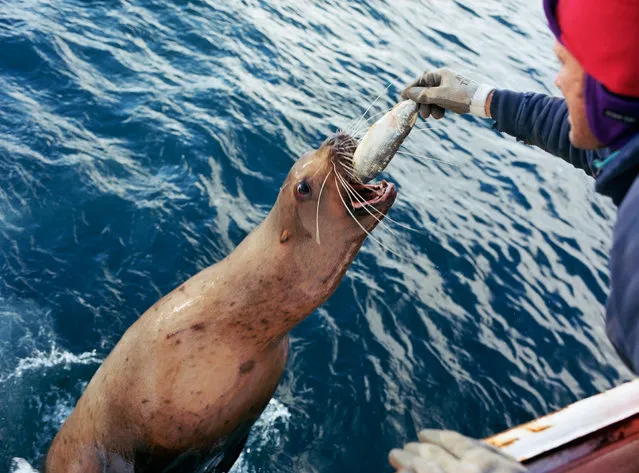
Before heading up to Alaska, the ship loads up with 3 months worth of food. Even so, it's hardly necessary. The ship's cook is constantly steaming fresh crab legs and seafood caught during the day. The hard labour of fishing requires a diet heavy in fat, protein, and omega-3s. Here, a sea lion gets a bite of the grub. (Photo by Corey Arnold)

In 2002 photographer Corey Arnold left behind a poor economy in San Francisco and headed up to Alaska to try his luck at his longtime passion of fishing. Arnold, who had worked summers during college on a salmon boat in Alaska, signed onto the f/v Rollo, a crabbing boat that fishes in the dangerous Bering Sea. While working long, strenuous hours on the Rollo, Arnold often stole away with the captain’s permission to grab his camera and photograph the crew and the ship. Arnold eventually put together “Fish Work: Bering Sea”, a documentation of his seven adventurous and dicey crab seasons aboard the Rollo. (Photo by Corey Arnold)
Details
20 Aug 2014 10:05:00
At the dead of night, the photographer – known to his Instagram followers as Dark Cyanide – heads out to look for hidden gems, like abandoned stations, provisions and tunnels. His intriguing images feature vibrant streaks, graffiti, and tight framing – and by adding individuals to some to some of shots, he is also able to depict the incredible scale of some of the tunnels. The photographer, 19, admitted what he and his friends do is highly dangerous, illegal, and he does not recommend others attempt to explore such tunnels. Here: Unnamed subway track in New York City. (Photo by Dark Cyanide/Caters News)

At the dead of night, the photographer – known to his Instagram followers as Dark Cyanide – heads out to look for hidden gems, like abandoned stations, provisions and tunnels. His intriguing images feature vibrant streaks, graffiti, and tight framing – and by adding individuals to some to some of shots, he is also able to depict the incredible scale of some of the tunnels. Here: Unnamed subway track in New York City. (Photo by Dark Cyanide/Caters News)
Details
29 Jan 2016 12:45:00
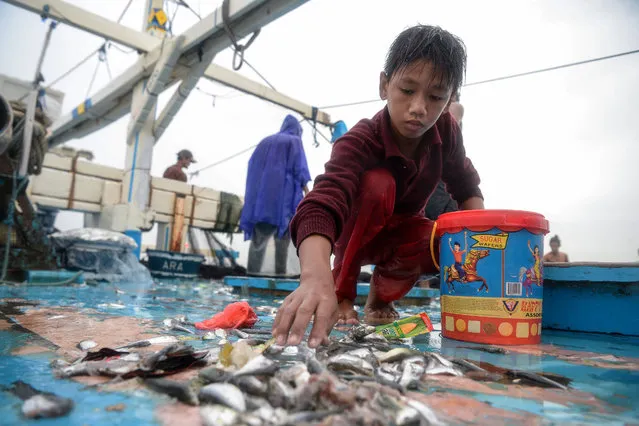
In this photo taken on March 16, 2019, 13-year-old Reymark Cavesirano collects left over herring onboard a fishing boat anchored at the mouth of Manila Bay off Navotas City in suburban Manila. (Photo by Ted Aljibe/AFP Photo)

In this photo taken on March 16, 2019, 13-year-old Reymark Cavesirano collects left over herring onboard a fishing boat anchored at the mouth of Manila Bay off Navotas City in suburban Manila. Cavesirano, a grade five student, paddles to the anchored fishing boats and helps crew clean their nets, and in exchange collects leftover herring still tangled in the nets. Across the Philippines, there are 5 million child labourers, aged between five and 17, many of them working in dangerous conditions. About 22 million people – a fifth of the population – live below the national poverty line. (Photo by Ted Aljibe/AFP Photo)
Details
12 Apr 2019 00:03:00
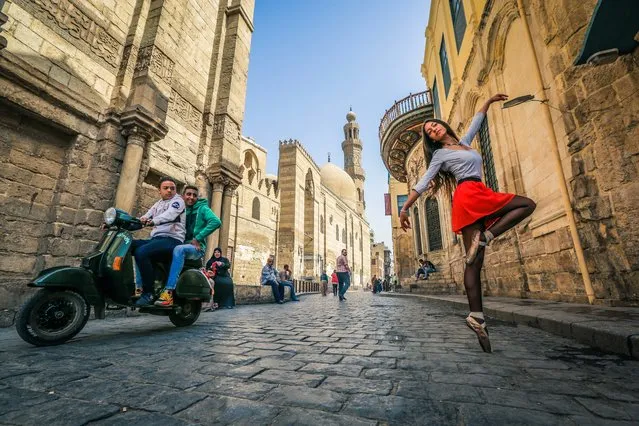
In his series “Ballerinas of Cairo”, photographer Mohamed Taher documents Egyptian dancers making the city streets their stage – pirouetting, leaping and posing their way through their country’s sprawling capital. The photos are, at first glance, stunning snapshots of a city’s vibrant culture in motion. But considering the dangers Egyptian women face for roaming these same streets on a daily basis, their impact is far deeper. Sexual harassment continues to present not just a possibility but a terrifying reality in present-day Egypt. A 2013 United Nations report calculated that 99.3 percent of women in the country have experienced sexual harassment on the streets, a problem that’s sparked initiatives giving women a way to fight back. The violence is rooted in an extreme conservative perspective encouraging women to stay in the home. (Photo by Mohamed Taher/Ballerinas of Cairo)

In his series “Ballerinas of Cairo”, photographer Mohamed Taher documents Egyptian dancers making the city streets their stage – pirouetting, leaping and posing their way through their country’s sprawling capital. The photos are, at first glance, stunning snapshots of a city’s vibrant culture in motion. (Photo by Mohamed Taher/Ballerinas of Cairo)
Details
17 Jan 2017 12:30:00
Auto polo, Coney Isl. Between ca. 1910 and ca. 1915. (Photo by George Grantham Bain Collection)

“Automobile polo or Auto polo was a motorsport invented in the United States with rules and equipment similar to equestrian polo but using automobiles instead of horses. The sport was popular at fairs, exhibitions and sports venues across the United States and several areas in Europe from 1911 until the late 1920s; but it was dangerous and carried the risk of injury and death to the participants and spectators”. – Wikipedia. Photo: Auto polo, Coney Isl., between ca. 1910 and ca. 1915. (Photo by George Grantham Bain Collection)

P.S. All pictures are presented in high resolution. To see Hi-Res images – just TWICE click on any picture. In other words, click small picture – opens the BIG picture. Click BIG picture – opens VERY BIG picture (if available; this principle works anywhere on the site AvaxNews).
Details
01 Mar 2013 13:23:00


“Baby jumping (El Colacho) is a traditional Spanish practice dating back to 1620 that takes place annually to celebrate the Catholic feast of Corpus Christi in the village of Castrillo de Murcia near Burgos. During the act – known as El Salto del Colacho (the devil's jump) or simply El Colacho – men dressed as the Devil (known as the Colacho) jump over babies born during the previous twelve months of the year who lie on mattresses in the street. ... The festival has been rated as one of the most dangerous in the world”. – Wikipedia

Photo: A man representing the devil leaps over babies during the festival of El Colacho on June 26, 2011 in Castrillo de Murcia near Burgos, Spain. The festival, held on the first Sunday after Corpus Cristi, represents the devil taking away original sin from the newly born babies by leaping over them. (Photo by Denis Doyle/Getty Images)
Details
27 Jun 2011 09:20:00
A man rides his bike along a controversial bike lane on Prospect Park West

A man rides his bike along a controversial bike lane on Prospect Park West on August 17, 2011 in the Brooklyn borough of New York City. In what is being viewed as a victory for the Bloomberg administration, a judge on Tuesday dismissed an effort by Brooklyn residents to remove a bicycle lane installed by the city on Prospect Park West. Mayor Michael Bloomberg, along with his transportation commissioner, Janette Sadik-Khan, has attempted to make New York more bicycle and pedestrian friendly with numerous bike and pedestrian lanes around New York City. The effort has angered some in the city who see the lanes as adding to traffic, taking up parking spaces and a danger to pedestrians. (Photo by Spencer Platt/Getty Images)
Details
18 Aug 2011 11:22:00