Loading...
Done
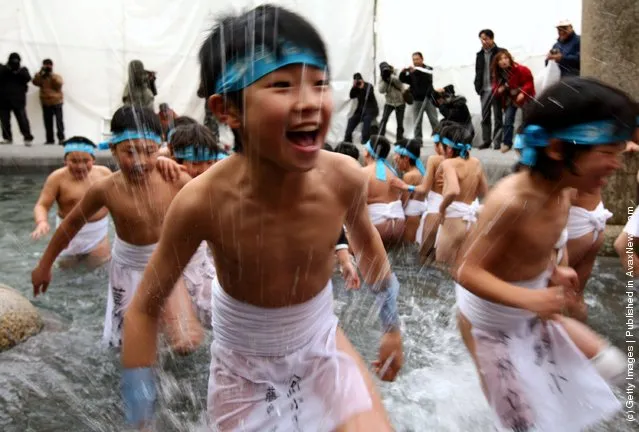
Japanese children wear loincloths as they splash about in freezing cold water during Saidaiji Naked Festival, at Saidaiji Temple

“A Hadaka Matsuri (“Naked Festival”) is a type of Japanese festival, or matsuri, in which participants wear a minimum amount of clothing; usually just a Japanese loincloth (called fundoshi), sometimes with a short happi coat, and rarely completely naked. Whatever the clothing, it is considered to be above vulgar, or everyday, undergarments, and on the level of holy Japanese shrine attire. Naked festivals are held in dozens of places throughout Japan every year, usually in the summer or winter. The most famous festival is held in Okayama, where the festival originated. Every year, over 9,000 men participate in this festival”. – Wikipedia

Photo: Japanese men wear loincloths as they splash about in freezing cold water during Saidaiji Naked Festival, at Saidaiji Temple on February 18, 2012 in Okayama, Japan. (Photo by Buddhika Weerasinghe/Getty Images)
Details
19 Feb 2012 12:18:00
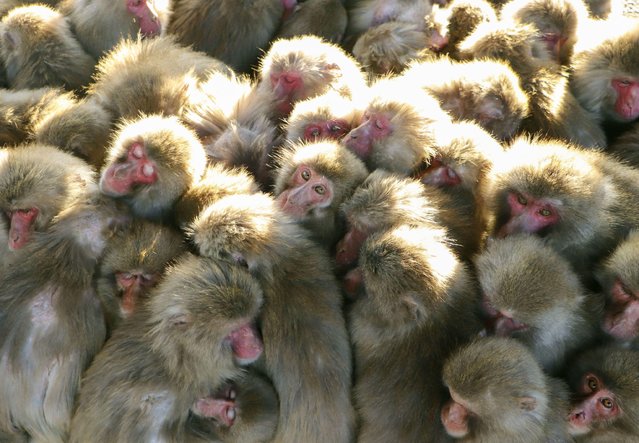
Japanese monkeys snuggle to keep warm at a zoo in Tonosho in Kagawa Prefecture, western Japan on January 24, 2023. (Photo by Kyodo Photo via Newscom/Alamy Live News)

Japanese monkeys snuggle to keep warm at a zoo in Tonosho in Kagawa Prefecture, western Japan on January 24, 2023. (Photo by Kyodo Photo via Newscom/Alamy Live News)
Details
02 Feb 2023 21:40:00
Women, dressed in traditional Japanese kimonos, cross a street in Kyoto, western Japan November 19, 2014. (Photo by Thomas Peter/Reuters)

Women, dressed in traditional Japanese kimonos, cross a street in Kyoto, western Japan November 19, 2014. (Photo by Thomas Peter/Reuters)
Details
20 Nov 2014 12:25:00
Japanese–British singer-songwriter and model Rina Sawayama, date unknown. (Photo by Press Handout for SFTW)

Japanese–British singer-songwriter and model Rina Sawayama, date unknown. (Photo by Press Handout for SFTW)
Details
03 Oct 2023 03:16:00
The view at night from the Shanghai Tower in Shanghai, China on August 7, 2015. The tower is technically smaller than the Burj Khalifa in Dubai but, while the observation deck of Dubai’s mega-structure is at 556m, the Shanghai Tower’s is at 561m, meaning the view is a little higher. (Photo by Paul Reiffer/REX Shutterstock)

The view at night from the Shanghai Tower in Shanghai, China on August 7, 2015. The tower is technically smaller than the Burj Khalifa in Dubai but, while the observation deck of Dubai’s mega-structure is at 556m, the Shanghai Tower’s is at 561m, meaning the view is a little higher. (Photo by Paul Reiffer/REX Shutterstock)
Details
21 Jan 2016 08:02:00
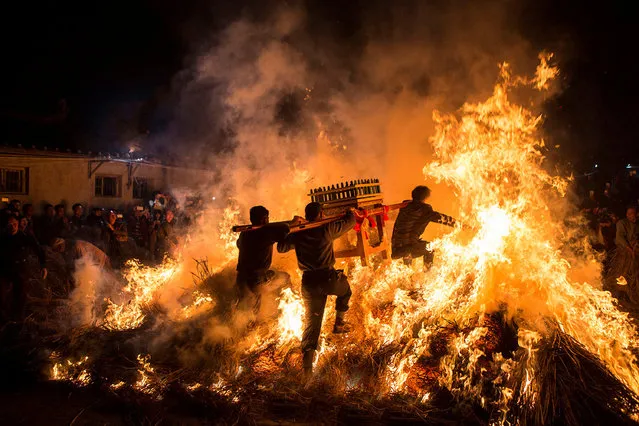
Men carrying a shrine jump over a bon fire, which means a wish for good luck during a traditional Chinese lunar new year celebration in Jieyang, Guangdong province, China, February 2, 2017. (Photo by Reuters/China Daily)

Men carrying a shrine jump over a bon fire, which means a wish for good luck during a traditional Chinese lunar new year celebration in Jieyang, Guangdong province, China, February 2, 2017. (Photo by Reuters/China Daily)
Details
09 Feb 2017 00:06:00
A reveller holds her dog dressed in costume, during the Rio Dog Carnival, known as the Blocao – with “bloco” meaning street party and “cao” dog, during pre- carnival celebrations at Copacabana beach in Rio de Janeiro, Brazil, on February 19, 2017. (Photo by Yasuyoshi Chiba/AFP Photo)

A reveller holds her dog dressed in costume, during the Rio Dog Carnival, known as the Blocao – with “bloco” meaning street party and “cao” dog, during pre- carnival celebrations at Copacabana beach in Rio de Janeiro, Brazil, on February 19, 2017. (Photo by Yasuyoshi Chiba/AFP Photo)
Details
22 Feb 2017 00:05:00
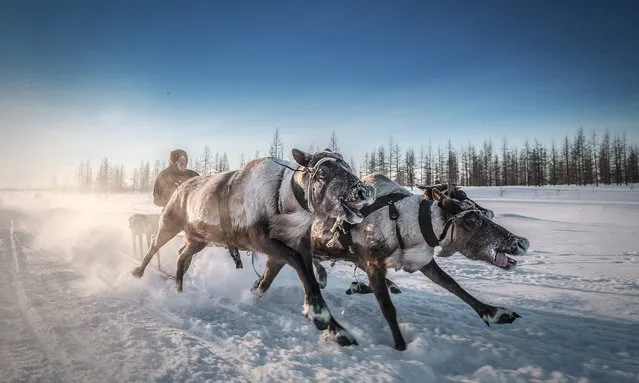
Take me away, deer, Russia. The Nenet people of Arctic Russia use reindeer and sledges as a prime mode of transport. The animals’ navigational ability means that in severe conditions they are sometimes the only hope of survival. (Photo by Kamil Nureev/Smithsonian Photo Contest)

Take me away, deer, Russia. The Nenet people of Arctic Russia use reindeer and sledges as a prime mode of transport. The animals’ navigational ability means that in severe conditions they are sometimes the only hope of survival. (Photo by Kamil Nureev/Smithsonian Photo Contest)
Details
06 Mar 2017 00:05:00