Loading...
Done
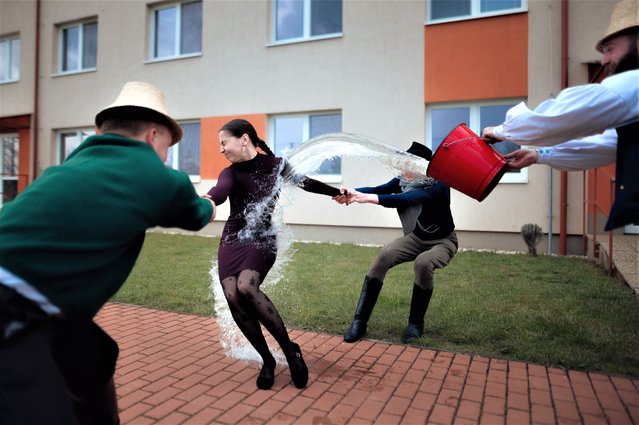
Boys and younger men from the Ilosvai Selymes Peter folk dance group pour buckets of cold water on a girl as they attend the traditional watering of local girls on Easter Monday in Komarovce, Velke Trakany, Slovakia on April 10, 2023. During Easter Holy Week, the ancient tradition of Easter sprinkling known as “watering of the girls” when Hungarian boys visit their female friends, recite poems, and pour water on them, and in exchange the girls offer the boys food and drink. (Photo by Robert Nemeti/Anadolu Agency via Getty Images)

Boys and younger men from the Ilosvai Selymes Peter folk dance group pour buckets of cold water on a girl as they attend the traditional watering of local girls on Easter Monday in Komarovce, Velke Trakany, Slovakia on April 10, 2023. During Easter Holy Week, the ancient tradition of Easter sprinkling known as “watering of the girls” when Hungarian boys visit their female friends, recite poems, and pour water on them, and in exchange the girls offer the boys food and drink. (Photo by Robert Nemeti/Anadolu Agency via Getty Images)
Details
20 Aug 2024 03:44:00
An employee of cake shop prepares chocolate Easter bunnies with masks in Lykovrisi, northern Athens, on Wednesday, April 8, 2020. Cake shops and bakeries in Greece have remained open during a strict circulation ban in Greece to contain the spread of the COVID-19, but authorities have intensified a crackdown on lockdown violations ahead of Easter, which is celebrated by Orthodox Christians on April 19. Greece's Orthodox Church says it will not permit any public gatherings for Easter services. (Photo by Thanassis Stavrakis/AP Photo)

An employee of cake shop prepares chocolate Easter bunnies with masks in Lykovrisi, northern Athens, on Wednesday, April 8, 2020. Cake shops and bakeries in Greece have remained open during a strict circulation ban in Greece to contain the spread of the COVID-19, but authorities have intensified a crackdown on lockdown violations ahead of Easter, which is celebrated by Orthodox Christians on April 19. Greece's Orthodox Church says it will not permit any public gatherings for Easter services. (Photo by Thanassis Stavrakis/AP Photo)
Details
10 Apr 2020 00:07:00
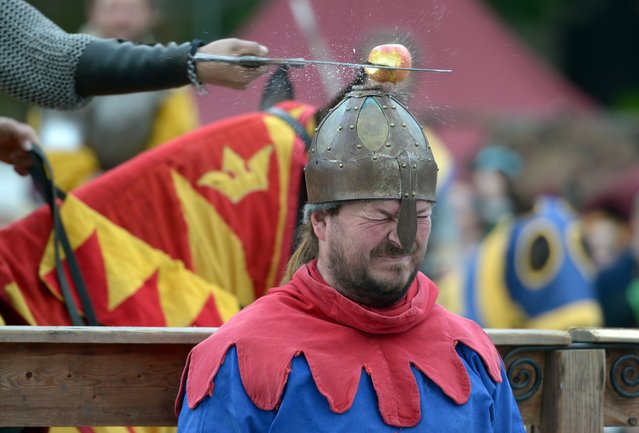
A man smashes an apple with a sword placed on the head of a man wearing a knave costume during the Easter knight event on April 21, 2014 in Berlin. The easter knight event delivers an insight into medieval lifestyle. (Photo by Rainer Jensen/AFP Photo/DPA)

A man smashes an apple with a sword placed on the head of a man wearing a knave costume during the Easter knight event on April 21, 2014 in Berlin. The easter knight event delivers an insight into medieval lifestyle. (Photo by Rainer Jensen/AFP Photo/DPA)
Details
26 Apr 2014 12:24:00
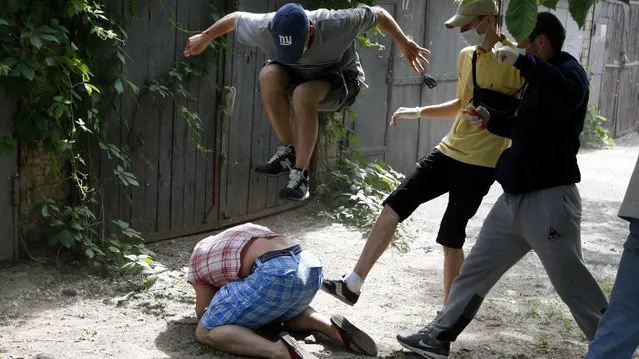
Unidentified people beat Svyatoslav Sheremet (L, bottom), head of Gay-Forum of Ukraine public organization, in Kiev, May 20, 2012. Sheremet was attacked after meeting with members of the media to inform them that a scheduled gay parade was cancelled. The attackers ran off when they realised members of the media were documenting the attack. (Photo by Anatolii Stepanov/Reuters)

Unidentified people beat Svyatoslav Sheremet (L, bottom), head of Gay-Forum of Ukraine public organization, in Kiev, May 20, 2012. Sheremet was attacked after meeting with members of the media to inform them that a scheduled gay parade was cancelled. The attackers ran off when they realised members of the media were documenting the attack. (Photo by Anatolii Stepanov/Reuters)
Details
16 May 2020 00:03:00
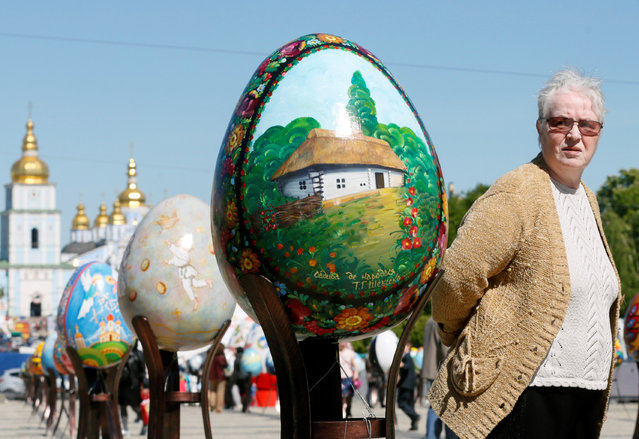
A woman looks at traditional Ukrainian Easter eggs “Pysanka”, installed as part of the upcoming celebrations of Easter, in central Kiev, Ukraine, April 29, 2016. A pysanka is a Ukrainian Easter egg, decorated with traditional Ukrainian folk designs using a wax-resist (batik) method. The word pysanka comes from the verb pysaty, “to write”, as the designs are not painted on, but written with beeswax. Many other eastern European ethnic groups decorate eggs using wax resist for Easter. These include the Belarusians, Bulgarians, Croats, Czechs, Hungarians, Lithuanians, Poles, Romanians, Serbs, Slovaks, Slovenes and Sorbs. (Photo by Valentyn Ogirenko/Reuters)

A woman looks at traditional Ukrainian Easter eggs “Pysanka”, installed as part of the upcoming celebrations of Easter, in central Kiev, Ukraine, April 29, 2016. A pysanka is a Ukrainian Easter egg, decorated with traditional Ukrainian folk designs using a wax-resist (batik) method. The word pysanka comes from the verb pysaty, “to write”, as the designs are not painted on, but written with beeswax. Many other eastern European ethnic groups decorate eggs using wax resist for Easter. These include the Belarusians, Bulgarians, Croats, Czechs, Hungarians, Lithuanians, Poles, Romanians, Serbs, Slovaks, Slovenes and Sorbs. (Photo by Valentyn Ogirenko/Reuters)
Details
30 Apr 2016 09:00:00
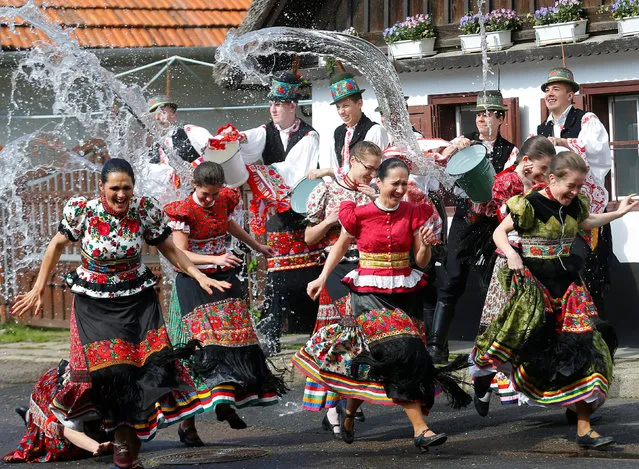
Girls dressed in traditional costumes run as men throw water on them as part of Easter celebrations during a presentation to the media in Mezokovesd, Hungary, April 13, 2017. (Photo by Laszlo Balogh/Reuters)

Girls dressed in traditional costumes run as men throw water on them as part of Easter celebrations during a presentation to the media in Mezokovesd, Hungary, April 13, 2017. (Photo by Laszlo Balogh/Reuters)
Details
15 Apr 2017 08:58:00
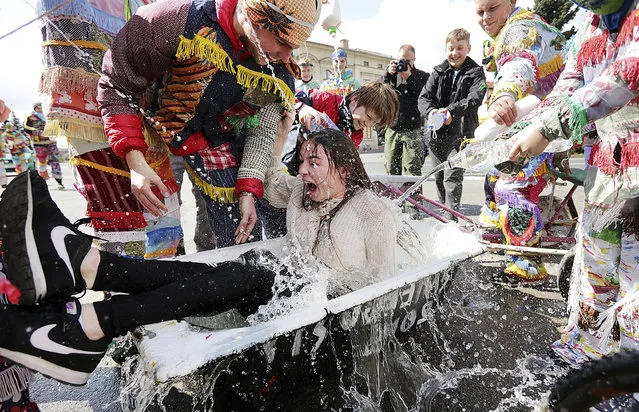
A girl is splashed with water by boys following a Polish Wet Easter Monday tradition, in Wilamowice, Poland, Monday, April. 17, 2017. (Photo by Jarek Praszkiewicz/AP Photo)

A girl is splashed with water by boys following a Polish Wet Easter Monday tradition, in Wilamowice, Poland, Monday, April. 17, 2017. (Photo by Jarek Praszkiewicz/AP Photo)
Details
18 Apr 2017 09:30:00
Racegoers shield themselves from the rain and wind at the Fairyhouse Easter Festival in Fairyhouse, Co. Meath, Ireland on April 10, 2023. (Photo by Morgan Treacy/Inpho)

Racegoers shield themselves from the rain and wind at the Fairyhouse Easter Festival in Fairyhouse, Co. Meath, Ireland on April 10, 2023. (Photo by Morgan Treacy/Inpho)
Details
08 May 2023 03:53:00