Loading...
Done
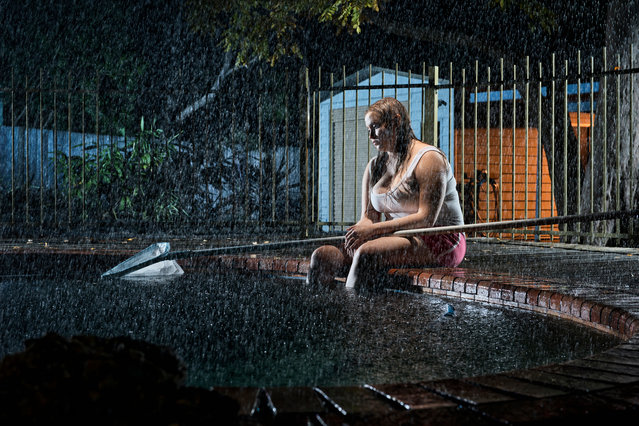
Each of them appears caught in contemplation or ennui as everyday life goes on around them. (Photo by Alec Dawson)

In his series of untitled photographs Nobody Claps Anymore, the Mexican-American photographer Alec Dawson portrays ordinary people in their homes in a downbeat, ultra-stylised manner. Staring into space as they watch TV or water the garden, the real-life subjects of photographer hint at vast reserves of boredom and regret. (Photo by Alec Dawson)
Details
26 Mar 2016 12:53:00
Bear Vs Tiger

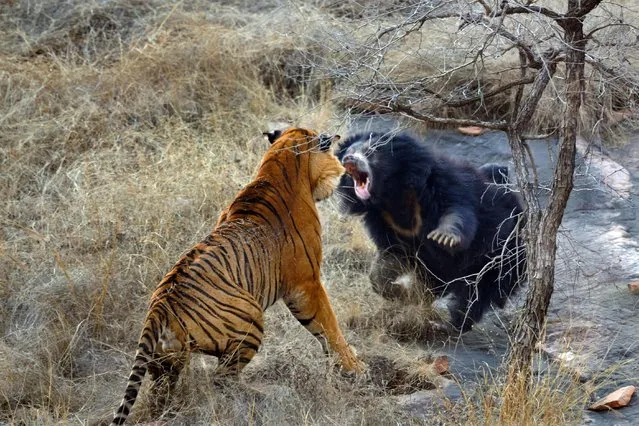
It's not often that two ferocious tigers have to beat a hasty retreat from a confrontation. But it seems that the wrath of a mother bear protecting two cubs on her back was more than enough to scare this pair off. Wildlife photographer Aditya Singh captured the encounter during a visit to Ranthambore Tiger Reserve in Rajasthan, India.
Details
24 Jan 2014 09:11:00
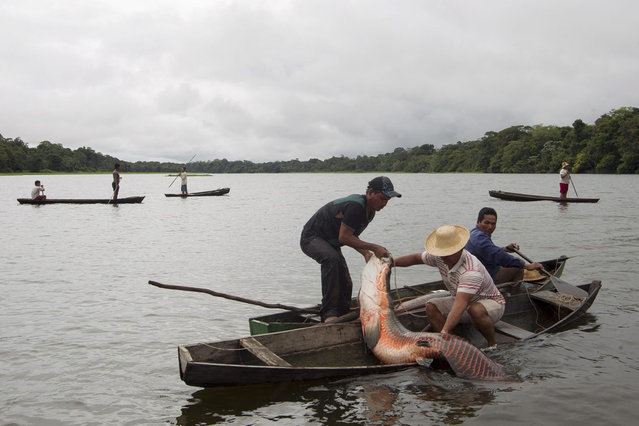
Villagers from the Porto Novo community load into their canoes arapaima or pirarucu, the largest freshwater fish species in South America and one of the largest in the world, while fishing in Poco Fundo lake along a branch of the Solimoes river, one of the main tributaries of the Amazon, in the Mamiraua nature reserve near Fonte Boa about 600 km (373 miles) west of Manaus, November 26, 2013. (Photo by Bruno Kelly/Reuters)

Villagers from the Porto Novo community load into their canoes arapaima or pirarucu, the largest freshwater fish species in South America and one of the largest in the world, while fishing in Poco Fundo lake along a branch of the Solimoes river, one of the main tributaries of the Amazon, in the Mamiraua nature reserve near Fonte Boa about 600 km (373 miles) west of Manaus, November 26, 2013. Catching the arapaima, a fish that is sought after for its meat and is considered by biologists to be a living fossil, is only allowed once a year by Brazil's environmental protection agency. The minimum size allowed for a fisherman to keep an arapaima is 1.5 meters (4.9 feet). (Photo by Bruno Kelly/Reuters)
Details
17 Dec 2013 08:03:00
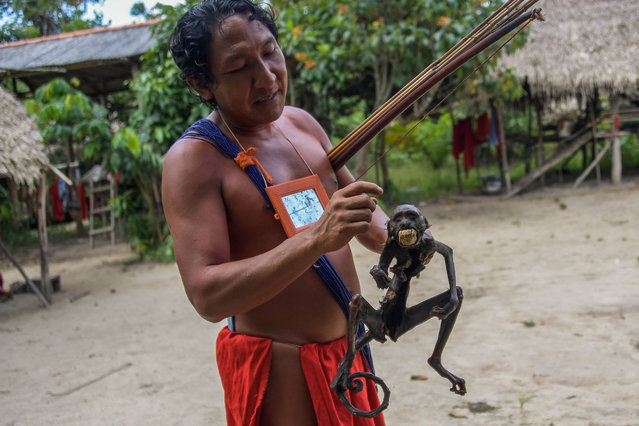
Chieftain Japarupi Waiapi shows a roasted monkey -part of Waiapi's diet, also based in Manioc and fruits- at the reserve in Amapa state in Brazil on October 13, 2017. When Waiapis walks into the Amazon forest surrounding their village, they do not see trees, but a kind of shopping mall providing medicine, food, shelter, tools and weapons  all under the eye of multiple spirits. (Photo by Apu Gomes/AFP Photo)

Chieftain Japarupi Waiapi shows a roasted monkey -part of Waiapi's diet, also based in Manioc and fruits- at the reserve in Amapa state in Brazil on October 13, 2017. When Waiapis walks into the Amazon forest surrounding their village, they do not see trees, but a kind of shopping mall providing medicine, food, shelter, tools and weapons all under the eye of multiple spirits. (Photo by Apu Gomes/AFP Photo)
Details
27 Oct 2017 08:39:00
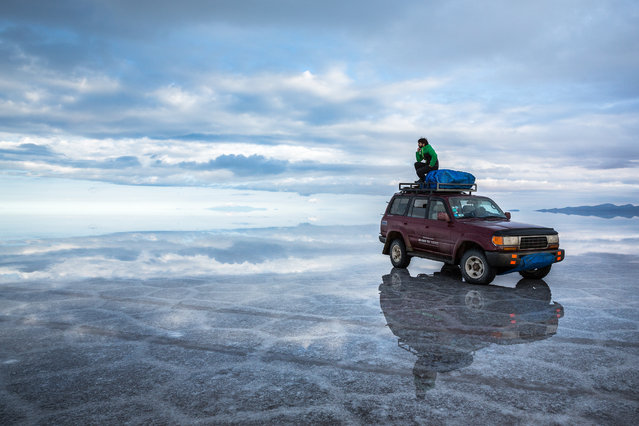
At 10,582 square kilometres, the Bolivian salt flats – otherwise known as Salar de Uyuni – are the largest on the planet and contain between 50 and 70% of the world’s lithium reserves. After exploring Chile and Argentina, photographer Joel Santos decided to travel to Bolivia in January 2017 to check the salt flats off his bucket list. With an electrical storm rolling in, Joel and his two travelling companions were the only souls left on the vast flats and captured the eerie flats without a person in sight. (Photo by Joel Santos/Barcroft Images)

At 10,582 square kilometres, the Bolivian salt flats – otherwise known as Salar de Uyuni – are the largest on the planet and contain between 50 and 70% of the world’s lithium reserves. After exploring Chile and Argentina, photographer Joel Santos decided to travel to Bolivia in January 2017 to check the salt flats off his bucket list. With an electrical storm rolling in, Joel and his two travelling companions were the only souls left on the vast flats and captured the eerie flats without a person in sight. (Photo by Joel Santos/Barcroft Images)
Details
12 Aug 2019 00:03:00
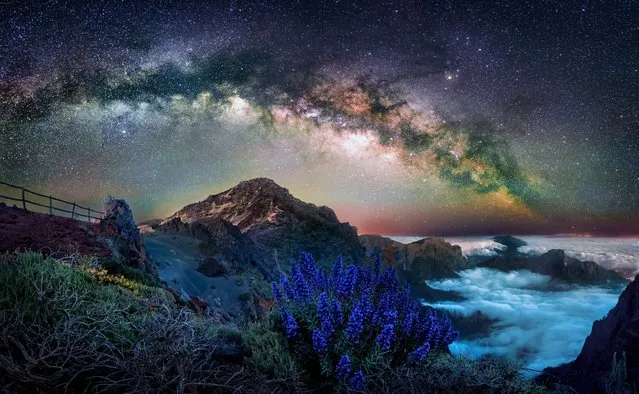
Tony North; First place, Breathing Spaces; Overall Winner; Blue Tajinaste, La Palma, Canary Islands, Spain. “Echium thyrsiflorum is endemic to the mountains of La Palma island – from high up, there was a magnificent view of both the caldera below, and the stars above. The Unesco La Palma biosphere reserve encompasses the entire island, with the Caldera de Taburiente containing mountains with a highest peak of 2,426 metres – the Roque de los Muchachos”. (Photo by Tony North/IGPOTY)

Tony North; First place, Breathing Spaces; Overall Winner; Blue Tajinaste, La Palma, Canary Islands, Spain. “Echium thyrsiflorum is endemic to the mountains of La Palma island – from high up, there was a magnificent view of both the caldera below, and the stars above. The Unesco La Palma biosphere reserve encompasses the entire island, with the Caldera de Taburiente containing mountains with a highest peak of 2,426 metres – the Roque de los Muchachos”. (Photo by Tony North/IGPOTY)
Details
10 Feb 2023 04:41:00
Elephant Hospital

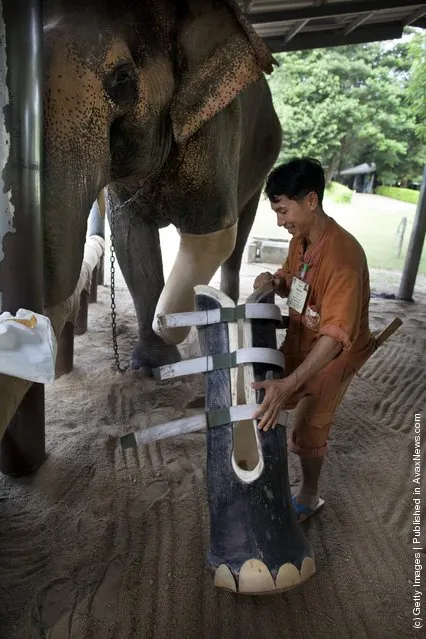
A mahout removes the prosthetic from Motala, age 50, at the Friends of the Asian Elephant (FAE) elephant hospital in the Mae Yao National Reserve August 29, 2011 Lampang,Thailand. Motala lost a foot many years back after stepping on a land mine and now is on her third prosthetic, as they need to be changed according to the weight of the elephant. (Photo by Paula Bronstein/Getty Images)
Details
01 Sep 2011 11:53:00
Gold bars from the vault of a bank and Swiss one franc coins are seen in this illustration picture taken in Zurich November 20, 2014. The “Save our Swiss gold” proposal, spearheaded by the right-wing Swiss People's Party (SVP), aims to ban the central bank from offloading its reserves and oblige it to hold at least 20 percent of its assets in gold. The referendum is scheduled for November 30. The SVP argues it would secure a stable Swiss franc. (Photo by Arnd Wiegmann/Reuters)

Gold bars from the vault of a bank and Swiss one franc coins are seen in this illustration picture taken in Zurich November 20, 2014. The “Save our Swiss gold” proposal, spearheaded by the right-wing Swiss People's Party (SVP), aims to ban the central bank from offloading its reserves and oblige it to hold at least 20 percent of its assets in gold. The referendum is scheduled for November 30. The SVP argues it would secure a stable Swiss franc. (Photo by Arnd Wiegmann/Reuters)
Details
22 Nov 2014 13:31:00