Loading...
Done
Macaque monkeys crowd together in their cage at a monkey farm on February 3, 2016 in Xinye county, Henan province, China. The area boasts a centuries-long and lucrative history of raising and training monkeys for performance. In Xinye, villagers are seeing an increase in business with the lunar calendar's “Year of the Monkey”. Farmers say most of the monkeys are bred and raised for domestic zoos, circuses, and performing groups, but add that some are also sold for medical research in China and the United States. Despite the popularity of the tradition, critics contend the training methods and conditions constitute animal cruelty. (Photo by Kevin Frayer/Getty Images)

Macaque monkeys crowd together in their cage at a monkey farm on February 3, 2016 in Xinye county, Henan province, China. The area boasts a centuries-long and lucrative history of raising and training monkeys for performance. In Xinye, villagers are seeing an increase in business with the lunar calendar's “Year of the Monkey”. Farmers say most of the monkeys are bred and raised for domestic zoos, circuses, and performing groups, but add that some are also sold for medical research in China and the United States. Despite the popularity of the tradition, critics contend the training methods and conditions constitute animal cruelty. (Photo by Kevin Frayer/Getty Images)
Details
31 Dec 2016 09:56:00
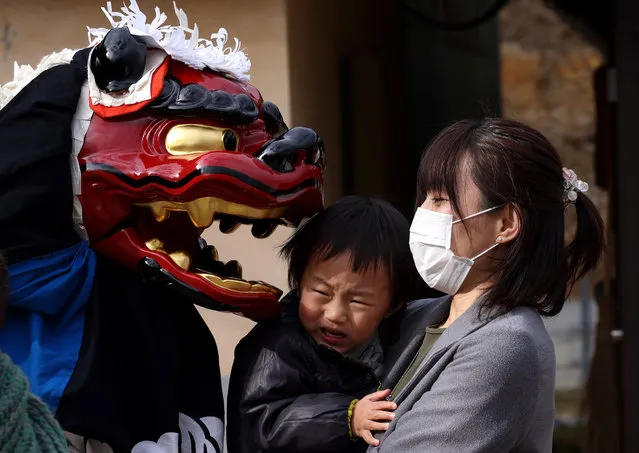
A performer wearing a lion mask performs the Ise Daikagura lion dance at the remote village of Yamanawa on February 08, 2021 in Ryuo, Japan. Ise Daikagura is a group of traditional Lion Dance performers who pray in front of farmers houses and businesses for good grain harvests and disease-free lives. Performers play sacred music using drums and flutes with two lion mask dancers. A lion mask is considered a symbol of God, who enters the house and performs in front of the Shinto God, a statue placed inside the house, mostly in the kitchen. These prayers are called “Kamodo Barai”. After the prayers, they are gifted with money, rice, sake and Japanese sweets from the householders. A group can travel for more than one hundred days to thousands of households and businesses throughout rural-villages in western Japan, and pray to those who are unable to visit the country’s most sacred shrine, the Grand Ise Shrine in Mie Prefecture. The group started its performance in the Edo era between 1603 to 1868 according to Japanese history. The Japanese government designated it as an important folk cultural national property in 1981. (Photo by Buddhika Weerasinghe/Getty Images)

A performer wearing a lion mask performs the Ise Daikagura lion dance at the remote village of Yamanawa on February 08, 2021 in Ryuo, Japan. Ise Daikagura is a group of traditional Lion Dance performers who pray in front of farmers houses and businesses for good grain harvests and disease-free lives. (Photo by Buddhika Weerasinghe/Getty Images)
Details
18 Feb 2021 09:27:00
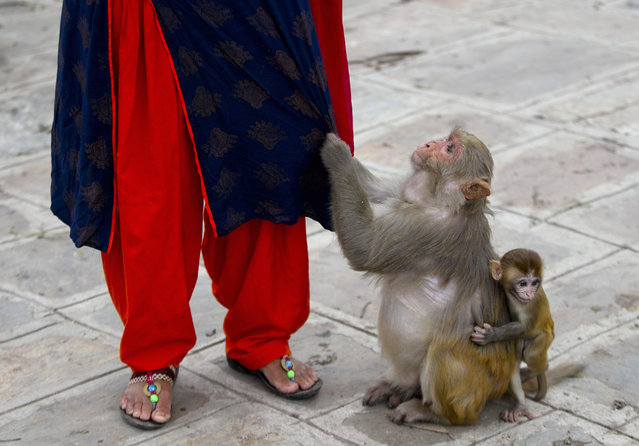
In this July 8, 2019, photo, a monkey pulls on the clothes of Saraswati Dangol as she arrives to feed monkeys in the forest near Pashupatinath temple in Kathmandu, Nepal. For the past four years, Dangol has been bringing the bread every day to feed the monkeys. As soon as they see her with her white sack, they gather around her, some patiently waiting for their turn while others less patiently snatching the bread from her hands. Many of Dangol's regulars are elderly, or are mother or baby monkeys who are unable to fight for their share of food in the wild. (Photo by Niranjan Shrestha/AP Photo)

In this July 8, 2019, photo, a monkey pulls on the clothes of Saraswati Dangol as she arrives to feed monkeys in the forest near Pashupatinath temple in Kathmandu, Nepal. For the past four years, Dangol has been bringing the bread every day to feed the monkeys. As soon as they see her with her white sack, they gather around her, some patiently waiting for their turn while others less patiently snatching the bread from her hands. Many of Dangol's regulars are elderly, or are mother or baby monkeys who are unable to fight for their share of food in the wild. (Photo by Niranjan Shrestha/AP Photo)
Details
26 Jul 2019 00:03:00
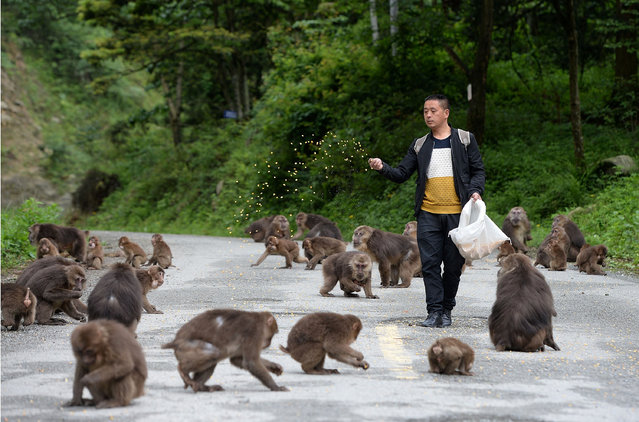
A man feeds monkeys at Longchi scenic area, in Dujiangyan, Sichuan province, China May 24, 2017. (Photo by Reuters/Stringer)

A man feeds monkeys at Longchi scenic area, in Dujiangyan, Sichuan province, China May 24, 2017. (Photo by Reuters/Stringer)
Details
25 May 2017 08:46:00
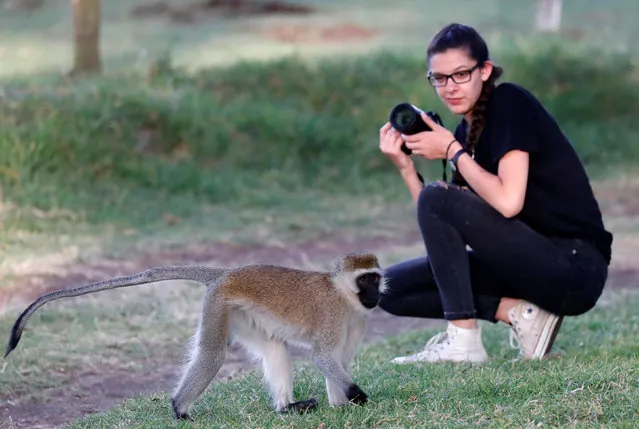
A vervet monkey passes in front of a woman on the shores of lake Naivasha, Kenya January 24, 2017. (Photo by Goran Tomasevic/Reuters)

A vervet monkey passes in front of a woman on the shores of lake Naivasha, Kenya January 24, 2017. (Photo by Goran Tomasevic/Reuters)
Details
25 Jan 2017 11:45:00
A wild macaque monkey eats fruit dropped by pedestrians in a suburb of Kuala Lumpur, Malaysia, on June 11, 2013. (Photo by Mohd Rasfan/AFP Photo)

A wild macaque monkey eats fruit dropped by pedestrians in a suburb of Kuala Lumpur, Malaysia, on June 11, 2013. (Photo by Mohd Rasfan/AFP Photo)
Details
15 Jun 2013 11:38:00
1928: Greyhounds with stuffed and sprung model monkeys strapped to their backs before a hurdle race at Wellinborough

Greyhounds with stuffed and sprung model monkeys strapped to their backs before a hurdle race at Wellinborough. (Photo by E. Bacon). 21st April 1928
Details
11 Jul 2012 09:57:00
Musafir, a pet monkey, eats sweets on a pavement in Kolkata, India, June 9, 2016. (Photo by Rupak De Chowdhuri/Reuters)

Musafir, a pet monkey, eats sweets on a pavement in Kolkata, India, June 9, 2016. (Photo by Rupak De Chowdhuri/Reuters)
Details
11 Jun 2016 12:10:00