Loading...
Done
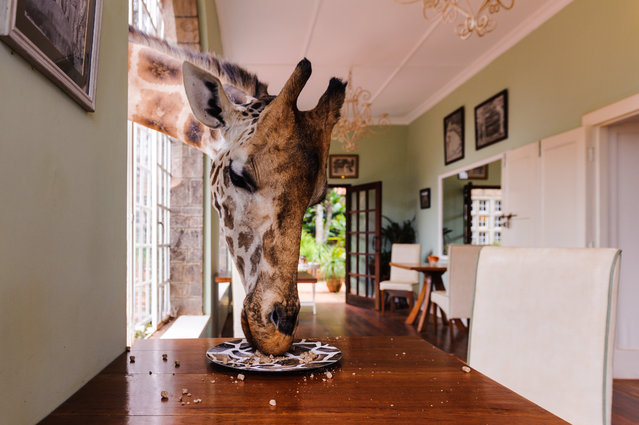
“Don't Leave Any Food On Your Plate”. The giraffes at Nairobi's Giraffe Manor are totally at home with humans. They will eat out of your hand, or even off your plate. Photo location: Giraffe Manor, Nairobi, Kenya. (Photo and caption by Gavin Werbeloff/National Geographic Photo Contest)

“Don't Leave Any Food On Your Plate”. The giraffes at Nairobi's Giraffe Manor are totally at home with humans. They will eat out of your hand, or even off your plate. Photo location: Giraffe Manor, Nairobi, Kenya. (Photo and caption by Gavin Werbeloff/National Geographic Photo Contest)
Details
20 Jun 2014 10:23:00
Photographers: Helmut Newton

“Newton was born in Berlin, the son of Klara “Claire” (Marquis) and Max Neustädter, a button factory owner. His family was Jewish. Newton attended the Heinrich-von-Treitschke-Realgymnasium and the American School in Berlin. Interested in photography from the age of 12 when he purchased his first camera, he worked for the German photographer Yva (Elsie Neulander Simon) from 1936. The increasingly oppressive restrictions placed on Jews by the Nuremberg laws meant that his father lost control of the factory in which he manufactured buttons and buckles; he was briefly interned in a concentration camp on “Kristallnacht”, November 9, 1938, which finally compelled the family to leave Germany. Newton's parents fled to South America. He was issued with a passport just after turning 18, and left Germany on December 5, 1938. At Trieste he boarded the “Conte Rosso” (along with about 200 others escaping the Nazis) intending to journey to China. After arriving in Singapore he found he was able to remain there, first and briefly as a photographer for the Straits Times and then as a portrait photographer”. – Wikipedia

Photo: Sigourney Weaver by Helmut Newton, 1995.
Details
08 Apr 2012 13:49:00
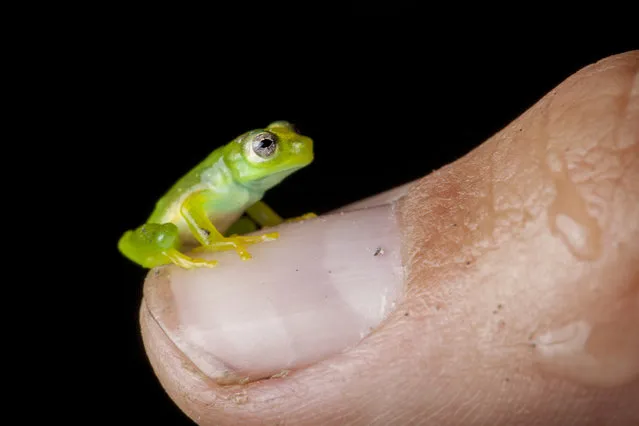
Miniature glass frog. (Photo by Robin Moore)

Thousands of species of amphibians are endangered and hundreds have already disappeared, but in recent years, a team of scientists and conservationists have re-discovered some of these “lost” species and uncovered previously unknown varieties. Here: Miniature glass frog. (Photo by Robin Moore)
Details
10 Oct 2014 12:55:00
A cat wearing a dress is carried around in a transparent rucksack at the annual Pet Expo Thailand 2021 in Bangkok on November 25, 2021. (Photo by Jack Taylor/AFP Photo)

A cat wearing a dress is carried around in a transparent rucksack at the annual Pet Expo Thailand 2021 in Bangkok on November 25, 2021. (Photo by Jack Taylor/AFP Photo)
Details
10 Dec 2021 09:05:00
Bonbibi, Treehouse Point, Fall City, WA. The Bonbibi is balanced on two steel yokes. The yokes spread out the load and allow for tree growth and movement in the wind. A small deck hangs from the beams below and uses the treehouse itself to shelter guests. (Photo by Pete Nelson)

Bonbibi, Treehouse Point, Fall City, WA. The Bonbibi is balanced on two steel yokes. The yokes spread out the load and allow for tree growth and movement in the wind. A small deck hangs from the beams below and uses the treehouse itself to shelter guests. (Photo by Pete Nelson)
Details
16 May 2014 16:00:00
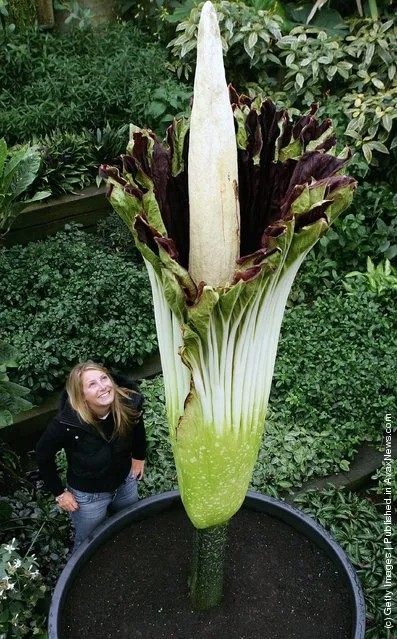
Kew Gardens employee Lauren Bird Royal examines the flowering of the Titan Arum lily at the Botanical Gardens

“The titan arum or Amorphophallus titanum (from Ancient Greek amorphos, “without form, misshapen” + phallos, “phallus”, and titan, “giant”) is a flowering plant with the largest unbranched inflorescence in the world. The titan arum's inflorescence is not as large as that of the Talipot palm, Corypha umbraculifera, but the inflorescence of the Talipot palm is branched rather than unbranched”. – Wikipedia

Photo: Kew Gardens employee Lauren Bird Royal examines the flowering of the Titan Arum lily at the Botanical Gardens at Kew on September 30, 2005 in London, England. For the first time in horticultural history, the Titan Arum lily can be seen at all three active stages in its lifecycle – in flower, fruit and leaf.The flowering corm is nearly three metres tall and weighs 91kg and is very rarely seen outside of the rainforests of Sumatra, Indonesia. (Photo by Scott Barbour/Getty Images)

Details
20 Sep 2011 11:13:00
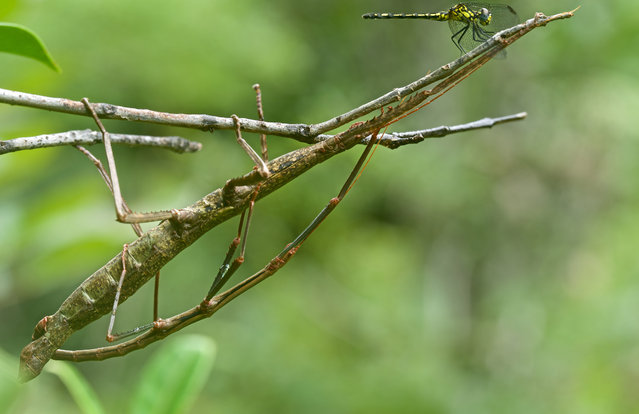
Stick insects. (Photo by Paul Bertner/Caters News)

These tiny insects are so well camouflaged it is nearly impossible to make out their cleverly disguised forms. Canadian photographer and adventurer Paul Bertner attempted to catch the bugs in their natural habitats as part of a hide-and-seek game to show biodiversity in nature. Here: Stick insects. (Photo by Paul Bertner/Caters News)
Details
02 Apr 2016 09:20:00
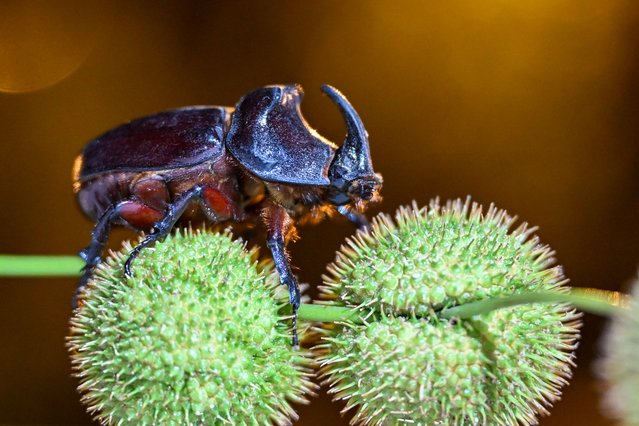
A “Rhino Beetle” (Oryctes nasicornis) is seen in Edremit, Van, Turkiye on August 2, 2024. Named “Rhino Beetle” due to the horn on its head, this beetle is commonly found in moist areas across Europe and Turkiye. (Photo by Ozkan Bilgin/Anadolu via Getty Images)

A “Rhino Beetle” (Oryctes nasicornis) is seen in Edremit, Van, Turkiye on August 2, 2024. Named “Rhino Beetle” due to the horn on its head, this beetle is commonly found in moist areas across Europe and Turkiye. (Photo by Ozkan Bilgin/Anadolu via Getty Images)
Details
24 Aug 2024 04:43:00