Loading...
Done
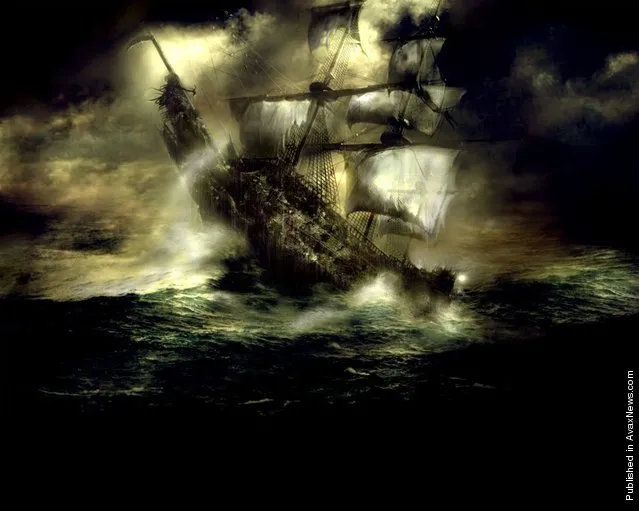
Ocean voyage

Do you think that history is a science? Well, not exactly. First, and foremost, history is the state's “legend of wars”, it’s official regalia. Of course, public historians are not interested in scientific truth – quite the opposite. In this respect, any attempt to present a state’s history as altruistic and benevolent as possible is welcomed and encouraged – as opposed to any revisionism attempts that may be more accurate. In this matter, Chinese have surpassed us all – they revised in highly creative manner (but rather shamelessly) the technology already invented by Europeans, a process that resulted in oldest state on the planet. Here is an interesting paradox: ask any sinologist about the Middle Kingdom during second century B.C., and he will describe it to you in such a vivid manner as if he has been living there all his life – but as soon as you will ask him to describe Chinese history in the 19-20th centuries… let's say, his eagerness will be greatly diminished. However, we will discuss China in a different article, and in the meantime we will try to understand how exactly historic “legend of wars” is formed and functions – based on a specific and well-known example. A great example is Ferdinand Magellan's first voyage around the world.
Details
14 Nov 2011 09:11:00
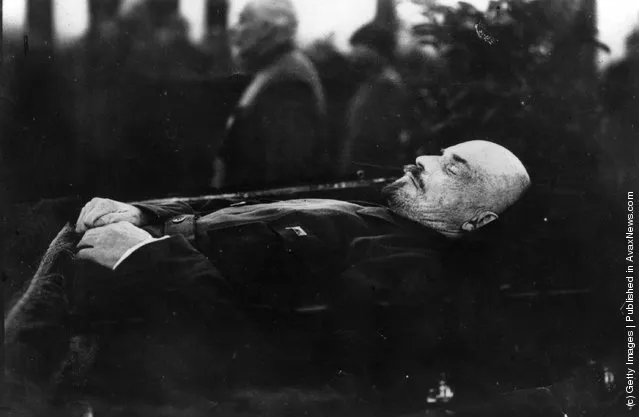
1924:  Vladimir Ilyich Lenin lying in state in the Kremlin

Photo: Vladimir Ilyich Lenin (1870 – 1924) lying in state in the Kremlin. (Photo by Hulton Archive/Getty Images). 1924

Important! For the same article in Russian language click here.

Something quite intriguing is happening within Russian-speaking internet during the last few – should you type a fully academic inquiry (at least, according to Russian academic requirements) in national search engines for "Lenin's mausoleum" – the first thing you get (even in top 10 searches) is website pages talking about black magic and occult. Website authors view this construction differently, but unconditionally agree on one thing: the mausoleum of the "leader of the world proletariat” – the essence of a magical artifact, a sort of “energy vampire”. It was built with a certain purpose: to drain the energy out of miserable Soviet citizens on one hand; and to poison the anthroposphere of one-sixth part of the earth with its vibes (the exact territory that was occupied by the former Soviet Union), depriving the Russian people of will to resist on the other hand. Complete nonsense? No doubt. Nevertheless, an intriguing one. Well, probably because some oddities do exist in mausoleum's history. These oddities are the thing we are going to discuss this time. First, let me refresh you memory on the subject.
Details
16 Oct 2011 11:27:00


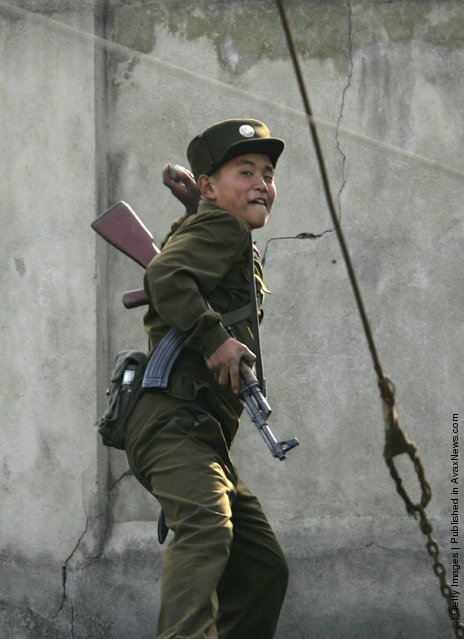
A North Korean soldier throws a stone towards a photographer on the banks of the Yalu River in the North Korean town of Sinuiju, opposite the Chinese border city of Dandong October 21, 2006 in Sinuiju, Democratic People's Republic of Korea. (Photo by Cancan Chu/Getty Images)
Details
16 May 2011 08:38:00
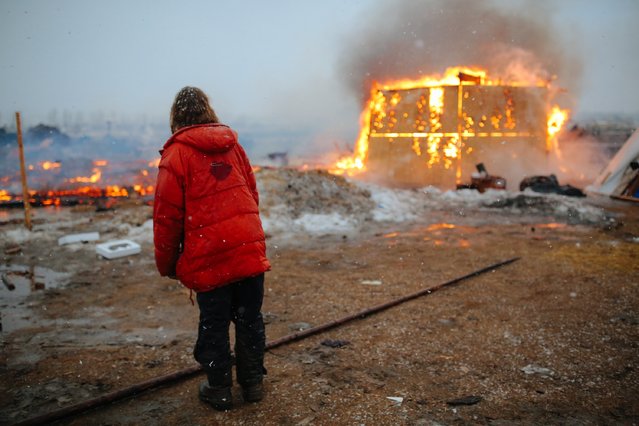
Campers set structures on fire in preparation of the Army Corp's 2pm deadline to leave the Oceti Sakowin protest camp on February 22, 2017 in Cannon Ball, North Dakota. (Photo by Stephen Yang/Getty Images)

Campers set structures on fire in preparation of the Army Corp's 2pm deadline to leave the Oceti Sakowin protest camp on February 22, 2017 in Cannon Ball, North Dakota. Activists and protesters have occupied the Standing Rock Sioux reservation for months in opposotion to the completion of the Dakota Access Pipeline. (Photo by Stephen Yang/Getty Images)
Details
26 Feb 2017 00:01:00
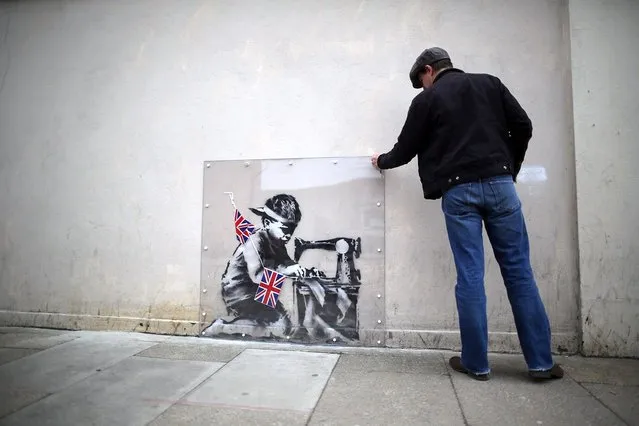
Banksy Artwork Appears In North London

A man inspects a plastic cover placed over an artwork attributed to Banksy on May 17, 2012 in London, England. The stencilled image depicts a poor child making Union Jack flags on a sewing machine and is located on the wall of a Poundland discount shop in the Wood Green area of north London. (Photo by Peter Macdiarmid)
Details
18 May 2012 11:18:00
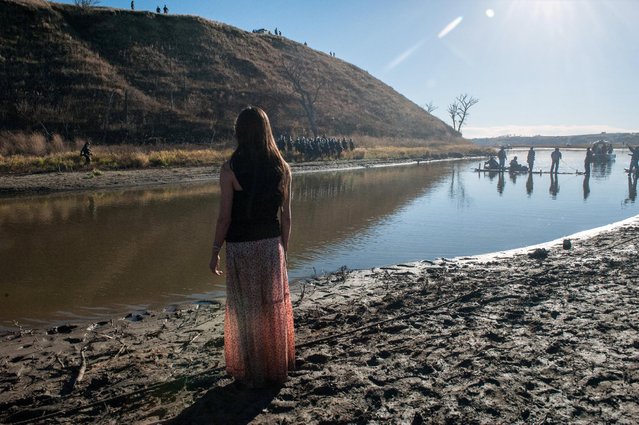
A woman prays at the edge of a river during a protest against the building of a pipeline near the Standing Rock Indian Reservation near Cannonball, North Dakota, U.S. November 2, 2016. (Photo by Stephanie Keith/Reuters)

A woman prays at the edge of a river during a protest against the building of a pipeline near the Standing Rock Indian Reservation near Cannonball, North Dakota, U.S. November 2, 2016. (Photo by Stephanie Keith/Reuters)
Details
09 Nov 2016 06:11:00
Women hold a demonstration on Backwater Bridge during a protest against plans to pass the Dakota Access pipeline near the Standing Rock Indian Reservation, near Cannon Ball, North Dakota, U.S. November 27, 2016. (Photo by Stephanie Keith/Reuters)

Women hold a demonstration on Backwater Bridge during a protest against plans to pass the Dakota Access pipeline near the Standing Rock Indian Reservation, near Cannon Ball, North Dakota, U.S. November 27, 2016. (Photo by Stephanie Keith/Reuters)
Details
30 Nov 2016 13:36:00
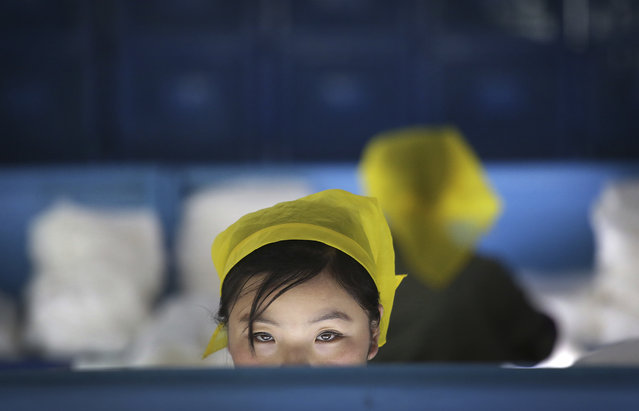
In this Friday, January 6, 2017, photo, a North Korean woman working at the Kim Jong Suk Silk Mill looks up from her workstation in Pyongyang, North Korea. The silk mill, named after North Korean leader Kim Jong Un's grandmother, is where 1,600 workers – mostly women – sort and process silkworms to produce silk thread that officials at the Pyongyang factory say is made into roughly 200 tons of silk a year. (Photo by Wong Maye-E/AP Photo)

In this Friday, January 6, 2017, photo, a North Korean woman working at the Kim Jong Suk Silk Mill looks up from her workstation in Pyongyang, North Korea. The silk mill, named after North Korean leader Kim Jong Un's grandmother, is where 1,600 workers – mostly women – sort and process silkworms to produce silk thread that officials at the Pyongyang factory say is made into roughly 200 tons of silk a year. (Photo by Wong Maye-E/AP Photo)
Details
17 Jan 2017 12:01:00