Loading...
Done
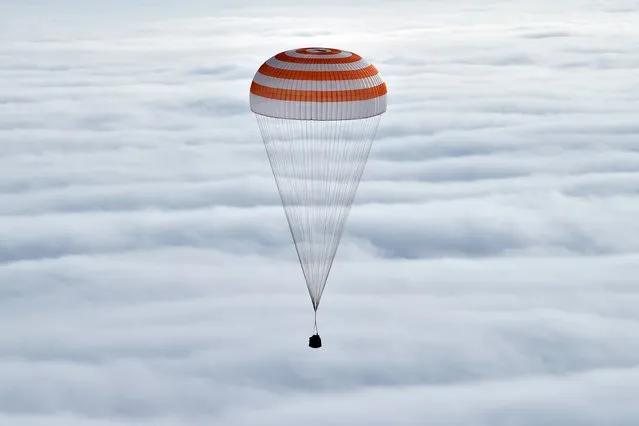
A Soyuz capsule carrying International Space Station (ISS) crew members U.S. astronaut Scott Kelly, Russian cosmonauts Sergei Volkov and Mikhail Korniyenko descends beneath a parachute near the town of Dzhezkazgan (Zhezkazgan), Kazakhstan, March 2, 2016. (Photo by Kirill Kudryavtsev/Reuters)

A Soyuz capsule carrying International Space Station (ISS) crew members U.S. astronaut Scott Kelly, Russian cosmonauts Sergei Volkov and Mikhail Korniyenko descends beneath a parachute near the town of Dzhezkazgan (Zhezkazgan), Kazakhstan, March 2, 2016. (Photo by Kirill Kudryavtsev/Reuters)
Details
03 Mar 2016 11:12:00
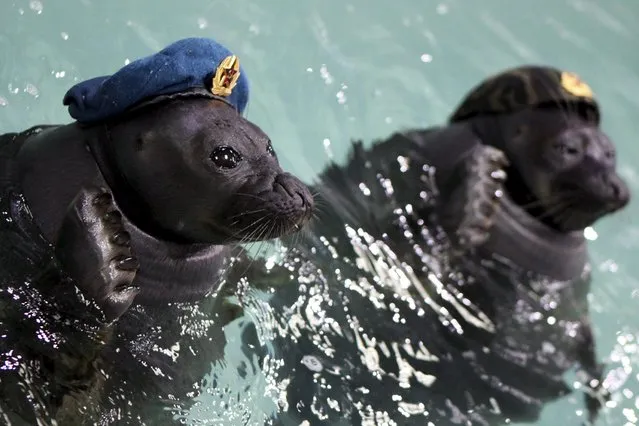
Seals dressed in military uniforms swim during a show marking the 70th anniversary of the end of World War Two, at an aquatic park in the Siberian city of Irkutsk, Russia, May 9, 2015. (Photo by Evgeny Kozyrev/Reuters)

Seals dressed in military uniforms swim during a show marking the 70th anniversary of the end of World War Two, at an aquatic park in the Siberian city of Irkutsk, Russia, May 9, 2015. (Photo by Evgeny Kozyrev/Reuters)
Details
10 May 2015 11:06:00


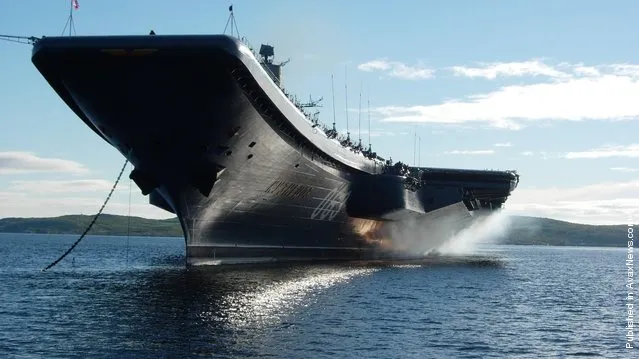
Admiral Flota Sovetskovo Soyuza Kuznetsov (Russian: Адмирал флота Советского Союза Кузнецов “Fleet Admiral of the Soviet Union Kuznetsov”), originally named Riga, renamed Leonid Brezhnev then Tbilisi) is an aircraft cruiser (heavy aircraft carrying missile cruiser (TAVKR) in Russian classification) serving as the flagship of the Russian Navy. She was originally commissioned in the Soviet Navy, and was intended to be the lead ship of her class, but the only other ship of her class, Varyag, was never commissioned and was sold to the People's Republic of China by Ukraine under the condition she would never be refitted for combat. Kuznetsov was named after the Admiral of the Fleet of the Soviet Union Nikolai Gerasimovich Kuznetsov.
Details
20 Nov 2011 03:51:00
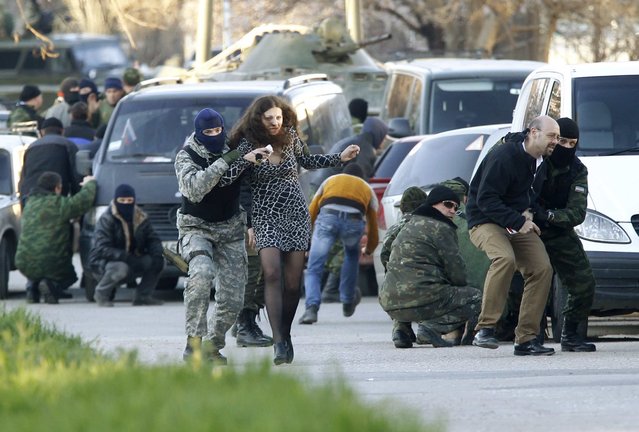
Civilians are led by members of pro-Russian self-defence units as they run outside a military base during an assault in the Crimean town of Belbek near Sevastopol March 22, 2014. Russian troops forced their way into a Ukrainian airbase in Crimea with armored vehicles, automatic fire and stun grenades on Saturday, injuring a Ukrainian serviceman and detaining the base's commander for talks. (Photo by Vasily Fedosenko/Reuters)

Civilians are led by members of pro-Russian self-defence units as they run outside a military base during an assault in the Crimean town of Belbek near Sevastopol March 22, 2014. Russian troops forced their way into a Ukrainian airbase in Crimea with armored vehicles, automatic fire and stun grenades on Saturday, injuring a Ukrainian serviceman and detaining the base's commander for talks. (Photo by Vasily Fedosenko/Reuters)
Details
22 Mar 2014 23:36:00


“Sektor gaza” (Russian: Сектор газа) was a Russian rock band formed on 5 December 1987 in the city of Voronezh, Russia. Despite only semi-officially existing (due to obscene lyrics), the group remains popular in Russia today. The group name was taken from an eponymous industrial district of Voronezh (itself named for high levels of environmental contamination). Their music style could be defined as Russian punk, integrated with elements of different musical genres such as rock, rap, and Russian folk. On 4 July 2000, group leader Yuri “Hoy” Klinskih complained of strong pains in his stomach and the left side of his chest. He suffered heart failure shortly thereafter. Klinskikh died in Voronezh (Russia)at the age of 35. He is buried in the Levoberezhniy Cemetery. The group ceased to exist.

About the music video: The First Chechen War, also known as the War in Chechnya, was a conflict between the Russian Federation and the Chechen Republic of Ichkeria, fought from December 1994 to August 1996. After the initial campaign of 1994 – 1995, culminating in the devastating Battle of Grozny, Russian federal forces attempted to seize control of the mountainous area of Chechnya but were set back by Chechen guerrilla warfare and raids on the flatlands in spite of Russia's overwhelming manpower, weaponry, and air support...

Details
24 May 2012 14:38:00
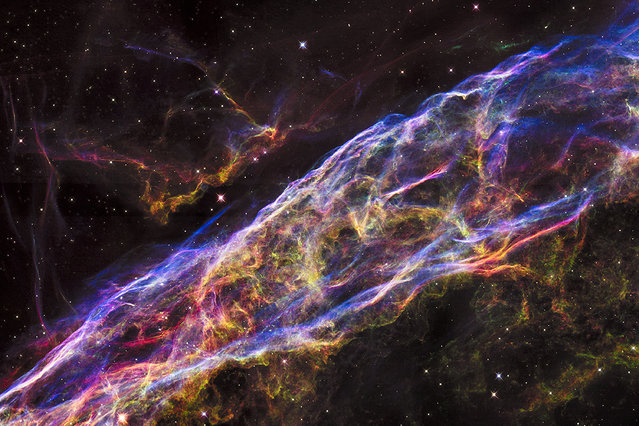
A small section of the expanding remains of the Veil Nebula, a massive star that exploded about 8,000 years ago. The entire nebula is 110 light-years across, covering six full moons on the sky as seen from Earth, and resides about 2,100 light-years away in the constellation Cygnus, the Swan. Image taken by NASA's Hubble Space Telescope. Released September 24, 2015. (Photo by Reuters/NASA/ESA/Hubble Heritage Team)

A small section of the expanding remains of the Veil Nebula, a massive star that exploded about 8,000 years ago. The entire nebula is 110 light-years across, covering six full moons on the sky as seen from Earth, and resides about 2,100 light-years away in the constellation Cygnus, the Swan. Image taken by NASA's Hubble Space Telescope. Released September 24, 2015. (Photo by Reuters/NASA/ESA/Hubble Heritage Team)
Details
10 Dec 2015 08:01:00
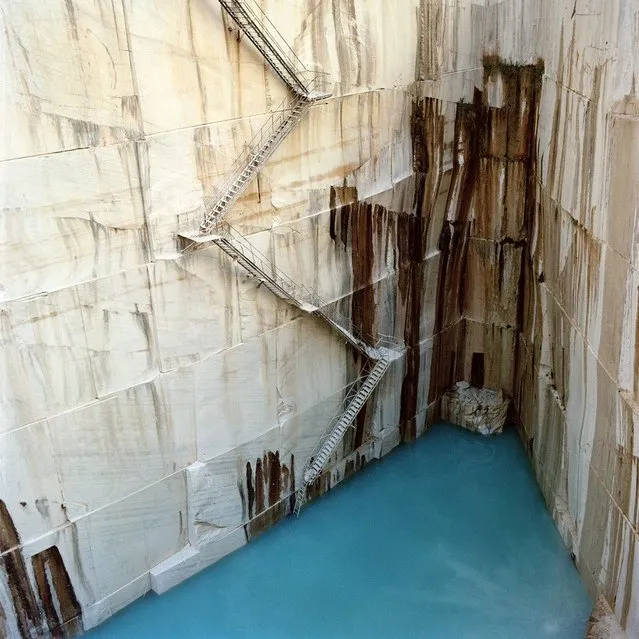
Open Space Office By Tito Mouraz

The photos, created by Tito Mouraz in Portugal, look too surreal, and it takes a while to realize that these are actually not painting but reality. The way people can completely transform the terrain is very reminiscent of the way people tend to change themselves. Chip away the granite of their soul, turning it into something that fits their idea of perfection. However, in the end, most of them end up with an obscene parody of beauty, rather than something truly marvelous. The reason for it is probably that people are actually oblivious to the true image of beauty, making them stumble around in the dark, hoping to find something that might not exist at all. (Photo by Tito Mouraz)
Details
30 Oct 2014 13:13:00
A Sign in Space by The photography of Lennart Nilsson

Stars are printed in the sand by a tractor as it drags a giant roller back and forth across the beach, then left to fade at the mercy of footsteps and the tide in this installation by Swedish artist Gunilla Klingberg.
Details
09 Oct 2012 14:15:00