Loading...
Done
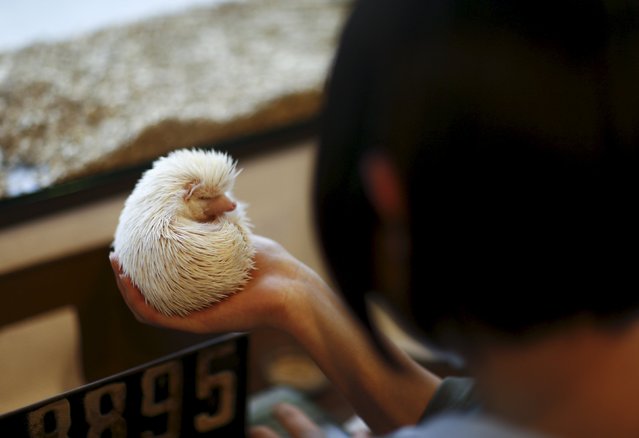
A woman holds a hedgehog at the Harry hedgehog cafe in Tokyo, Japan, April 5, 2016. (Photo by Thomas Peter/Reuters)

A woman holds a hedgehog at the Harry hedgehog cafe in Tokyo, Japan, April 5, 2016. In a new animal-themed cafe, 20 to 30 hedgehogs of different breeds scrabble and snooze in glass tanks in Tokyo's Roppongi entertainment district. Customers have been queuing to play with the prickly mammals, which have long been sold in Japan as pets. The cafe's name Harry alludes to the Japanese word for hedgehog, harinezumi. (Photo by Thomas Peter/Reuters)
Details
08 Apr 2016 14:56:00
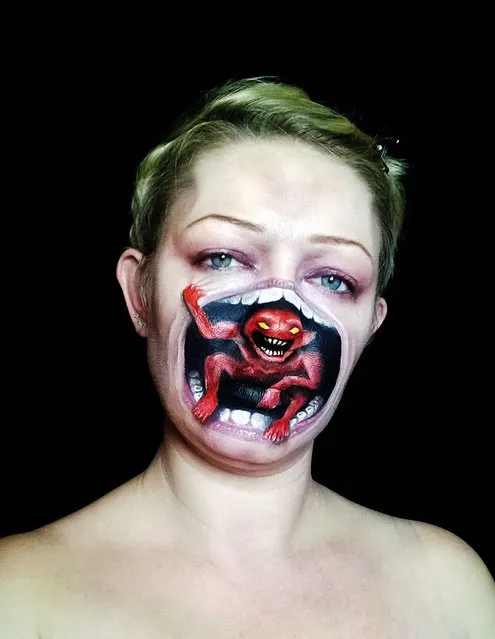
The Devil inside by Nikki Shelley. (Photo by Nikki Shelley/Caters News)

Normally, pictures can be worth a thousand words but these images of some horrifyingly brilliant face paint art will give you the shivers. The fascinating photographs will make your head spin and your stomach churn as the life-like illustrations leave you shocked. Nikki Shelley, 34, from Rugby in Warwickshire, has built a career out of face painting after she started practicing on her children. Here: The Devil inside by Nikki Shelley. (Photo by Nikki Shelley/Caters News)
Details
01 Nov 2015 08:04:00
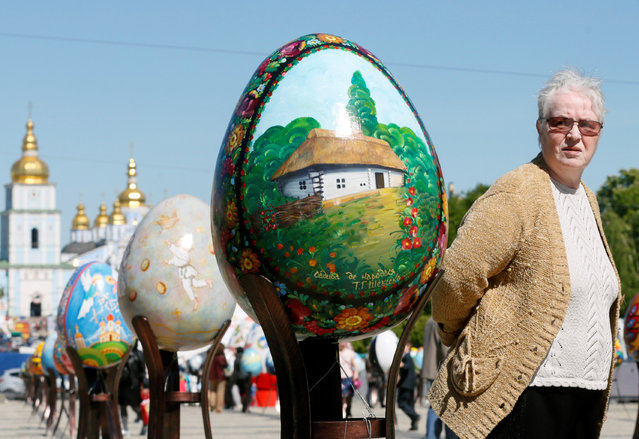
A woman looks at traditional Ukrainian Easter eggs “Pysanka”, installed as part of the upcoming celebrations of Easter, in central Kiev, Ukraine, April 29, 2016. A pysanka is a Ukrainian Easter egg, decorated with traditional Ukrainian folk designs using a wax-resist (batik) method. The word pysanka comes from the verb pysaty, “to write”, as the designs are not painted on, but written with beeswax. Many other eastern European ethnic groups decorate eggs using wax resist for Easter. These include the Belarusians, Bulgarians, Croats, Czechs, Hungarians, Lithuanians, Poles, Romanians, Serbs, Slovaks, Slovenes and Sorbs. (Photo by Valentyn Ogirenko/Reuters)

A woman looks at traditional Ukrainian Easter eggs “Pysanka”, installed as part of the upcoming celebrations of Easter, in central Kiev, Ukraine, April 29, 2016. A pysanka is a Ukrainian Easter egg, decorated with traditional Ukrainian folk designs using a wax-resist (batik) method. The word pysanka comes from the verb pysaty, “to write”, as the designs are not painted on, but written with beeswax. Many other eastern European ethnic groups decorate eggs using wax resist for Easter. These include the Belarusians, Bulgarians, Croats, Czechs, Hungarians, Lithuanians, Poles, Romanians, Serbs, Slovaks, Slovenes and Sorbs. (Photo by Valentyn Ogirenko/Reuters)
Details
30 Apr 2016 09:00:00
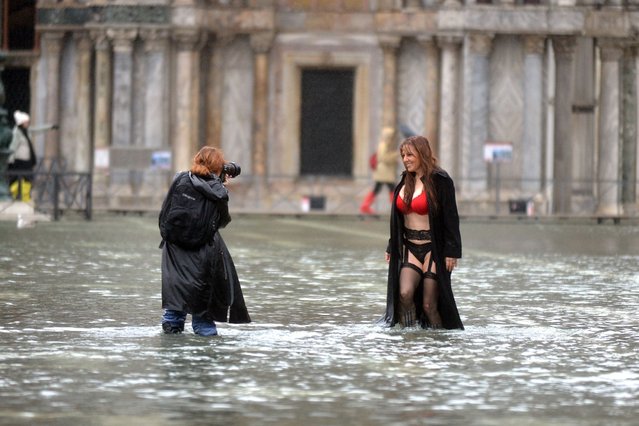
A woman poses on the flooded St. Mark's square during an acqua-alta (high-water) alert in Venice, on November 19, 2013. (Photo by Andrea Pattaro/AFP Photo)

A woman poses on the flooded St. Mark's square during an acqua-alta (high-water) alert in Venice, on November 19, 2013. (Photo by Andrea Pattaro/AFP Photo)

P.S. All pictures, as usual, are presented in high resolution. To see Hi-Res images – just TWICE click on any picture. In other words, click small picture – opens the BIG picture. Click BIG picture – opens VERY BIG picture (if available; this principle works anywhere on the site AvaxNews).
Details
23 Nov 2013 11:21:00
“For a bouquet of flowers”. Photographs made ​​in the last hours of the day. A goat is directed by a dangerous way to eat a small bouquet of flowers. Location: España, Barcelona, Montserrat. (Photo and caption by Renato Lopez Baldo/National Geographic Traveler Photo Contest)

“For a bouquet of flowers”. Photographs made ​​in the last hours of the day. A goat is directed by a dangerous way to eat a small bouquet of flowers. Location: España, Barcelona, Montserrat. (Photo and caption by Renato Lopez Baldo/National Geographic Traveler Photo Contest)

ATTENTION! All pictures are presented in high resolution. To see Hi-Res images – just TWICE click on any picture. In other words, click small picture – opens the BIG picture. Click BIG picture – opens VERY BIG picture.
Details
25 Jun 2013 12:51:00
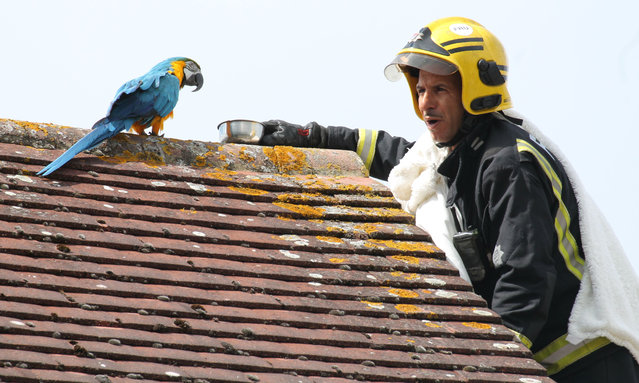
A parrot stuck on a roof for three days greeted firefighters sent to its aid on August 13, 2018 with a four-letter tirade. Jessie, the multi-lingual Macaw, flipped the bird after escaping from her owner's home in Edmonton, north London, UK. When she could not be lured down from a neighbour's roof, firefighters were called out and told to tell the bird “I love you” – to which Jessie replied “I love you back”. But she then ruffled her would-be rescuers' feathers by telling them to “f**k off” before flying off to another nearby rooftop. The foul-mouthed pet also speaks Turkish and Greek according to its owner, but had its own choice words in English for the rescue team. As Jessie wasn't injured, the firefighters, who had been called in by the RSPCA, left her on her perch. The parrot was later reunited with its owner. (Photo by Rex Features/Shutterstock)

A parrot stuck on a roof for three days greeted firefighters sent to its aid on August 13, 2018 with a four-letter tirade. Jessie, the multi-lingual Macaw, flipped the bird after escaping from her owner's home in Edmonton, north London, UK. When she could not be lured down from a neighbour's roof, firefighters were called out and told to tell the bird “I love you” – to which Jessie replied “I love you back”. But she then ruffled her would-be rescuers' feathers by telling them to “f**k off” before flying off to another nearby rooftop. The foul-mouthed pet also speaks Turkish and Greek according to its owner, but had its own choice words in English for the rescue team. As Jessie wasn't injured, the firefighters, who had been called in by the RSPCA, left her on her perch. The parrot was later reunited with its owner. (Photo by Rex Features/Shutterstock)
Details
14 Aug 2018 08:23:00


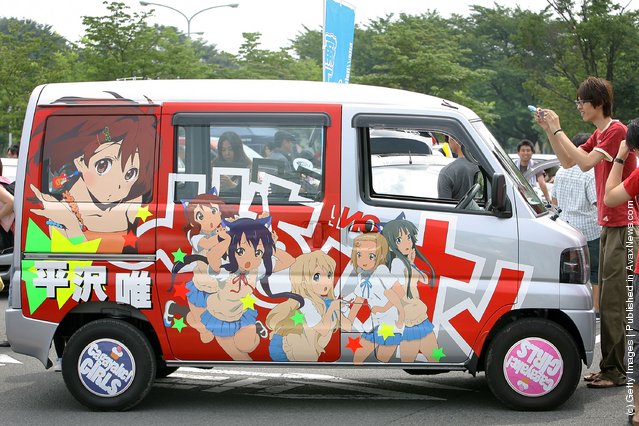
“Itasha (痛車), literally “painmobile”, is a Japanese term for an otaku fad of individuals decorating the bodies of their cars with fictional characters of anime, manga, or video games (especially bishōjo game or eroge). These characters are predominately “cute” female. The decorations usually involve paint schemes and stickers. Automobiles are called Itasha, while similar motorcycles and bicycles are called itansha (痛単車) and itachari (痛チャリ), respectively”. – Wikipedia


Photo: A visitor takes pictures of an anime-decorated «Itasha» car displayed during the “Moe Fes in Washimiya” at Washimiya Town Hall on July 18, 2009 in Washimiya, Saitama, Japan. Itasha, a word derived from “itai” (painful) and “sha” (car), are vehicles decorated with mostly female characters from Japanese manga, anime and video games. (Photo by Kiyoshi Ota/Getty Images)
Details
02 May 2011 08:38:00
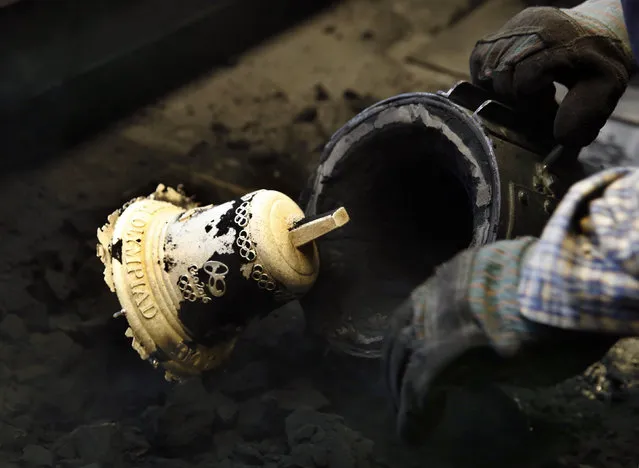
Serge Huguenin of the Blondeau foundry takes the newly melted bell out of the mould in La Chaux-de-Fonds, Switzerland January 21, 2016. At this year's Summer Olympics in Rio de Janeiro, no matter how elaborate the opening ceremony or how sophisticated the live broadcasts, the final lap of athletics races will be announced the traditional way by ringing an old-fashioned bell. (Photo by Denis Balibouse/Reuters)

Serge Huguenin of the Blondeau foundry takes the newly melted bell out of the mould in La Chaux-de-Fonds, Switzerland January 21, 2016. At this year's Summer Olympics in Rio de Janeiro, no matter how elaborate the opening ceremony or how sophisticated the live broadcasts, the final lap of athletics races will be announced the traditional way by ringing an old-fashioned bell. Omega, the official timekeeper of the event, has ordered 21 bells, forged almost entirely by hand by Blondeau's Bell Foundry in the Jura Mountains in Switzerland. Each last-lap bell is branded with the RIO 2016 logo and circled with the words “2016 GAMES OF THE XXXI OLYMPIAD”. (Photo by Denis Balibouse/Reuters)
Details
02 Feb 2016 13:51:00