Loading...
Done
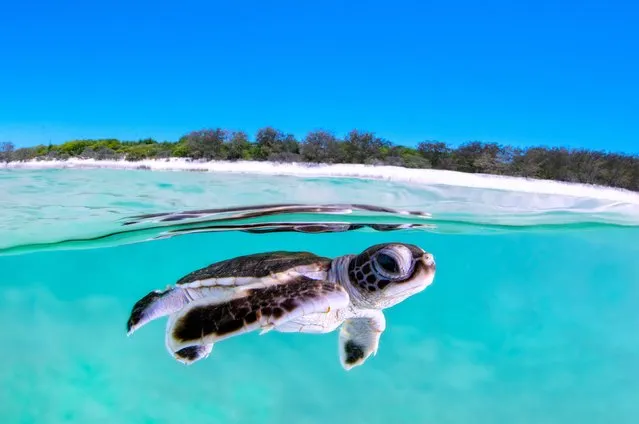
A baby turtle's perilous first moments are captured as it takes to the sea for the first time on Heron Island in Queensland, Australia in July 2022. Predators such as sharks, birds, and pollution mean that approximately only one out of every 1000 turtles that hatch make it to adulthood, with some not even reaching open ocean. Amateur photographer (Photo by Hannah Mitchell/Solent News & Photo Agency)

A baby turtle's perilous first moments are captured as it takes to the sea for the first time on Heron Island in Queensland, Australia in July 2022. Predators such as sharks, birds, and pollution mean that approximately only one out of every 1000 turtles that hatch make it to adulthood, with some not even reaching open ocean. Amateur photographer (Photo by Hannah Mitchell/Solent News & Photo Agency)
Details
06 Oct 2023 04:29:00
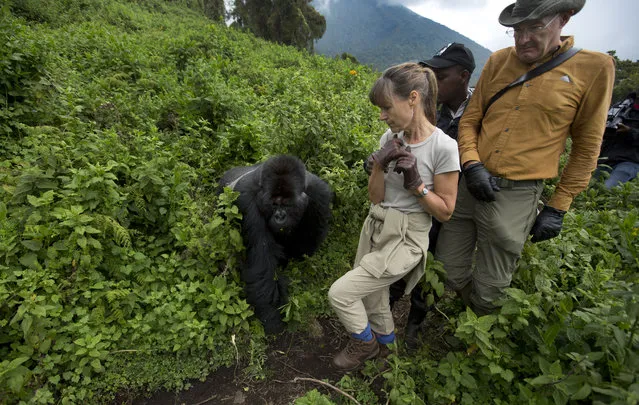
In this photo taken Friday, September 4, 2015, tourists Sarah and John Scott from Worcester, England, take a step back as a male silverback mountain gorilla from the family of mountain gorillas named Amahoro, which means “peace” in the Rwandan language, unexpectedly steps out from the bush to cross their path in the dense forest on the slopes of Mount Bisoke volcano in Volcanoes National Park, northern Rwanda. (Photo by Ben Curtis/AP Photo)

In this photo taken Friday, September 4, 2015, tourists Sarah and John Scott from Worcester, England, take a step back as a male silverback mountain gorilla from the family of mountain gorillas named Amahoro, which means “peace” in the Rwandan language, unexpectedly steps out from the bush to cross their path in the dense forest on the slopes of Mount Bisoke volcano in Volcanoes National Park, northern Rwanda. Deep in Rwanda's steep-sloped forest, increasing numbers of tourists are heading to see the mountain gorillas, a subspecies whose total population is an estimated 900 and who also live in neighboring Uganda and Congo, fueling an industry seen as key to the welfare of the critically endangered species as well as Rwanda's economy. (Photo by Ben Curtis/AP Photo)
Details
18 Sep 2015 14:55:00
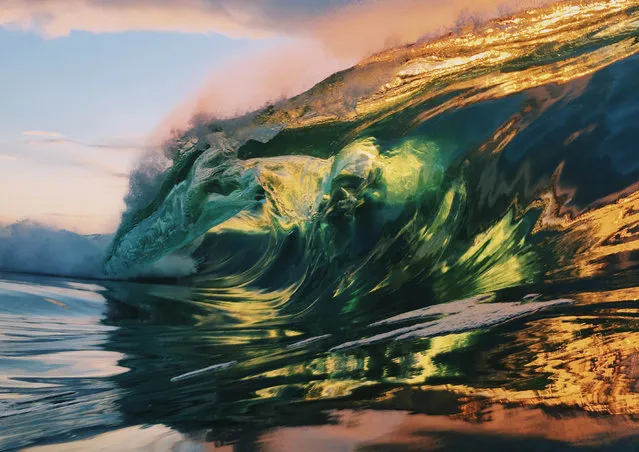
“Whether that means getting up way before the sun, like I do most days, going out somewhere that I’m not comfortable or just trying to get different angles or styles of photos, I am trying to display the crazy beauty of the ocean, and usually moments that literally last less than a split second”. (Photo by Ryan Pernoski/Caters News Agency)

These kaleidoscopic images are the work of one persistent photographer’s efforts to capture vibrant hues at the exact moment a wave breaks. Ryan Pernofski‘s stunning shots feature brilliant yellows, reds, blues and purples as an array of sunlight hits the water at the perfect time. What’s even more impressive: Ryan, a 27-year-old Australian, began shooting his popular masterpieces without using a professional camera, taking his iPhone out into the water instead. Ryan began experimenting with this method in 2012, using an underwater housing to protect his phone, as he could not afford a professional camera. (Photo by Ryan Pernoski/Caters News Agency)
Details
09 Jun 2018 00:05:00
Polar Bear club swimmers take their annual swim in the sea at Coney Island in New York City on January 1, 2014. (Photo by Curtis Means/ACE/INFphoto.com)

Polar Bear club swimmers take their annual swim in the sea at Coney Island in New York City on January 1, 2014. (Photo by Curtis Means/ACE/INFphoto.com)
Details
03 Jan 2014 10:38:00
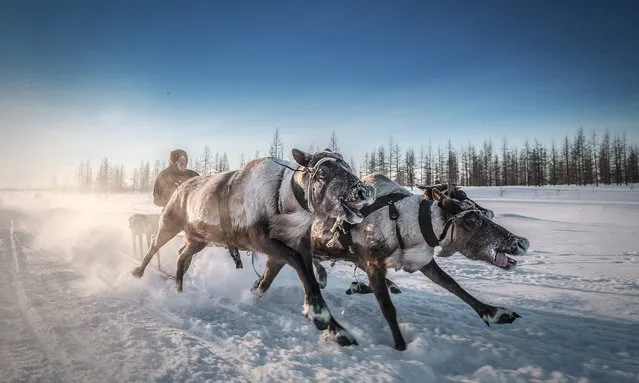
Take me away, deer, Russia. The Nenet people of Arctic Russia use reindeer and sledges as a prime mode of transport. The animals’ navigational ability means that in severe conditions they are sometimes the only hope of survival. (Photo by Kamil Nureev/Smithsonian Photo Contest)

Take me away, deer, Russia. The Nenet people of Arctic Russia use reindeer and sledges as a prime mode of transport. The animals’ navigational ability means that in severe conditions they are sometimes the only hope of survival. (Photo by Kamil Nureev/Smithsonian Photo Contest)
Details
06 Mar 2017 00:05:00
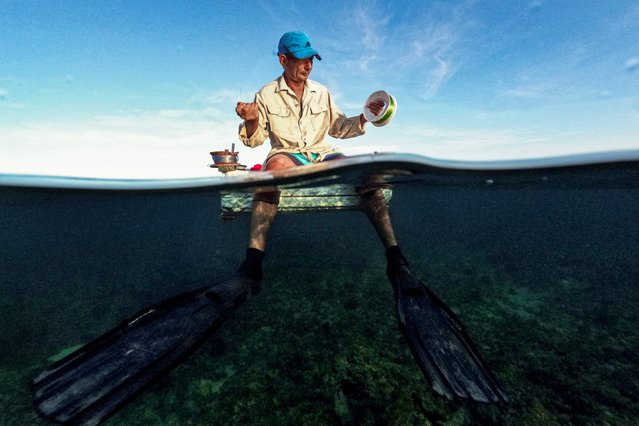
A Cuban fisherman prepares to fish in a makeshift raft in Havana Bay on July 16, 2024. When the weather permits, artisanal fishermen take to the water in improvised polystyrene rafts to make up for the lack of means and fuel. (Photo by Yamil Lage/AFP Photo)

A Cuban fisherman prepares to fish in a makeshift raft in Havana Bay on July 16, 2024. When the weather permits, artisanal fishermen take to the water in improvised polystyrene rafts to make up for the lack of means and fuel. (Photo by Yamil Lage/AFP Photo)
Details
10 Sep 2024 03:48:00
“Business-class” cabins are seen at First Cabin hotel, which was converted from an old office building, in Tokyo, July 3, 2015. Record tourists to Japan are stretching the ability of hotels to accommodate them in a sector constrained by high costs, forcing developers to think out of the box for means to quickly increase lodging options without breaking the bank. (Photo by Toru Hanai/Reuters)

“Business-class” cabins are seen at First Cabin hotel, which was converted from an old office building, in Tokyo, July 3, 2015. Record tourists to Japan are stretching the ability of hotels to accommodate them in a sector constrained by high costs, forcing developers to think out of the box for means to quickly increase lodging options without breaking the bank. (Photo by Toru Hanai/Reuters)
Details
31 Jul 2015 10:57:00
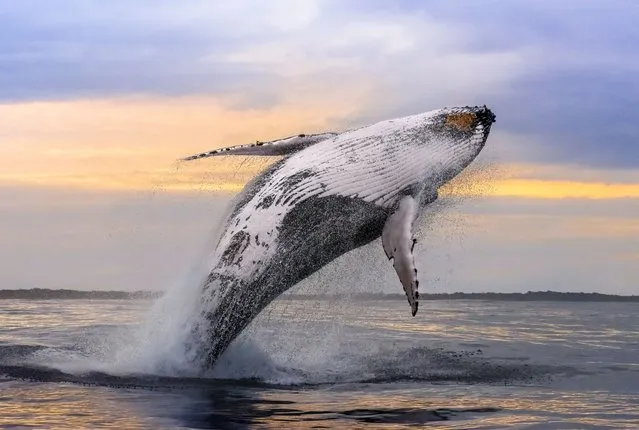
A 40-tonne humpback launching out of the water in an incredible breach in New South Wales, Australia on October 2022 in front of a sunset. The humpback whale can grow up to 56 feet long and typically covers 9,900 miles a year as it travels through the oceans of the world. Humpback whales are a species of Baleen whale, meaning they don't have teeth. Instead, they have baleen which helps them to filter feed. Their main source of food is krill or tiny bait fish. (Photo by Jodie Lowe/Media Drum Images)

A 40-tonne humpback launching out of the water in an incredible breach in New South Wales, Australia on October 2022 in front of a sunset. The humpback whale can grow up to 56 feet long and typically covers 9,900 miles a year as it travels through the oceans of the world. Humpback whales are a species of Baleen whale, meaning they don't have teeth. Instead, they have baleen which helps them to filter feed. Their main source of food is krill or tiny bait fish. (Photo by Jodie Lowe/Media Drum Images)
Details
30 Oct 2022 04:28:00