Loading...
Done
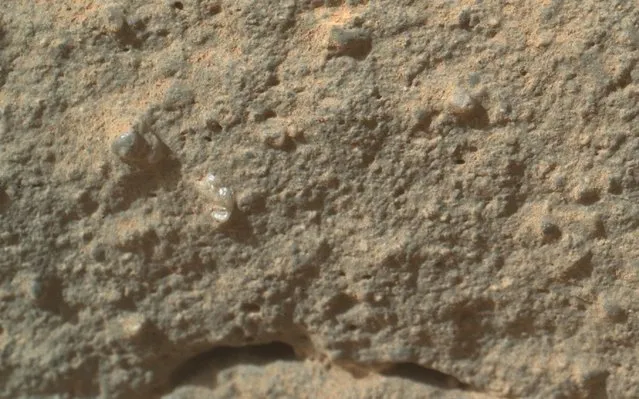
Scientists say that a “Martian flower”, seen here in an image from the Curiosity rover's Mars Hand Lens Imager, is a 2-millimeter-wide grain or pebble that's embedded in the surrounding rock. Another, darker-colored mineral grain can be seen above and to the left. (Photo by NASA)

“The scientists behind NASA's $2.5 billion Curiosity rover mission on Mars on Tuesday explained the nature of a tiny, gleaming "flower" embedded in Red Planet rock, and revealed where they'll be using the SUV-sized robot's drill for the first time”. – Alan Boyle via NBCNews.com

Photo: Scientists say that a “Martian flower”, seen here in an image from the Curiosity rover's Mars Hand Lens Imager, is a 2-millimeter-wide grain or pebble that's embedded in the surrounding rock. Another, darker-colored mineral grain can be seen above and to the left. (Photo by NASA)
Details
16 Jan 2013 11:12:00
First lady Michelle Obama (R), joined by daughters Sasha Obama (C) and Malia Obama, is presented with the official White House Christmas Tree

First lady Michelle Obama (R), joined by daughters Sasha Obama (C) and Malia Obama, is presented with the official White House Christmas Tree on November 25, 2011 in Washington, DC. The tree, a 19-foot-tall balsam fir, was grown on Schroeder's Forevergreens farm near Neshkoro, Wisconsin. (Photo by Brendan Hoffman/Getty Images)
Details
26 Nov 2011 13:06:00


Flowers are placed on actress Elizabeth Taylor's Star on the Hollywood Walk of Fame on March 23, 2011 in Hollywood, California. The Academy Award winning actress died Wednesday at age 79. (Photo by Charley Gallay/Getty Images)
Details
24 Mar 2011 12:42:00
A white Bengal tiger cub born in captivity is seen during a press presentation at Huachipa's private zoo in Lima, Peru, March 16, 2016. (Photo by Mariana Bazo/Reuters)

A white Bengal tiger cub born in captivity is seen during a press presentation at Huachipa's private zoo in Lima, Peru, March 16, 2016. (Photo by Mariana Bazo/Reuters)
Details
18 Mar 2016 12:19:00


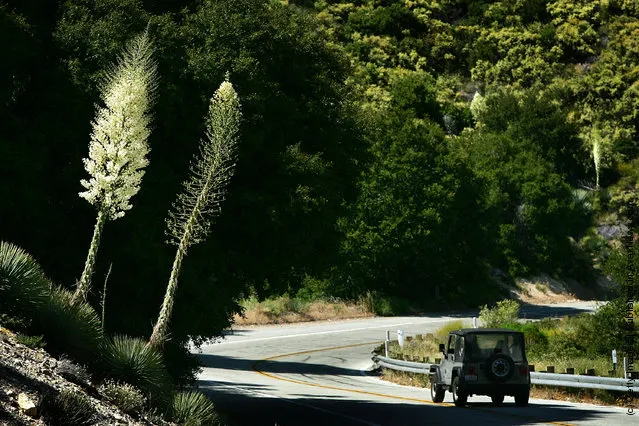
“Yucca is a genus of perennial shrubs and trees in the agave family, Agavaceae. Its 40-50 species are notable for their rosettes of evergreen, tough, sword-shaped leaves and large terminal panicles of white or whitish flowers. They are native to the hot and dry (arid) parts of North America, Central America, South America, and the Caribbean. Early reports of the species were confused with the cassava (Manihot esculenta). Consequently, Linnaeus mistakenly derived the generic name from the Carib word for the latter, yuca. It is also colloquially known in the midwest United States as “Ghosts in the graveyard”, as it is commonly found growing in rural graveyards and when in bloom the flowers appear as an apparition floating.” – Wikipedia

Photo: A yucca standing among flowers bursts forth a very large stalk of flowers as a heavy wildflower bloom on June 21, 2005 in the Angeles National Forest northwest of La Canada, California. (Photo by David McNew/Getty Images)
Details
29 Mar 2011 07:31:00
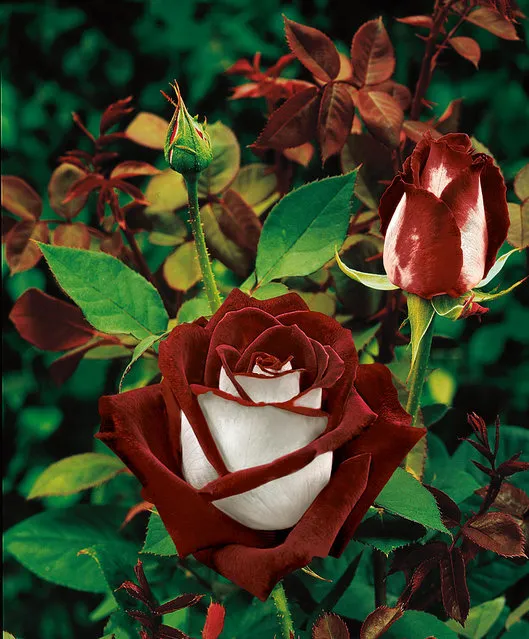
Rosa Osiria

Standard Rose 'Osiria' distinguishes itself from other roses due to its nicely-shaped and attractive flowers. This well-known fragrant floribunda rose is now available as a colourful standard. This very striking rose has an unusual colour combination. The petals are flaming red on the inside and white on the outside.
Details
12 Aug 2013 08:21:00
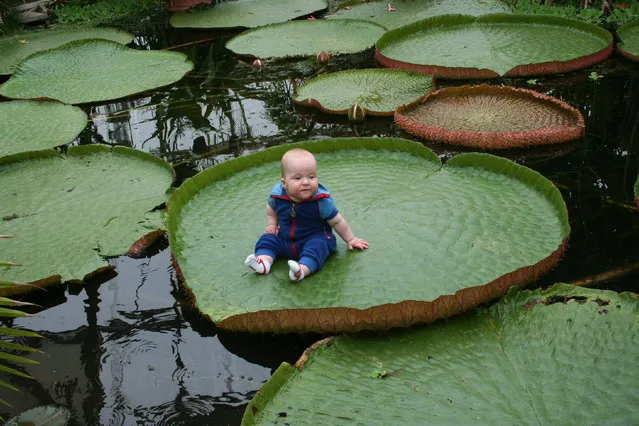
Victoria amazonica

The species has very large leaves, up to 3 m in diameter, that float on the water's surface on a submerged stalk, 7–8 m in length. The species was once called Victoria regia after Queen Victoria, but the name was superseded. V. amazonica is native to the shallow waters of the Amazon River basin, such as oxbow lakes and bayous. It is depicted in the Guyanese coat of arms. The flowers are white the first night they are open and become pink the second night. They are up to 40 cm in diameter, and are pollinated by beetles.
Details
03 Sep 2012 06:58:00
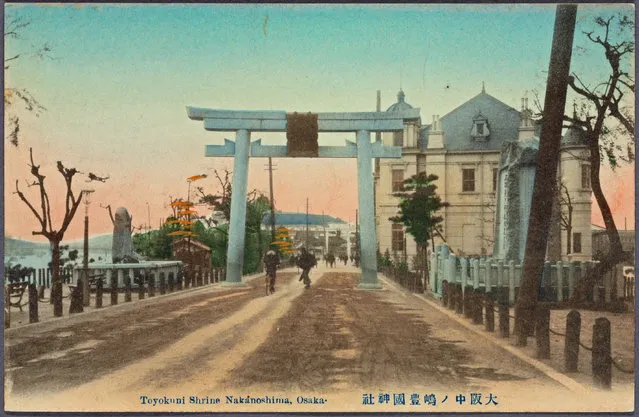
Toyokuni Shrine Nakanoshima, Osaka, Japan. (Photo by New York Public Library/Caters News)

These timeless postcards offer an eye-opening glimpse into life in Japan in the early 20th century. Taken from hand-colored photographs, the postcards showcase the still beauty of the country, depicting a nation on the cusp of modernization. The images feature solemn fishermen, bustling streets, temples and shrines: a country yet to be influenced by Western culture. The tinting effect brings out the rich colors of the natural surroundings, with trees, flowers and cherry blossoms jumping from the original black-and-white images. Here: Toyokuni Shrine Nakanoshima, Osaka, Japan. (Photo by New York Public Library/Caters News)
Details
02 Apr 2016 09:33:00