Loading...
Done
Sharks fed by Vincent Canabal near Tiger Beach. (Photo by Vincent Canabal/Barcroft Media)

“It doesn’t look like a relaxing swim in the warm waters of the Bahamas. But for Vincent Canabal it is all in a days work when it comes to feeding his favourite a 16-foot long Tiger shark Emma. The 34-year-old qualified doctor has been diving with sharks since he was just. His passion has taken him around the world”. Barcroft Media via The Daily Mirror. Photo: Sharks fed by Vincent Canabal near Tiger Beach. (Photo by Vincent Canabal/Barcroft Media)
Details
15 Dec 2013 10:10:00
A Comb jelly – Beroe cucumis. (Photo by Alexander Semenovs/Caters News)

Underwater photographer Alexander Semenovs has snapped some of the most stunning, fragile life forms anywhere on planet Earth. Shot in deep, dark conditions, the images continue to provide an insight into what lies beneath, with glowing creatures appearing a lot like aliens in the pitch-black water. Semenovs has shot the likes of bioluminescent jellyfish, aggressive-looking worms and many species that leave a lot to the imagination. The 30-year-old from Moscow does the majority of his work in the White Sea, near the Arctic Circle. Here: A Comb jelly – Beroe cucumis. (Photo by Alexander Semenovs/Caters News)
Details
23 Nov 2015 08:06:00
Mira Saville, 11, spins in her petticoat on the sand at the Nashuva Spiritual Community Jewish New Year celebration on Venice Beach in Los Angeles, California, United States September 14, 2015. (Photo by Lucy Nicholson/Reuters)

Mira Saville, 11, spins in her petticoat on the sand at the Nashuva Spiritual Community Jewish New Year celebration on Venice Beach in Los Angeles, California, United States September 14, 2015. As Jews take part in the Tashlich prayer, a Rosh Hashanah ritual, bread crumbs are tossed into the waters to symbolically cast away sins. (Photo by Lucy Nicholson/Reuters)
Details
16 Sep 2015 13:36:00
A man holds on a rope as he tries to board a truck while crossing floodwaters brought by typhoon Koppu that battered Candaba town, Pampanga province, north of Manila October 20, 2015. (Photo by Romeo Ranoco/Reuters)

A man holds on a rope as he tries to board a truck while crossing floodwaters brought by typhoon Koppu that battered Candaba town, Pampanga province, north of Manila October 20, 2015. Typhoon Koppu swept across the northern Philippines killing at least nine people as trees, power lines and walls were toppled and flood waters spread far from riverbeds, but tens of thousands of people were evacuated in time. (Photo by Romeo Ranoco/Reuters)
Details
22 Oct 2015 08:06:00
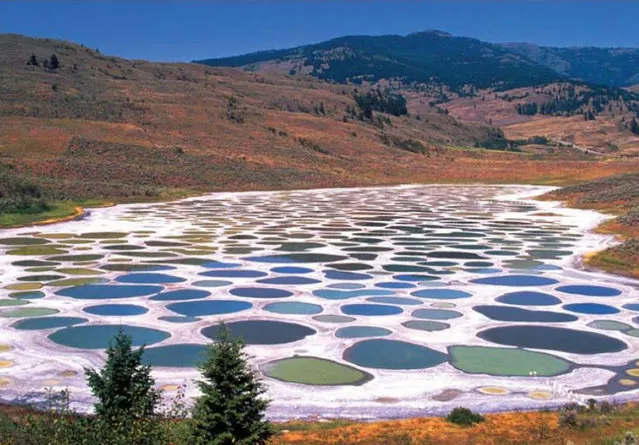
Kliluk, the Spotted Lake, Canada

Originally known to the First Nations of the Okanagan Valley as Khiluk, which was- and remains today revered as a sacred site producing therapeutic waters. During World War I the minerals of Spotted Lake were used in manufacturing ammunition. Later the area came under the control of the Ernest Smith Family, for a term of about 40 years. In 1979 Smith attempted to create interest in a spa at the lake. The First Nations responded with an effort to buy the lake; in October 2001 they finally struck a deal. First Nations arranged the purchase of 22 hectares of land for a total of $720,000, and contributed about 20% of the cost. The Indian Affairs Department paid the remainder.
Details
06 Mar 2015 12:59:00
The Dubai Fountain

The Dubai Fountain is a record-setting choreographed fountain system set on the 30-acre manmade Burj Khalifa Lake, at the center of the Downtown Dubai development in Dubai, United Arab Emirates. It was designed by WET Design, the California-based company responsible for the fountains at the Bellagio Hotel Lake in Las Vegas. Illuminated by 6,600 lights and 25 colored projectors, it is 275 m (902 ft) long and shoots water 240 feet into the air accompanied by a range of classical to contemporary Arabic and world music. It was built at a cost of AED 800 million (USD 218 million).
Details
08 Jun 2015 10:55:00
Leafy sea dragon

The leafy seadragon or Glauert's seadragon, Phycodurus eques, is a marine fish in the family Syngnathidae, which also includes the seahorses. It is the only member of the genus Phycodurus. It is found along the southern and western coasts of Australia. The name is derived from the appearance, with long leaf-like protrusions coming from all over the body. These protrusions are not used for propulsion; they serve only as camouflage. The leafy seadragon propels itself by means of a pectoral fin on the ridge of its neck and a dorsal fin on its back closer to the tail end. These small fins are almost completely transparent and difficult to see as they undulate minutely to move the creature sedately through the water, completing the illusion of floating seaweed.
Details
05 Sep 2012 08:51:00
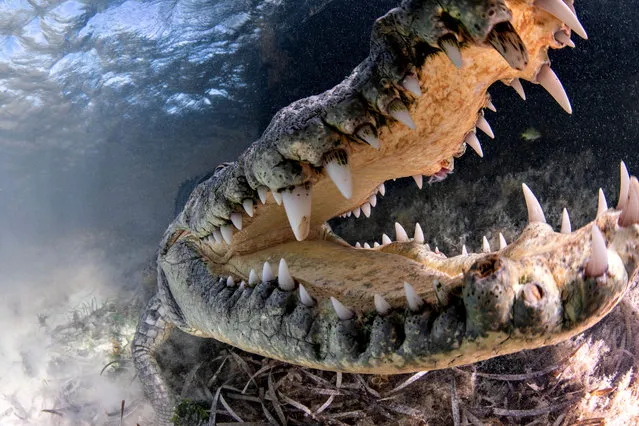
The trip to get to the reef takes eight hours by car and boat, and there is no luxury hotel at the other end. (Photo by Alex Suh/Caters News Agency)

A photographer with a passion for wild animals was able to get up close and personal with one of nature’s deadliest creatures. Alex Suh has traveled to Mexico’s Banco Chinchorro reef twice in the past three years to get into the waters and capture the crocodiles in their natural habitat after an invitation from Yucatan Dive Trek. (Photo by Alex Suh/Caters News Agency)
Details
24 Aug 2018 00:01:00