Loading...
Done
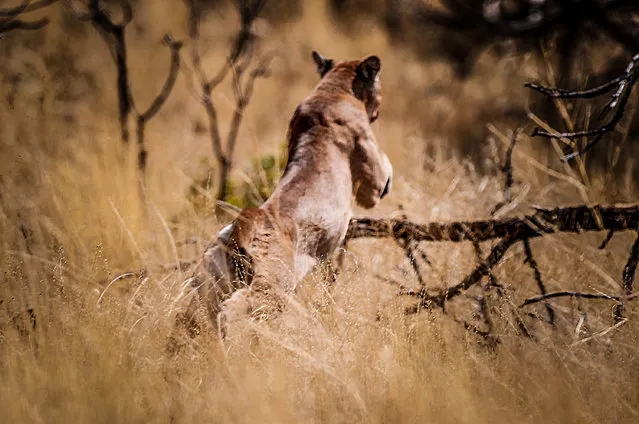
In this Monday, September 22, 2014 photo provided by the Utah Division of Wildlife Resources, a young  cougar is released back into Utah's mountains by the Utah Division of Wildlife Resources in an undisclosed site in central Utah. (Photo by Steve Gray/AP Photo/Utah Division of Wildlife Resources)

In this Monday, September 22, 2014 photo provided by the Utah Division of Wildlife Resources, a young cougar is released back into Utah's mountains by the Utah Division of Wildlife Resources in an undisclosed site in central Utah. State wildlife officials received reports of the cougar roaming Sunday afternoon in a residential area of the city's eastern flank, a few miles from the base of the Wasatch Mountains. Authorities say cougars generally avoid humans but sometimes enter neighborhoods close to their mountain habitats. (Photo by Steve Gray/AP Photo/Utah Division of Wildlife Resources)
Details
27 Sep 2014 12:32:00
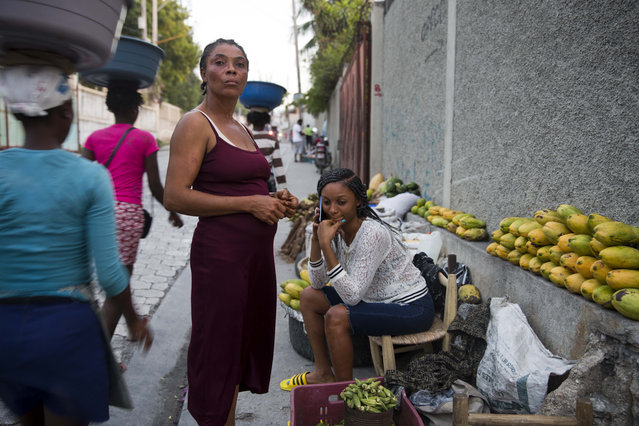
In this November 27, 2019 photo, Wadlande Pierre, right, talks on her mobile phone as she helps her mother, Vanlancia Julien, center, at their fruit and vegetable stand on a sidewalk in Delmas, a district of in Port-au-Prince, Haiti. Pierre, 23, said she temporarily moved in with her aunt in the southwest town of Les Cayes to escape the violent protests in Port-au-Prince. However, she had to move back to the capital because there was no gas, power or water in Les Cayes, and food was becoming scarce. (Photo by Dieu Nalio Chery/AP Photo)

In this November 27, 2019 photo, Wadlande Pierre, right, talks on her mobile phone as she helps her mother, Vanlancia Julien, center, at their fruit and vegetable stand on a sidewalk in Delmas, a district of in Port-au-Prince, Haiti. Pierre, 23, said she temporarily moved in with her aunt in the southwest town of Les Cayes to escape the violent protests in Port-au-Prince. However, she had to move back to the capital because there was no gas, power or water in Les Cayes, and food was becoming scarce. (Photo by Dieu Nalio Chery/AP Photo)
Details
01 Feb 2020 00:05:00
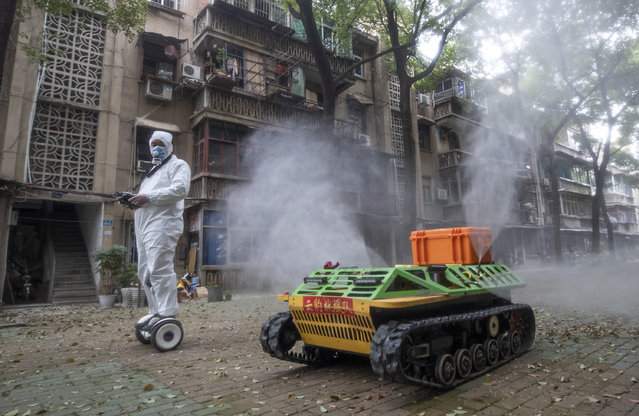
A volunteer operates a remote controlled disinfection robot to disinfect a residental area amid the COVID-19 coronavirus outbreak in Wuhan in China's central Hubei province on March 16, 2020. China tightened quarantine measures for international arrivals on March 16 as the country worries about a rise in imported cases of the deadly coronavirus and anger rages online at how Europe and the United States are handling the pandemic. (Photo by AFP Photo/China Stringer Network)

A volunteer operates a remote controlled disinfection robot to disinfect a residental area amid the COVID-19 coronavirus outbreak in Wuhan in China's central Hubei province on March 16, 2020. China tightened quarantine measures for international arrivals on March 16 as the country worries about a rise in imported cases of the deadly coronavirus and anger rages online at how Europe and the United States are handling the pandemic. (Photo by AFP Photo/China Stringer Network)
Details
18 Mar 2020 00:07:00
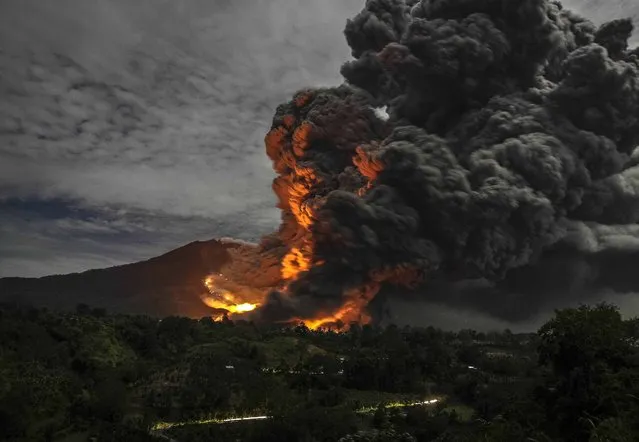
Mount Sinabung volcano erupts, as seen from Tiga Pancur village, Karo Regency in Indonesia's North Sumatra province October 8, 2014. (Photo by Y. T. Haryono/Reuters)

Mount Sinabung volcano erupts, as seen from Tiga Pancur village, Karo Regency in Indonesia's North Sumatra province October 8, 2014. (Photo by Y. T. Haryono/Reuters)
Details
11 Oct 2014 13:23:00
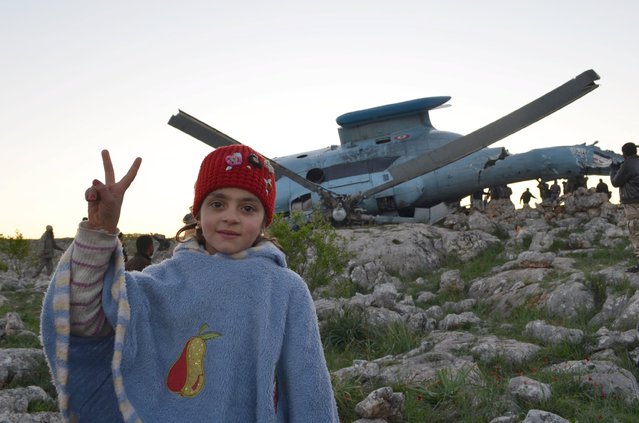
A girl flashes a victory sign as she poses near a helicopter that belongs to forces loyal to Syria's President Bashar Al-Assad after it crashed in Jabal al-Zawiya in the southern countryside of Idlib  March 22, 2015. (Photo by Abed Kontar/Reuters)

A girl flashes a victory sign as she poses near a helicopter that belongs to forces loyal to Syria's President Bashar Al-Assad after it crashed in Jabal al-Zawiya in the southern countryside of Idlib March 22, 2015. The Syrian military helicopter crashed in northwestern Syria on Sunday and at least four of its crew were captured by rebels, according to a monitoring group. (Photo by Abed Kontar/Reuters)
Details
28 Mar 2015 11:34:00
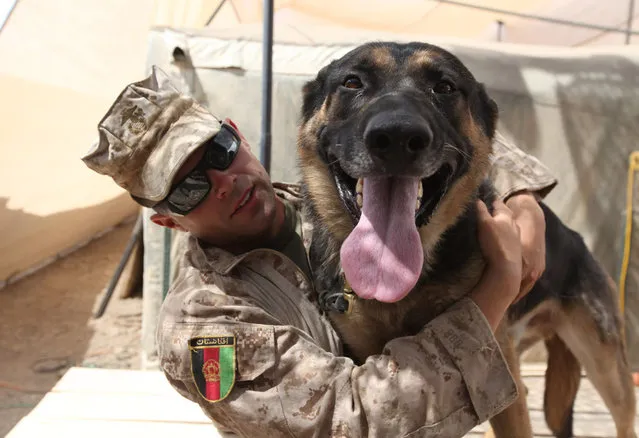
Afghanistan: Dogs of War Part 1

Throughout the course of the long war in Afghanistan, Coalition troops have relied on thousands of military working dogs to help keep them safe, and make their jobs easier. The dogs are trained to detect explosives, to find illegal drugs, to search for missing comrades, or target enemy combatants. Not only are they active on the front lines, but behind the lines they serve as therapy dogs, service dogs, and loyal companions. They also share the same risks as the ground troops, suffering injuries and sometimes death on the battlefields. Gathered here are images of these dogs and their handlers in Afghanistan and back home, from over the past several years, part of the ongoing series here on Afghanistan.
Details
03 Jun 2014 21:02:00
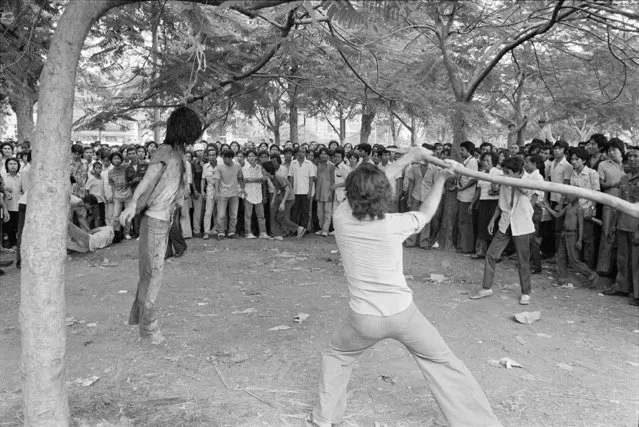
In this October 6, 1976 file photo a member of a Thai political faction strikes at the lifeless body of a hanged student outside Thammasat University in Bangkok Oct. 6, 1976. (Photo by Neal Ulevich/AP Photo)

In this October 6, 1976 file photo a member of a Thai political faction strikes at the lifeless body of a hanged student outside Thammasat University in Bangkok October 6, 1976. For some Thais, the bloody events of October 6, 1976 are still a nightmare. On that day, heavily armed security forces shot up Bangkok's Thammasat University campus and killed scores of students, while right-wing vigilantes captured would-be escapees, subjecting them to ghoulish lynchings. (Photo by Neal Ulevich/AP Photo)
Details
05 Oct 2016 09:22:00
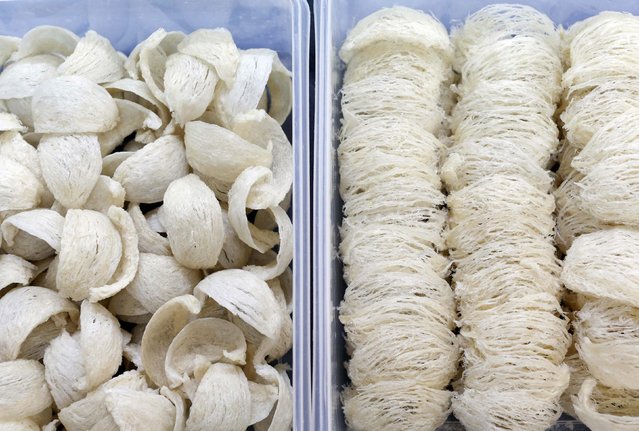
Two styles of cleaned bird's nest, Yan Zhan (L) and Su Zhan (R) await repacking at a processing plant in Kuala Lumpur, February 17, 2015. Prized in China for is alleged health benefits for hundreds of years, nests made from swiftlets' saliva are being mixed into coffee and cereal as the Southeast Asian producers of the delicacy seek to broaden its appeal, and their profit margins. (Photo by Olivia Harris/Reuters)

Two styles of cleaned bird's nest, Yan Zhan (L) and Su Zhan (R) await repacking at a processing plant in Kuala Lumpur, February 17, 2015. Prized in China for is alleged health benefits for hundreds of years, nests made from swiftlets' saliva are being mixed into coffee and cereal as the Southeast Asian producers of the delicacy seek to broaden its appeal, and their profit margins. The nests are among the world's most expensive foods, selling for up to $2,500 a kg and the swiftlets that weave them are indigenous to Indonesia, Malaysia, Thailand and Vietnam. (Photo by Olivia Harris/Reuters)
Details
24 Feb 2015 13:57:00