Loading...
Done
People run away as a building is toppled during a controlled demolition as part of an urban transformation in Ankara, Turkey, February 3, 2014. (Photo by Serap Doganyigit/Reuters)

People run away as a building is toppled during a controlled demolition as part of an urban transformation in Ankara, Turkey, February 3, 2014. (Photo by Serap Doganyigit/Reuters)
Details
29 Mar 2017 09:32:00
Titled 8,100,000 after the price paid for Bal du moulin de la Galette. (Photo by Trina Merry/Caters News)

An innovative artist has camouflaged nude bodies by painting them into the worlds most expensive artworks. New York body artist, Trina Merry picked the 20 top dearest paintings, then photographed naked models disguised as part of the piece. Here: Titled 8,100,000 after the price paid for Bal du moulin de la Galette. (Photo by Trina Merry/Caters News)
Details
03 Jun 2017 06:36:00
“Shanghai Tian Wai №26, 2014”. This series was an attempt to document an ever-changing city and the things it loses, as working-class neighbourhoods give way to ever-more modern urban development. (Photo by Liu Tao/The Guardian)

This 2014 series Shanghai Tian Wa saw Chinese photographer Liu Tao train his lens on two distinct districts in Shanghai. Here: “Shanghai Tian Wai №26, 2014”. (Photo by Liu Tao/The Guardian)
Details
25 May 2018 00:01:00
Soap Bubble Structures by Kym Cox. Bubbles optimise space and minimise their surface area for a given volume of air. This phenomenon makes them a useful tool in many areas of research, in particular, materials science and ‘packing’ – how things fit together. Bubble walls drain under gravity, thin at the top, thick at the bottom, which interferes with travelling lightwaves to create bands of colour. Black spots show the wall is too thin for interference colours, indicating the bubble is about to burst. (Photo by Kym Cox/2019 Science Photographer of the Year/RPS)

Soap Bubble Structures by Kym Cox. Bubbles optimise space and minimise their surface area for a given volume of air. This phenomenon makes them a useful tool in many areas of research, in particular, materials science and “packing” – how things fit together. Bubble walls drain under gravity, thin at the top, thick at the bottom, which interferes with travelling lightwaves to create bands of colour. Black spots show the wall is too thin for interference colours, indicating the bubble is about to burst. (Photo by Kym Cox/2019 Science Photographer of the Year/RPS)
Details
15 Aug 2019 00:03:00
Live fish. Vietnam has the highest number of motorbikes in all of south-east Asia – Hanoi alone has 5m of them, and only half a million cars. Now the city is planning to ban them by 2030 to cut pollution. (Photo by Jon Enoch/The Guardian)

From footballs to live fish, delivery mopeds piled high with unwieldy, unlikely goods are one of the Vietnamese capital’s most distinctive sights. As the city plans to ban motorbikes altogether, photographer Jon Enoch captured the drivers at work. (Photo by Jon Enoch/The Guardian)

Details
11 May 2019 00:05:00
“The sustainable development goals cannot be met unless waste management is addressed as a priority”, says UK waste management charity Waste Aid. “E-waste is one of the fastest growing categories of the 7-10bn tonnes of waste produced globally every year”, adds director Mike Webster. “In our view, decent waste management is a basic right and we want governments around the world take this issue much more seriously – in 2012 only 0.2% of international aid went on improving solid waste management – it’s just not enough”. (Photo by Kai Loeffelbein/laif Agentur)

Sustainable development goal target 12.5 is to reduce waste. But with a planet increasingly dependent on technology, is that even possible? As of today, over 30m tonnes of electronic waste has been thrown out so far this year, according to the World Counts. Most e-waste is sent to landfills in Asia and Africa where it is recycled by hand, exposing the people who do it to environmental hazards. Kai Loeffelbein’s photographs of e-waste recycling in Guiyu, southern China show what happens to discarded computers. (Photo by Kai Loeffelbein/laif Agentur)
Details
19 Oct 2016 12:14:00
Happiness on a Rainy Day by Fardin Oyan, Bangladesh. Winner of the young environmental photographer of the year. Many children in Bangladesh love to bathe and play in the rain. The country, which is flat and occupied by the huge Ganges-Brahmaputra Delta, is exposed to floods, especially during monsoon season. (Photo by Fardin Oyan/2018 Ciwem environmental photographer of the year 2018)

Happiness on a Rainy Day by Fardin Oyan, Bangladesh. Winner of the young environmental photographer of the year. Many children in Bangladesh love to bathe and play in the rain. The country, which is flat and occupied by the huge Ganges-Brahmaputra Delta, is exposed to floods, especially during monsoon season. (Photo by Fardin Oyan/2018 Ciwem environmental photographer of the year 2018)
Details
24 Sep 2018 00:03:00
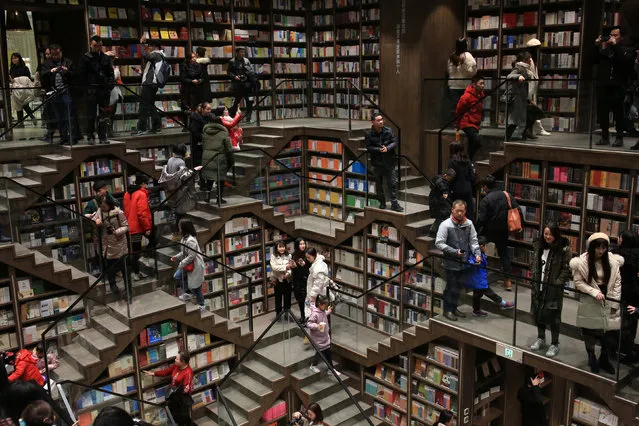
Visitors are seen inside a newly opened bookstore in Chongqing, China on January 29, 2019. Covering an area of 1,400 square meters, the Zhongshuge Bookstore in Chongqing attracts readers with its creative decor. (Photo by Reuters/China Stringer Network)

Visitors are seen inside a newly opened bookstore in Chongqing, China on January 29, 2019. Covering an area of 1,400 square meters, the Zhongshuge Bookstore in Chongqing attracts readers with its creative decor. (Photo by Reuters/China Stringer Network)
Details
31 Jan 2019 10:52:00