Loading...
Done
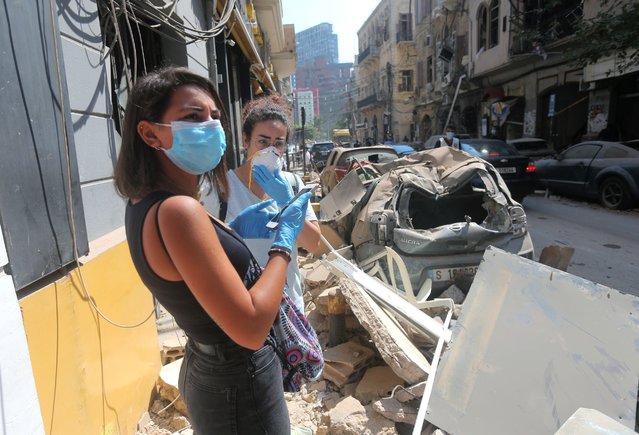
Young Lebanese women wearing protective masks and gloves against the coronavirus pandemic, stand on August 5, 2020 amid the rubble in Beirut's Gimmayzeh commercial district which was heavily damaged by the previous day's powerful explosion that tore through Lebanon's capital, resulting from the ignition of a huge depot of ammonium nitrate at the city's main port. Rescuers searched for survivors in Beirut after a cataclysmic explosion at the port sowed devastation across entire neighbourhoods, killing more than 100 people, wounding thousands and plunging Lebanon deeper into crisis. The blast, which appeared to have been caused by a fire igniting 2,750 tonnes of ammonium nitrate left unsecured in a warehouse, was felt as far away as Cyprus, some 150 miles (240 kilometres) to the northwest. (Photo by AFP Photo/Stringer)

Young Lebanese women wearing protective masks and gloves against the coronavirus pandemic, stand on August 5, 2020 amid the rubble in Beirut's Gimmayzeh commercial district which was heavily damaged by the previous day's powerful explosion that tore through Lebanon's capital, resulting from the ignition of a huge depot of ammonium nitrate at the city's main port. Rescuers searched for survivors in Beirut after a cataclysmic explosion at the port sowed devastation across entire neighbourhoods, killing more than 100 people, wounding thousands and plunging Lebanon deeper into crisis. The blast, which appeared to have been caused by a fire igniting 2,750 tonnes of ammonium nitrate left unsecured in a warehouse, was felt as far away as Cyprus, some 150 miles (240 kilometres) to the northwest. (Photo by AFP Photo/Stringer)
Details
10 Aug 2020 00:05:00
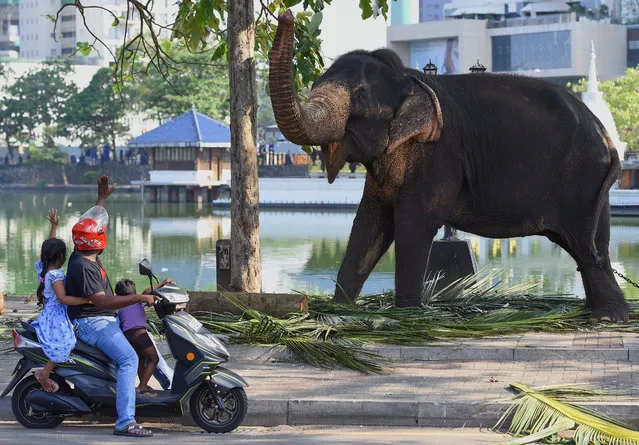
Commuters interact with an elephant as he rests in a public road ahead of the annual Perahera festival of the historic Gangaramaya Temple in Colombo on February 18, 2019. Some 50 elephants, most of them from the central area of Kandy along with thousands of traditional drummers, dancers, and monks have gathered in the Sri Lankan capital to participate in the city's biggest two-day annual Buddhist Navam procession, scheduled for February 18-19. (Photo by Ishara S. Kodikara/AFP Photo)

Commuters interact with an elephant as he rests in a public road ahead of the annual Perahera festival of the historic Gangaramaya Temple in Colombo on February 18, 2019. Some 50 elephants, most of them from the central area of Kandy along with thousands of traditional drummers, dancers, and monks have gathered in the Sri Lankan capital to participate in the city's biggest two-day annual Buddhist Navam procession, scheduled for February 18-19. (Photo by Ishara S. Kodikara/AFP Photo)
Details
18 Jun 2019 00:03:00
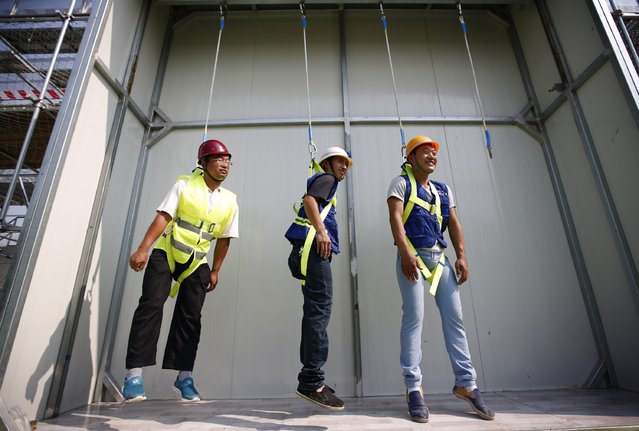
Participants hang from ropes as they learn how to use safety gears at an experience centre for construction safety training in Beijing, September 5, 2014. The centre which opened in June 2014 was established to educate workers about construction safety. According to the centre, about 1,000 construction workers undergo 3-hour classes which comprises of 33 modules every month. (Photo by Kim Kyung-Hoon/Reuters)

Participants hang from ropes as they learn how to use safety gears at an experience centre for construction safety training in Beijing, September 5, 2014. The centre which opened in June 2014 was established to educate workers about construction safety. According to the centre, about 1,000 construction workers undergo 3-hour classes which comprises of 33 modules every month. (Photo by Kim Kyung-Hoon/Reuters)
Details
06 Sep 2014 11:46:00
Athletes from Australia's Olympic team going to the 2016 Olympics in Rio present their uniforms alongside Brazilian Samba dancer Sashya Jay at an official unveiling ceremony at Sydney's Bondi Beach, March 30, 2016. (Photo by Jason Reed/Reuters)

Athletes from Australia's Olympic team going to the 2016 Olympics in Rio present their uniforms alongside Brazilian Samba dancer Sashya Jay at an official unveiling ceremony at Sydney's Bondi Beach, March 30, 2016. (Photo by Jason Reed/Reuters)
Details
31 Mar 2016 11:41:00
Andrea Petkovic of Germany in action against Sara Errani of Italy during day one of the Mutua Madrid Open tennis tournament at the Caja Magica on May 3, 2014 in Madrid, Spain. (Photo by Julian Finney/Getty Images)

Andrea Petkovic of Germany in action against Sara Errani of Italy during day one of the Mutua Madrid Open tennis tournament at the Caja Magica on May 3, 2014 in Madrid, Spain. (Photo by Julian Finney/Getty Images)
Details
10 May 2014 14:22:00
Iranian visitors practice shooting with shooting simulators made in Iran at a police shooting simulation booth at the 19th International Police Security and Safety Equipment Exhibition (IPAS 2022) at the grand Mosalla mosque in Tehran, Iran, on October 20, 2022. (Photo by Rouzbeh Fouladi/Avalon)

Iranian visitors practice shooting with shooting simulators made in Iran at a police shooting simulation booth at the 19th International Police Security and Safety Equipment Exhibition (IPAS 2022) at the grand Mosalla mosque in Tehran, Iran, on October 20, 2022. (Photo by Rouzbeh Fouladi/Avalon)
Details
29 Oct 2022 04:00:00
Festival goers kiss in the “Silent Disco” at the “Music in the Park” stage during the 50th Montreux Jazz Festival, in Montreux, Switzerland, July 9, 2016. (Photo by Anthony Anex/EPA)

Festival goers kiss in the “Silent Disco” at the “Music in the Park” stage during the 50th Montreux Jazz Festival, in Montreux, Switzerland, July 9, 2016. (Photo by Anthony Anex/EPA)
Details
11 Jul 2016 12:49:00
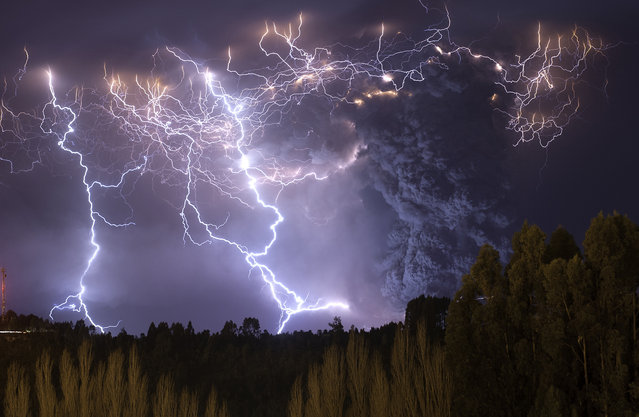
The eruption of Cordon Caulle began on June 4, 2011, located in the Region of Los Rios in Chile. For about 12 months, people and animals became accustomed to living with the daily fall of ash, which also caused problems in the air traffic in South America. The explosions and lightning during first days of the eruption could be seen from hundreds of miles around. This photograph was taken on the second night of eruption from the town of Lago Ranco. (Photo and caption by Francisco Negroni/National Geographic Traveler Photo Contest)

The eruption of Cordon Caulle began on June 4, 2011, located in the Region of Los Rios in Chile. For about 12 months, people and animals became accustomed to living with the daily fall of ash, which also caused problems in the air traffic in South America. The explosions and lightning during first days of the eruption could be seen from hundreds of miles around. This photograph was taken on the second night of eruption from the town of Lago Ranco. (Photo and caption by Francisco Negroni/National Geographic Traveler Photo Contest)

ATTENTION! All pictures are presented in high resolution. To see Hi-Res images – just TWICE click on any picture. In other words, click small picture – opens the BIG picture. Click BIG picture – opens VERY BIG picture.
Details
23 Jun 2013 11:24:00