Loading...
Done
Costume details featuring Joao Candido, a black sailor who led a revolt against the physical punishment of Brazilian Navy soldiers at the beginning of the 20th century, lie inside the Paraíso do Tuiuti Samba school at the Samba City complex in Rio de Janeiro, Brazil, Tuesday, January 16, 2024. Samba schools are gearing up for this year's Carnival, scheduled from Feb. 9-17. (Photo by Bruna Prado/AP Photo)

Costume details featuring Joao Candido, a black sailor who led a revolt against the physical punishment of Brazilian Navy soldiers at the beginning of the 20th century, lie inside the Paraíso do Tuiuti Samba school at the Samba City complex in Rio de Janeiro, Brazil, Tuesday, January 16, 2024. Samba schools are gearing up for this year's Carnival, scheduled from Feb. 9-17. (Photo by Bruna Prado/AP Photo)
Details
05 Apr 2025 02:24:00


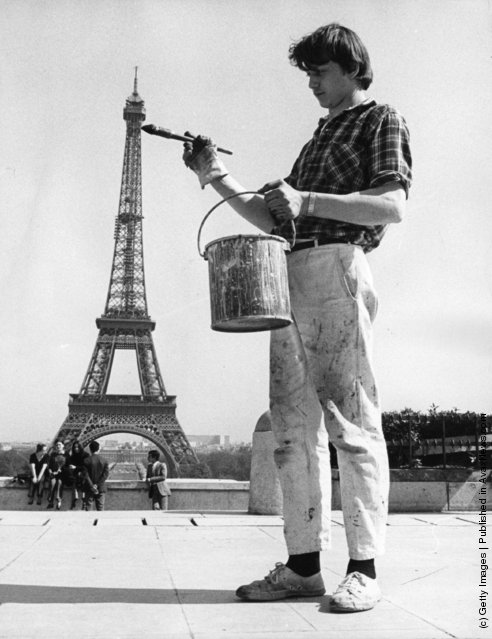
A young man “painting” the Eiffel Tower. (Photo by Keystone/Getty Images). 9th May 1970
Details
12 May 2011 09:05:00
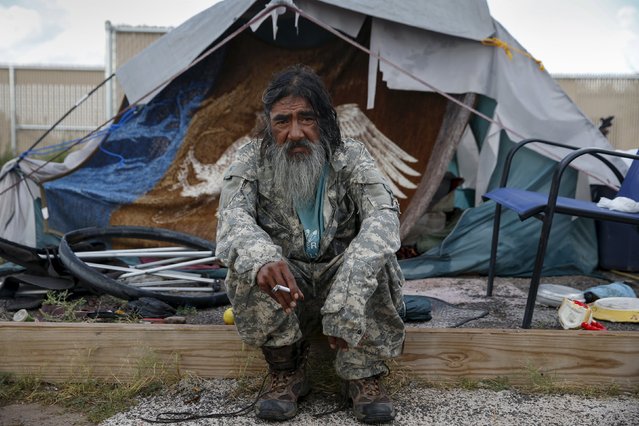
Daniel J. Wabsey, a 58-year-old war veteran, sits outside his tent at Camp Hope in Las Cruces, New Mexico October 6, 2015. “I've been traveling for 35 or 38 years. Getting inside would take a while to get used to. I just want to be able to eat, sleep and be safe. We all get along and understand in Camp Hope. We've all been there. With common sense you can survive out here”, Wabsey said. Camp Hope describe themselves as an “alternative transitional living project for the homeless”. Around 50 people live at the camp. (Photo by Shannon Stapleton/Reuters)

Daniel J. Wabsey, a 58-year-old war veteran, sits outside his tent at Camp Hope in Las Cruces, New Mexico October 6, 2015. “I've been traveling for 35 or 38 years. Getting inside would take a while to get used to. I just want to be able to eat, sleep and be safe. We all get along and understand in Camp Hope. We've all been there. With common sense you can survive out here”, Wabsey said. Camp Hope describe themselves as an “alternative transitional living project for the homeless”. Around 50 people live at the camp. (Photo by Shannon Stapleton/Reuters)
Details
19 Dec 2015 08:05:00
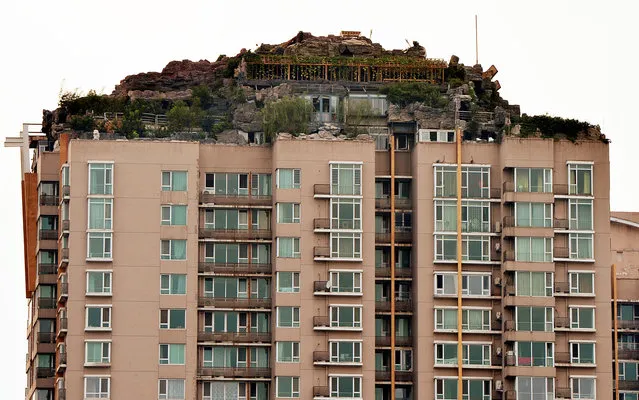
A villa privately built on the rooftop of a residential building in downtown Beijing has prompted complaints from neighbours living below. Professor Zhang, the villa owner, has been instructed to tear down the illegal building, according to the property managers. (Photo by Mark Ralston/AFP Photo)

A villa privately built on the rooftop of a residential building in downtown Beijing has prompted complaints from neighbours living below. Professor Zhang, the villa owner, has been instructed to tear down the illegal building, according to the property managers. (Photo by Mark Ralston/AFP Photo)
Details
13 Aug 2013 10:30:00


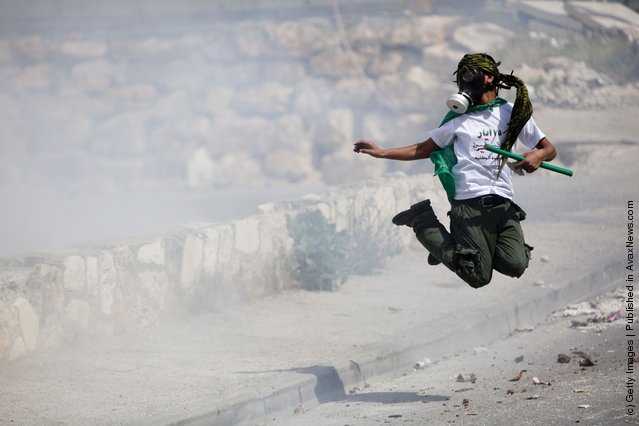
A Palestinian demonstrator jumps in the air during clashes with Israeli riot police on May 13, 2011 in the East Jerusalem neighbourhood of Issawiya, Israel. Palestinians began marking the “Nakba” or “catastrophe” which befell them following Israel's establishment in 1948. (Photo by Uriel Sinai/Getty Images)
Details
15 May 2011 09:05:00


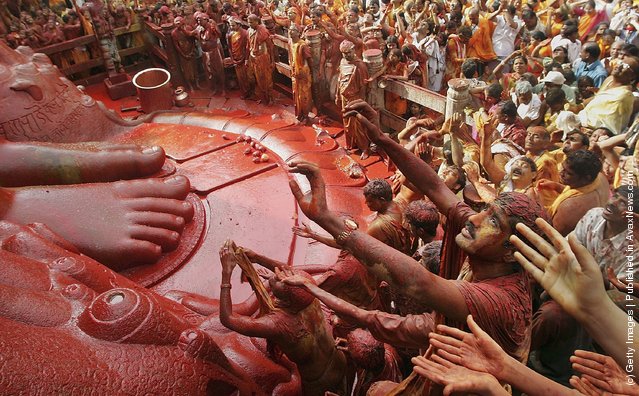
“The Mahamasthakabhisheka (or Mahamasthak Abhishek) is an important Jain festival held once every twelve years in the town of Shravanabelagola in Karnataka state, India. The festival is held in veneration of an immense 18 meter high statue of the Bhagwan (or Saint) Gomateshwara Bahubali. The anointing last took place in February 2006, and the next ceremony will occur in 2018”. – Wikipedia

Photo: A Jain Sadhu (2nd L) and devotees gather and pray at the feet of the monolithic statue of Jain sage Gomateswara during preparations for the Mahamastak Abhisheka ceremony February 7, 2006 in Shravanabelagola, India. The Mahamastak Abhisheka ceremony is held just once every twelve years where the statue will be bathed with milk, yogurt, saffron, gold coins and other religious items. The statue is said to be the world's largest monolith. The ceremony officially runs February 8-19. (Photo by Mario Tama/Getty Images)
Details
21 Jun 2011 12:27:00
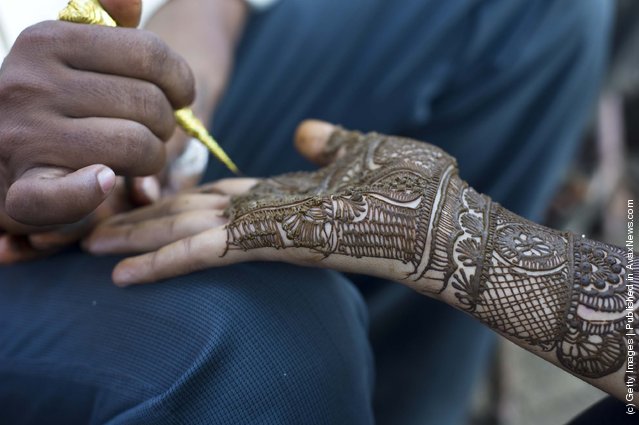
Application of henna or “Mehndi”  to a girls hand in a market in Jaipur, India

“Mehndi or menhdi is the application of henna as a temporary form of skin decoration in India, as well as by expatriate communities from the country. The word mehndi is derived from the Sanskrit word mendhikā. The use of mehndi and turmeric is described in the earliest Vedic ritual books. Haldi (Staining oneself with turmeric paste) as well as mehndi are important Vedic customs as a symbolic representation of the Outer and the Inner Sun. Vedic customs are meant to awaken the “inner light” and so the gold of the inner Sun has an important symbolic function”. – Wikipedia

Photo: Application of henna or “Mehndi” to a girls hand in a market on October 18, 2010 in Jaipur, India. (Photo by Simon de Trey-White/Getty Images)
Details
23 Nov 2011 13:33:00
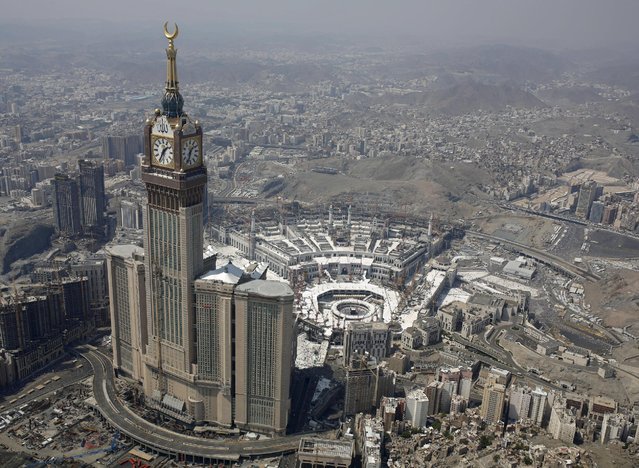
An aerial view of the Grand Mosque is seen on the second day of Eid al-Adha, during the annual haj pilgrimage in the holy city of Mecca September 25, 2015. (Photo by Ahmad Masood/Reuters)

An aerial view of the Grand Mosque is seen on the second day of Eid al-Adha, during the annual haj pilgrimage in the holy city of Mecca September 25, 2015. (Photo by Ahmad Masood/Reuters)
Details
28 Sep 2015 08:00:00