Loading...
Done
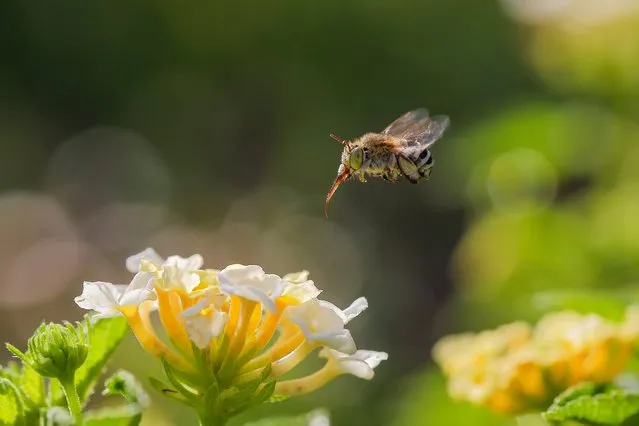
“Tasty Nature” by Dipesh Bhatt. “The blue banded bee (Amegilla cingulata) is pointing this sheath towards the flowers in preparation for sipping nectar”. Taken in Gujarat, India. (Photo by Dipesh Bhatt/2016 Royal Society of Biology Photographer of the Year competition)

“Tasty Nature” by Dipesh Bhatt. “The blue banded bee (Amegilla cingulata) is pointing this sheath towards the flowers in preparation for sipping nectar”. Taken in Gujarat, India. (Photo by Dipesh Bhatt/2016 Royal Society of Biology Photographer of the Year competition)
Details
30 Sep 2016 09:32:00
Life reconstruction of the new oviraptorosaurian dinosaur species Anzu wyliei in its 66 million-year-old environment in western North America as seen in an undated handout illustration by Mark A. Klinger, Carnegie Museum of Natural History. Some 18,000 species, great and small, were discovered in 2014, adding to the 2 million already known, scientists said on May 21, 2015 as they released a “Top 10” list that highlights the diversity of life. (Photo by Mark A. Klingler/Reuters/Carnegie Museum of Natural History)

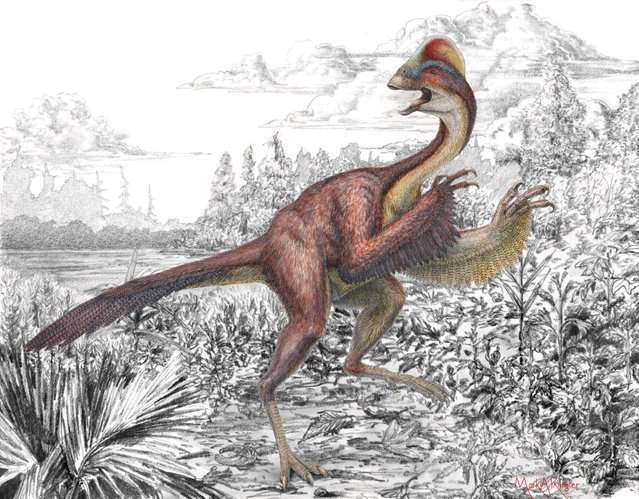
Life reconstruction of the new oviraptorosaurian dinosaur species Anzu wyliei in its 66 million-year-old environment in western North America as seen in an undated handout illustration by Mark A. Klinger, Carnegie Museum of Natural History. Some 18,000 species, great and small, were discovered in 2014, adding to the 2 million already known, scientists said on May 21, 2015 as they released a “Top 10” list that highlights the diversity of life. Anzu wyliei, one of the top 10, dubbed “the chicken from hell”, is extinct. The feathered dinosaur whose partial skeletons were unearthed in the Dakotas was a contemporary of T. rex and Triceratops. (Photo by Mark A. Klingler/Reuters/Carnegie Museum of Natural History)

Details
22 May 2015 12:31:00
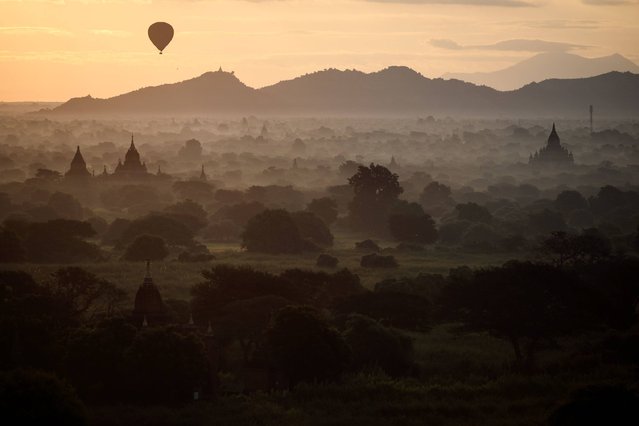
In this picture taken on November 28, 2016, a hot-air balloon carrying tourists sails over the archeological site at sunrise in Bagan. Located in central Myanmar, Bagan is home to more than 2,000 ancient Buddhist monuments deeply revered in the Buddhist-majority nation and is one of the country's most popular tourist destinations. (Photo by Dale De La Rey/AFP Photo)

In this picture taken on November 28, 2016, a hot-air balloon carrying tourists sails over the archeological site at sunrise in Bagan. Located in central Myanmar, Bagan is home to more than 2,000 ancient Buddhist monuments deeply revered in the Buddhist-majority nation and is one of the country's most popular tourist destinations. (Photo by Dale De La Rey/AFP Photo)
Details
10 Dec 2016 09:01:00
Tournament officials use golf carts to coax an alligator off of the 17th fairway and back into the water during the third round of the PGA Zurich Classic golf tournament at TPC Louisiana in Avondale, La., Saturday, April 24, 2021. (Photo by Gerald Herbert/AP Photo)

Tournament officials use golf carts to coax an alligator off of the 17th fairway and back into the water during the third round of the PGA Zurich Classic golf tournament at TPC Louisiana in Avondale, La., Saturday, April 24, 2021. (Photo by Gerald Herbert/AP Photo)
Details
04 May 2021 10:07:00
1924:  Vladimir Ilyich Lenin lying in state in the Kremlin

Photo: Vladimir Ilyich Lenin (1870 – 1924) lying in state in the Kremlin. (Photo by Hulton Archive/Getty Images). 1924

Important! For the same article in Russian language click here.

Something quite intriguing is happening within Russian-speaking internet during the last few – should you type a fully academic inquiry (at least, according to Russian academic requirements) in national search engines for "Lenin's mausoleum" – the first thing you get (even in top 10 searches) is website pages talking about black magic and occult. Website authors view this construction differently, but unconditionally agree on one thing: the mausoleum of the "leader of the world proletariat” – the essence of a magical artifact, a sort of “energy vampire”. It was built with a certain purpose: to drain the energy out of miserable Soviet citizens on one hand; and to poison the anthroposphere of one-sixth part of the earth with its vibes (the exact territory that was occupied by the former Soviet Union), depriving the Russian people of will to resist on the other hand. Complete nonsense? No doubt. Nevertheless, an intriguing one. Well, probably because some oddities do exist in mausoleum's history. These oddities are the thing we are going to discuss this time. First, let me refresh you memory on the subject.
Details
16 Oct 2011 11:27:00
Promotional models use their smartphones during their break at the Global Mobile Internet Conference in Beijing May 6, 2014. Mobile Internet industry executives, developers and investors from more than 30 countries took part in the Global Mobile Internet Conference in Beijing, the organiser said. (Photo by Kim Kyung-Hoon/Reuters)

Promotional models use their smartphones during their break at the Global Mobile Internet Conference in Beijing May 6, 2014. Mobile Internet industry executives, developers and investors from more than 30 countries took part in the Global Mobile Internet Conference in Beijing, the organiser said. (Photo by Kim Kyung-Hoon/Reuters)
Details
10 May 2014 14:12:00
Miniature spring-wound 35-mm film camera in a modified cigarette pack. The Tessina’s small size and quiet operation provided more options for concealment than most commercially available models. (Photo by Central Intelligence Agency)

Miniature spring-wound 35-mm film camera in a modified cigarette pack. The Tessina’s small size and quiet operation provided more options for concealment than most commercially available models. (Photo by Central Intelligence Agency)
Details
18 Jul 2014 13:27:00
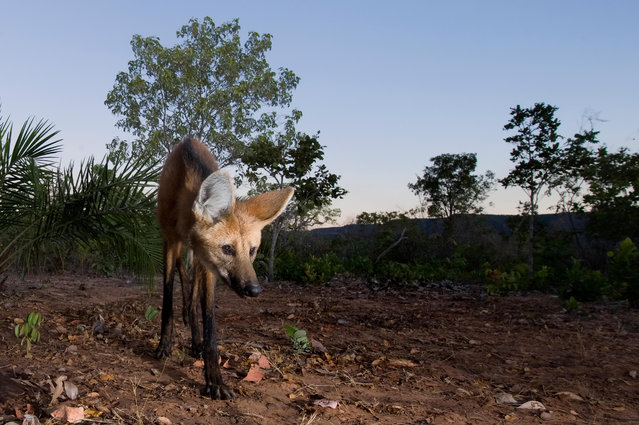
The maned wolf is among the large mammals in the Brazilian Cerrado that are threatened by the increasing conversion of grasslands into farmland for grazing and growing crops. (Photo by Ben Cranke/Nature Picture Library/Alamy Stock Photo)

Global wildlife populations will decline by 67% by 2020 unless urgent action is taken to reduce human impact on species and ecosystems, warns the biennial Living Planet Index report from WWF (World Wide Fund for Nature) and ZSL (Zoological Society of London). From elephants to eels, here are some of the wildlife populations most affected by human activity. Here: The maned wolf is among the large mammals in the Brazilian Cerrado that are threatened by the increasing conversion of grasslands into farmland for grazing and growing crops. (Photo by Ben Cranke/Nature Picture Library/Alamy Stock Photo)
Details
28 Oct 2016 10:47:00