Loading...
Done
New Yorkers Celebrate At West Indian Day Parade

“The Labor Day Parade (or West Indian Carnival), is an annual celebration held on American Labor Day (the first Monday in September), in Crown Heights, Brooklyn, New York. Ms. Jessie Waddell and some of her West Indian friends started the Carnival in Harlem in the 1920s by staging costume parties in large enclosed places like the Savoy, Renaissance and Audubon Ballrooms due to the cold wintry weather of February. This is the usual time for the pre-Lenten celebrations held in most countries around the world. However, because of the very nature of Carnival, and the need to parade in costume to music, indoor confinement did not work well. The earliest known Carnival street parade was held on September 1, 1947. The Trinidad Carnival Pageant Committee was the founding force behind the parade, which was held in Harlem. The parade route was along Seventh Avenue, starting at 110th St.” – Wikipedia

Photo: A reveler looks on during the West Indian-American Day Parade September 5, 2011 in the Brooklyn borough of New York City. More than 2 million spectators were expected to attend the celebration of Caribbean culture. (Photo by Mario Tama/Getty Images)
Details
06 Sep 2011 11:18:00
In this February 7, 2014 file photo, Matt Figi hugs and tickles his once severely-ill seven year old daughter Charlotte, as they walk together inside a greenhouse for a special strain of medical marijuana known as Charlotte's Web, which was named after the girl early in her treatment for crippling severe epilepsy, in the mountains west of Colorado Springs, Colo. (Photo by Brennan Linsley/AP Photo)

In this February 7, 2014 file photo, Matt Figi hugs and tickles his once severely-ill seven year old daughter Charlotte, as they walk together inside a greenhouse for a special strain of medical marijuana known as Charlotte's Web, which was named after the girl early in her treatment for crippling severe epilepsy, in the mountains west of Colorado Springs, Colo. Colorado is poised to award more than $8 million for medical marijuana research, a step toward addressing complaints that little is known about pot's medical potential. Among the research projects poised for approval on Wednesday, December 17, 2014, are one for pediatric epilepsy patients, and another for children with brain tumors. (Photo by Brennan Linsley/AP Photo)
Details
29 Dec 2014 13:12:00
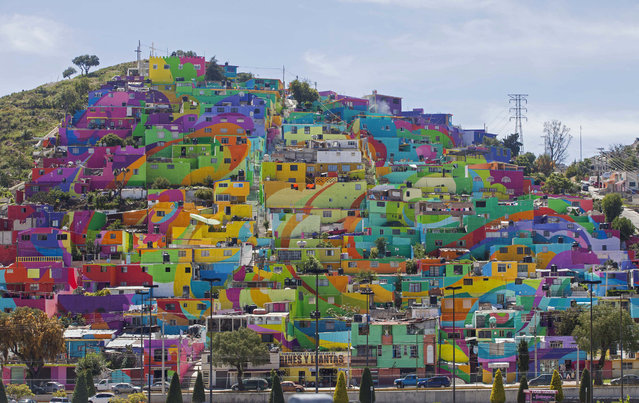
Hundreds of houses painted in bright colors in what organizers claim is Mexico's largest mural, is part of a government-sponsored project is called Pachuca Paints Itself, in the Palmitas neighborhood, in Pachuca, Mexico, Thursday, July 30, 2015. German Crew is the artist collective responsible for painting the mural project. Director Enrique Gomez, who goes by MYBE, said the crew has painted 1,500 square meters with 20,000 liters of paint. (Photo by Sofia Jaramillo/AP Photo)

Hundreds of houses painted in bright colors in what organizers claim is Mexico's largest mural, is part of a government-sponsored project is called Pachuca Paints Itself, in the Palmitas neighborhood, in Pachuca, Mexico, Thursday, July 30, 2015. German Crew is the artist collective responsible for painting the mural project. Director Enrique Gomez, who goes by MYBE, said the crew has painted 1,500 square meters with 20,000 liters of paint. Working hand-in-hand with residents, muralists have painted the facades of 200 homes bright lavender, lime green, incandescent orange – hues more commonly found in a bag of Skittles than in the drab, cement-and-cinderblock neighborhoods where many of Mexico's poor live. The project aims to bring the community together and rehabilitate the area. (Photo by Sofia Jaramillo/AP Photo)
Details
03 Aug 2015 12:02:00
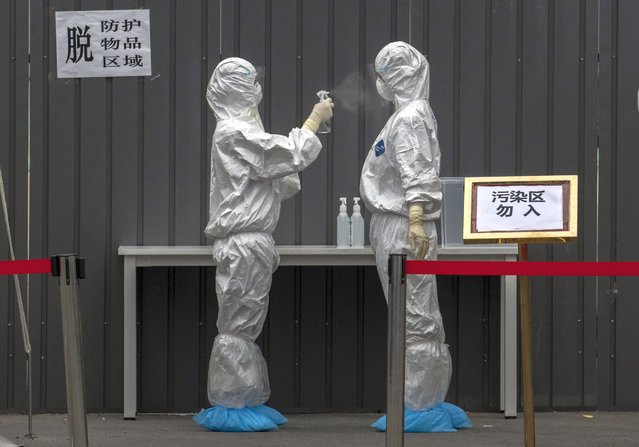
Chinese epidemic control workers wear protective suits as they disinfect each other after performing nucleic acid swab test for COVID-19 on citizens at a government testing site in Xicheng District during an organized tour on June 24, 2020 in Beijing, China. While Chinese government medical officials have said they believe they have controlled the spread, authorities are trying to contain the outbreak linked to the Xinfadi wholesale food market, Beijing's biggest supplier of produce and meat. More than 2.5 million people have undergone nucleic acid tests for COVID-19 at dozens of sites across the city in recent days, with officials using contact tracing to target high and middle risk areas and people who may have had contact with the market or food that came from there. Several neighborhoods have been locked down and a number of other food markets have been closed, The outbreak has triggered fears of a second wave of infection after 56 straight days with no domestically transmitted cases in the capital. (Photo by Kevin Frayer/Getty Images)

Chinese epidemic control workers wear protective suits as they disinfect each other after performing nucleic acid swab test for COVID-19 on citizens at a government testing site in Xicheng District during an organized tour on June 24, 2020 in Beijing, China. While Chinese government medical officials have said they believe they have controlled the spread, authorities are trying to contain the outbreak linked to the Xinfadi wholesale food market, Beijing's biggest supplier of produce and meat. (Photo by Kevin Frayer/Getty Images)
Details
26 Jun 2020 00:01:00
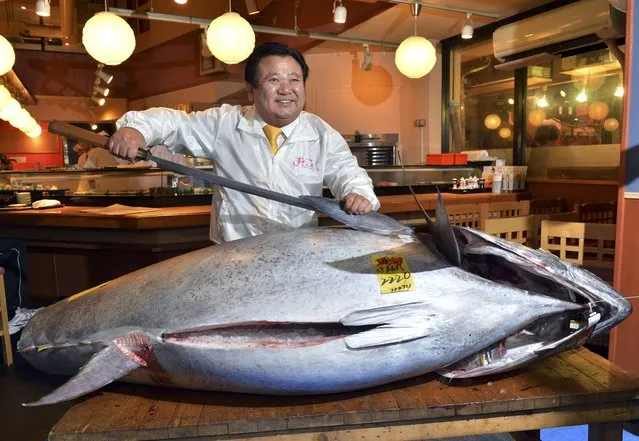
President of sushi restaurant chain Sushi-Zanmai, Kiyoshi Kimura, displays a 222kg bluefin tuna at his main restaurant near Tokyo's Tsukiji fish market on January 5, 2013. The bluefin tuna was traded at 155.4 million yen (1.77 million USD) at the wholesale market, smashing a previous record. (Photo by Yoshikazu Tsuno/AFP Photo)

Japanese businessman Kiyoshi Kimura has paid 1.38 million euros ($1.76 million, or 155.4 million yen) for a blue fin tuna – more than three times the previous high – which he also set one year ago. The 222-kilogram fish will be served to Kimura’s customers. Blue fin tuna is annually sold in a traditional New Year’s auction. Japan consumes 80 percent blue fin tuna caught worldwide.

Photo: President of sushi restaurant chain Sushi-Zanmai, Kiyoshi Kimura, displays a 222kg bluefin tuna at his main restaurant near Tokyo's Tsukiji fish market on January 5, 2013. The bluefin tuna was traded at 155.4 million yen (1.77 million USD) at the wholesale market, smashing a previous record. (Photo by Yoshikazu Tsuno/AFP Photo)
Details
06 Jan 2013 13:26:00
Thai office workers walk past armed soldiers standing guard outside the Shinawatra Tower Two in Bangkok, Thailand, 20 May 2014. Thai army Chief Prayuth Chan-ocha early on 20 May 2014, declared martial law giving the military full control to prevent further protest-related violence in the country. (Photo by Narong Sangnak/EPA)

Thai office workers walk past armed soldiers standing guard outside the Shinawatra Tower Two in Bangkok, Thailand, 20 May 2014. Thai army Chief Prayuth Chan-ocha early on 20 May 2014, declared martial law giving the military full control to prevent further protest-related violence in the country. The statement was issued about 3 am on 20 May (2000 GMT), according to local media reports. Prayuth has the authority to declare martial law without the consent of the government, which has had caretaker status since 09 December 2013. Thailand has been wracked by six months of non-stop protests seeking to topple the government. At least 25 people have died in political-related violence and more than 700 injured. (Photo by Narong Sangnak/EPA)
Details
21 May 2014 10:09:00
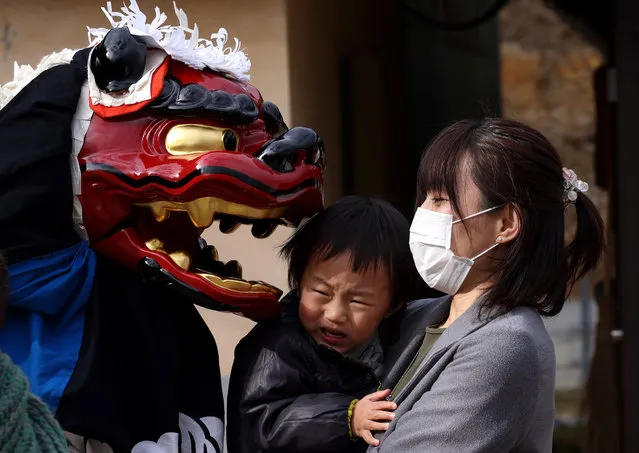
A performer wearing a lion mask performs the Ise Daikagura lion dance at the remote village of Yamanawa on February 08, 2021 in Ryuo, Japan. Ise Daikagura is a group of traditional Lion Dance performers who pray in front of farmers houses and businesses for good grain harvests and disease-free lives. Performers play sacred music using drums and flutes with two lion mask dancers. A lion mask is considered a symbol of God, who enters the house and performs in front of the Shinto God, a statue placed inside the house, mostly in the kitchen. These prayers are called “Kamodo Barai”. After the prayers, they are gifted with money, rice, sake and Japanese sweets from the householders. A group can travel for more than one hundred days to thousands of households and businesses throughout rural-villages in western Japan, and pray to those who are unable to visit the country’s most sacred shrine, the Grand Ise Shrine in Mie Prefecture. The group started its performance in the Edo era between 1603 to 1868 according to Japanese history. The Japanese government designated it as an important folk cultural national property in 1981. (Photo by Buddhika Weerasinghe/Getty Images)

A performer wearing a lion mask performs the Ise Daikagura lion dance at the remote village of Yamanawa on February 08, 2021 in Ryuo, Japan. Ise Daikagura is a group of traditional Lion Dance performers who pray in front of farmers houses and businesses for good grain harvests and disease-free lives. (Photo by Buddhika Weerasinghe/Getty Images)
Details
18 Feb 2021 09:27:00
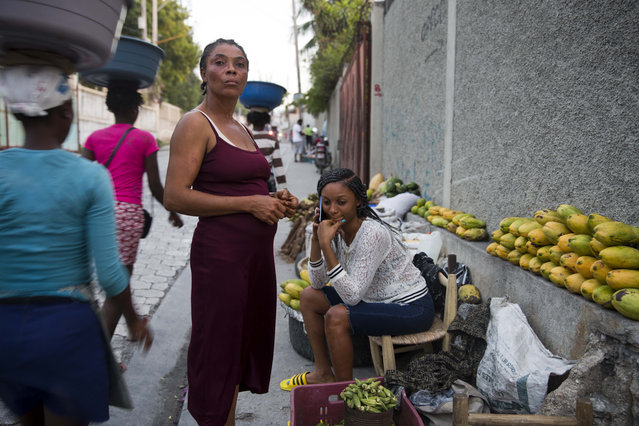
In this November 27, 2019 photo, Wadlande Pierre, right, talks on her mobile phone as she helps her mother, Vanlancia Julien, center, at their fruit and vegetable stand on a sidewalk in Delmas, a district of in Port-au-Prince, Haiti. Pierre, 23, said she temporarily moved in with her aunt in the southwest town of Les Cayes to escape the violent protests in Port-au-Prince. However, she had to move back to the capital because there was no gas, power or water in Les Cayes, and food was becoming scarce. (Photo by Dieu Nalio Chery/AP Photo)

In this November 27, 2019 photo, Wadlande Pierre, right, talks on her mobile phone as she helps her mother, Vanlancia Julien, center, at their fruit and vegetable stand on a sidewalk in Delmas, a district of in Port-au-Prince, Haiti. Pierre, 23, said she temporarily moved in with her aunt in the southwest town of Les Cayes to escape the violent protests in Port-au-Prince. However, she had to move back to the capital because there was no gas, power or water in Les Cayes, and food was becoming scarce. (Photo by Dieu Nalio Chery/AP Photo)
Details
01 Feb 2020 00:05:00