Loading...
Done
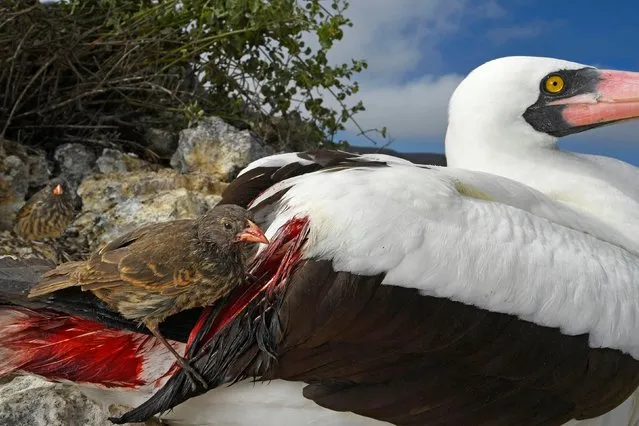
Bloodthirsty by Thomas P Peschak, Germany/South Africa — winner, Behaviour: birds. When rations run short on Wolf Island, in the remote northern Galápagos, the sharp-beaked ground finches become vampires. Their sitting targets are Nazca boobies and other large birds. The finches rely on a scant diet of seeds and insects, which regularly dries up, so they drink blood to survive. ‘I’ve seen more than half a dozen finches drinking from a single Nazca booby,’ says Tom. Rather than leave their nests the boobies tolerate the vampires, and the blood loss doesn’t seem to cause permanent harm. (Photo by Thomas P Peschak/2018 Wildlife Photographer of the Year)

Bloodthirsty by Thomas P. Peschak, Germany/South Africa — winner, Behaviour: birds. When rations run short on Wolf Island, in the remote northern Galápagos, the sharp-beaked ground finches become vampires. Their sitting targets are Nazca boobies and other large birds. The finches rely on a scant diet of seeds and insects, which regularly dries up, so they drink blood to survive. ‘I’ve seen more than half a dozen finches drinking from a single Nazca booby,’ says Tom. Rather than leave their nests the boobies tolerate the vampires, and the blood loss doesn’t seem to cause permanent harm. (Photo by Thomas P. Peschak/2018 Wildlife Photographer of the Year)
Details
19 Oct 2018 00:05:00
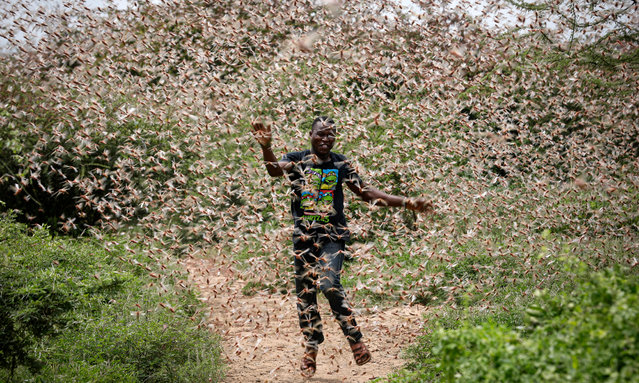
A local farmer Theophilus Mwendwa runs through a swarm of desert locusts to chase them away in the bush near Enziu, Kitui County, some 200km east of the capital Nairobi, Kenya, 24 January 2020. Large swarms of desert locusts have been invading Kenya for weeks, after having infested some 70 thousand hectares of land in Somalia which the United Nations Food and Agriculture Organisation (FAO) has termed the “worst situation in 25 years” in the Horn of Africa. FAO cautioned that it poses an “unprecedented threat” to food security and livelihoods in the region. (Photo by Dai Kurokawa/EPA/EFE)

A local farmer Theophilus Mwendwa runs through a swarm of desert locusts to chase them away in the bush near Enziu, Kitui County, some 200km east of the capital Nairobi, Kenya, 24 January 2020. Large swarms of desert locusts have been invading Kenya for weeks, after having infested some 70 thousand hectares of land in Somalia which the United Nations Food and Agriculture Organisation (FAO) has termed the “worst situation in 25 years” in the Horn of Africa. FAO cautioned that it poses an “unprecedented threat” to food security and livelihoods in the region. (Photo by Dai Kurokawa/EPA/EFE)
Details
22 Feb 2020 00:01:00
Rush-hour in Russia means one thing for this daredevil: train surfing! The 19-year-old daredevil who goes by the name Kobzarro started train surfing aged 15 as a way of escaping an oppressive family life. Here Kobzarro can be seen balanced on top of a train as it speeds through the wintery Russian environment. Kobzarro is so dedicated to train surfing that she rarely gets inside a train. Even in winter she prefers to travel in this less conventional way. It has resulted in a few run ins with the law, but Kobzarro says it has never resulted in anything more serious than a fine, with many police officers even being interested in the train surfing community. (Photo by Caters News Agency)

Rush-hour in Russia means one thing for this daredevil: train surfing! The 19-year-old daredevil who goes by the name Kobzarro started train surfing aged 15 as a way of escaping an oppressive family life. Here Kobzarro can be seen balanced on top of a train as it speeds through the wintery Russian environment. Kobzarro is so dedicated to train surfing that she rarely gets inside a train. Even in winter she prefers to travel in this less conventional way. It has resulted in a few run ins with the law, but Kobzarro says it has never resulted in anything more serious than a fine, with many police officers even being interested in the train surfing community. (Photo by Caters News Agency)
Details
11 Nov 2016 08:28:00
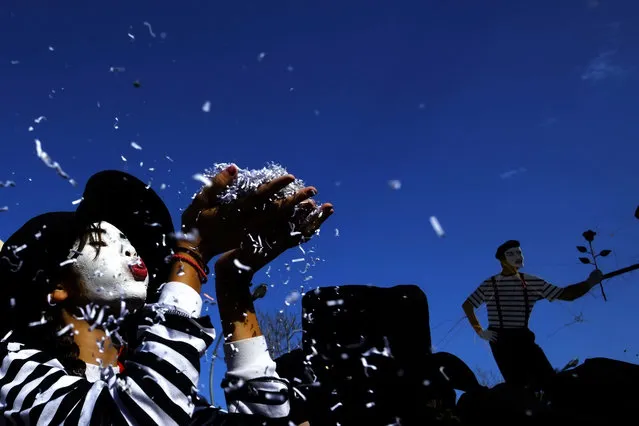
A child blowing confetti from her hands during a Carnival parade in Cyprus' coastal city of Limassol, Sunday, March 13, 2016. Limassol's long-established parade is Cyprus' biggest and most famous, drawing revelers from across the east Mediterranean island. This year's parade drew huge crowds as people sought lighthearted reprieve from the bailed-out country's recession. The parade marks the start of the 40-day fasting period of Lent in the run-up to the Orthodox Christian Easter. (Photo by Petros Karadjias/AP Photo)

A child blowing confetti from her hands during a Carnival parade in Cyprus' coastal city of Limassol, Sunday, March 13, 2016. Limassol's long-established parade is Cyprus' biggest and most famous, drawing revelers from across the east Mediterranean island. This year's parade drew huge crowds as people sought lighthearted reprieve from the bailed-out country's recession. The parade marks the start of the 40-day fasting period of Lent in the run-up to the Orthodox Christian Easter. (Photo by Petros Karadjias/AP Photo)
Details
14 Mar 2016 10:21:00
Topless protesters from the organization PETA (People for the Ethical Treatment of Animals) stand with “banderillas” filled with red powder as about 100 people rally in front of the town hall square in Pamplona, Navarra, northern Spain, demonstrating against the treatment of fighting bulls in the Fiesta de San Fermin, 05 July 2017. The renowned eight-day festival made famous by Ernest Hemingway's 1926 novel “The Sun Also Rises” has running-with-the-bulls and a bullfight each day for the fair, which begins at noon on 06 July 2017. (Photo by Jim Hollander/EPA)

Topless protesters from the organization PETA (People for the Ethical Treatment of Animals) stand with “banderillas” filled with red powder as about 100 people rally in front of the town hall square in Pamplona, Navarra, northern Spain, demonstrating against the treatment of fighting bulls in the Fiesta de San Fermin, 05 July 2017. The renowned eight-day festival made famous by Ernest Hemingway's 1926 novel “The Sun Also Rises” has running-with-the-bulls and a bullfight each day for the fair, which begins at noon on 06 July 2017. (Photo by Jim Hollander/EPA)
Details
06 Jul 2017 09:08:00
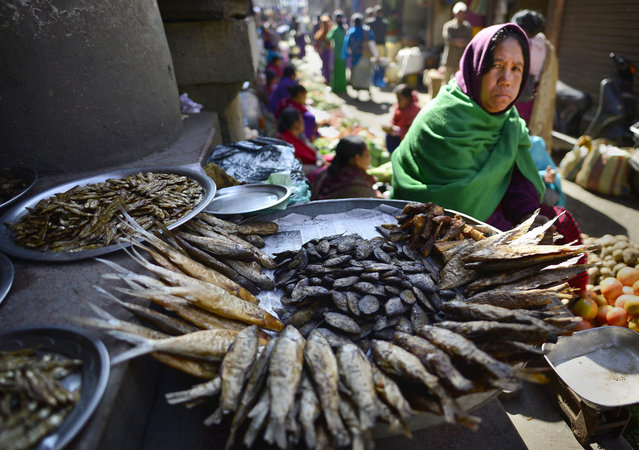
A Manipuri woman sells smoked and dry fish in Ima market - the world's largest all women market - in Imphal city, Manipur state, 06 January 2016. The 150-year-old Ima Keithel or 'Mothers's market' complex, which is run exclusively by women and was damaged in the 04 January 2016 earthquake, is returning back to normal. Nine deaths have been reported from in and around Imphal due to falling debris. (Photo by EPA/Stringer)

A Manipuri woman sells smoked and dry fish in Ima market - the world's largest all women market – in Imphal city, Manipur state, 06 January 2016. The 150-year-old Ima Keithel or “Mothers's market” complex, which is run exclusively by women and was damaged in the 04 January 2016 earthquake, is returning back to normal. Nine deaths have been reported from in and around Imphal due to falling debris. Imphal has a population of some 270,000 and people were jolted from their sleep and ran out of their homes in panic when the earth shook 04 January, reports say. (Photo by EPA/Stringer)
Details
08 Jan 2016 08:04:00
Centre of the Heart Nebula by Ivan Eder (Hungary). Situated 7500 light years away in the ‘W’-shaped constellation of Cassiopeia, the Heart Nebula is a vast region of glowing gas, energized by a cluster of young stars at its centre. The image depicts the central region, where dust clouds are being eroded and moulded into rugged shapes by the searing cosmic radiation. (Photo by Ivan Eder)

The competition, which is run by the Royal Observatory Greenwich in association with BBC Sky at Night Magazine, is now in its sixth year and has received over 2,500 entries. Photo: Centre of the Heart Nebula by Ivan Eder (Hungary). Situated 7500 light years away in the “W”-shaped constellation of Cassiopeia, the Heart Nebula is a vast region of glowing gas, energized by a cluster of young stars at its centre. The image depicts the central region, where dust clouds are being eroded and moulded into rugged shapes by the searing cosmic radiation. (Photo by Ivan Eder)
Details
03 Jul 2014 11:59:00


“The Daleks are a fictional extraterrestrial race of genetically manipulated mutants from the British science fiction television series Doctor Who. Various storylines portray them as having had every emotion removed except hate, leaving them with a desire to purge the Universe of all non-Dalek life. Collectively they are the greatest enemies of the series' protagonist, the Time Lord known as the Doctor. Their famous catchphrase is “Exterminate!”, with each syllable individually synthesised in a frantic electronic voice” – Wikipedia

Photo: Max Hardy, aged 6, stands by a street sign from the Doctor Who Experience as Dalek, from the cult television show Doctor Who watches him on April 16, 2011 in London, England. The Doctor Who Experience Exhibition is currently running at Kensington Olympia Two, celebrating the science fiction programme that was originally screened in 1963. (Photo by Matthew Lloyd/Getty Images for BBC Worldwide)
Details
04 May 2011 10:47:00