Loading...
Done
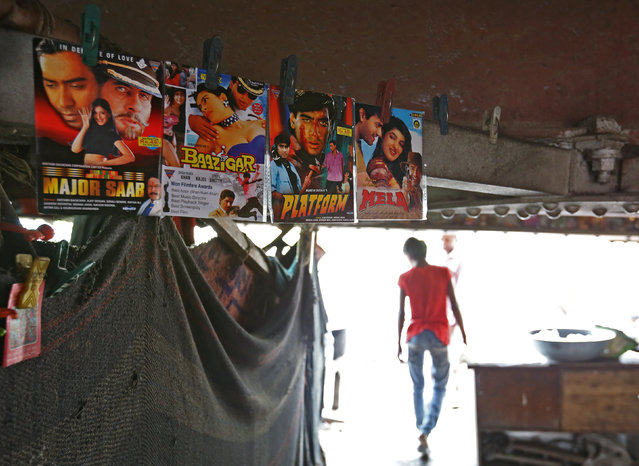
Films that are being screened are advertised in a makeshift cinema located under a bridge in the old quarters of Delhi, India May 25, 2016. (Photo by Cathal McNaughton/Reuters)

Films that are being screened are advertised in a makeshift cinema located under a bridge in the old quarters of Delhi, India May 25, 2016. A makeshift cinema hall under a 140-year-old bridge in the Indian capital is allowing poor rickshaw pullers and migrant labourers to escape daily hardship and sweltering heat into a world of Bollywood song, dance and romance. With the rusty iron floor of the bridge as its ceiling and some old rags acquired on the cheap from a nearby crematorium serving as curtains and floor mats, the cinema shows four films a day. (Photo by Cathal McNaughton/Reuters)
Details
28 May 2016 12:21:00
A view of traditional bolinhos de bacalhau (fried codfish balls) in Rio de Janeiro, Brazil, May 7, 2016. (Photo by Sergio Moraes/Reuters)

If the most popular foods of Rio de Janeiro have one thing in common, it is their informality. You can find fine restaurants in the city, but they do not set Rio apart from other places. What does set it apart, and what invariably brings its residents, known as "Cariocas," together is the unpretentious food they eat in bright, loud, crowded bars and restaurants, on busy street corners, or after a day at the beach. Here: A view of traditional bolinhos de bacalhau (fried codfish balls) in Rio de Janeiro, Brazil, May 7, 2016. (Photo by Sergio Moraes/Reuters)
Details
05 Aug 2016 13:20:00
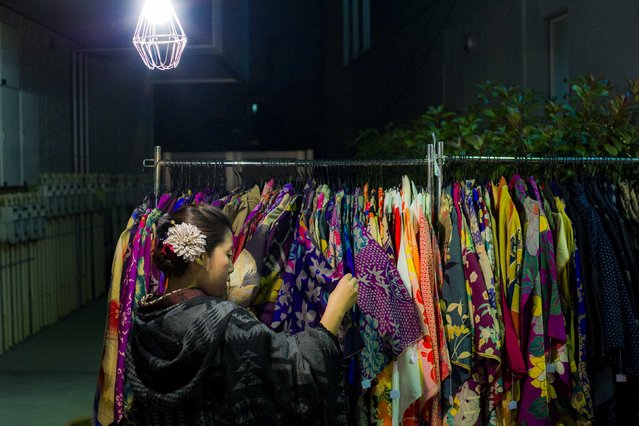
A woman browses through kimonos for sale at Boroichi flea market in Tokyo December 15, 2014. In the 16th century, Boroichi was a place for farmers to buy and sell rags, known as boro, for mending clothes and weaving sandals. Now in its 436th year, the original spirit lingers, with about 700 stands hawking fabric, used clothes and piles of rags. Others sell kitchen tools, pottery, seaweed and spices. (Photo by Thomas Peter/Reuters)

A woman browses through kimonos for sale at Boroichi flea market in Tokyo December 15, 2014. In the 16th century, Boroichi was a place for farmers to buy and sell rags, known as boro, for mending clothes and weaving sandals. Now in its 436th year, the original spirit lingers, with about 700 stands hawking fabric, used clothes and piles of rags. Others sell kitchen tools, pottery, seaweed and spices. About 200,000 people flock to the market, which is only open for four mid-winter days a year – two in December and two in January. (Photo by Thomas Peter/Reuters)
Details
19 Dec 2014 12:50:00
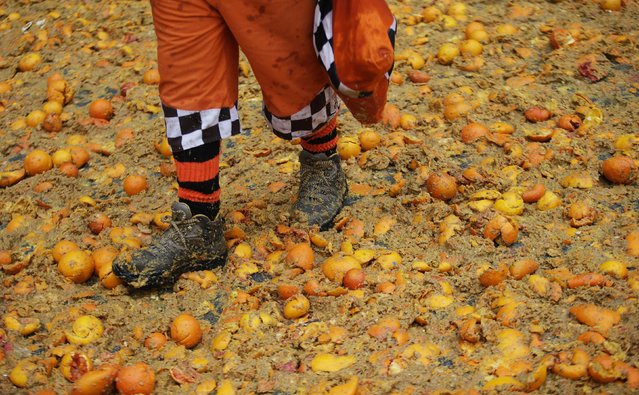
A member of a rival team walks during an annual carnival battle with oranges in the northern Italian town of Ivrea February 15, 2015. Dressed up as Middle Age kings' guards, a group of men ride in a horse-drawn carriage and pelt “foot soldiers” with oranges as thousands of people gather to re-enact a Middle Age battle when the townsfolk of Ivrea overthrew an evil king. (Photo by Max Rossi/Reuters)

A member of a rival team walks during an annual carnival battle with oranges in the northern Italian town of Ivrea February 15, 2015. Dressed up as Middle Age kings' guards, a group of men ride in a horse-drawn carriage and pelt “foot soldiers” with oranges as thousands of people gather to re-enact a Middle Age battle when the townsfolk of Ivrea overthrew an evil king. In a strange twist, instead of swords and cross bows, these days the weapons of choice are oranges. (Photo by Max Rossi/Reuters)
Details
16 Feb 2015 13:06:00
People take pictures and Buddhist monk chants as a groom and a bride lay inside a pink coffin during their wedding ceremony at Wat Takien temple in Nonthaburi province, on the outskirts of Bangkok February 14, 2015. (Photo by Damir Sagolj/Reuters)

People take pictures and Buddhist monk chants as a groom and a bride lay inside a pink coffin during their wedding ceremony at Wat Takien temple in Nonthaburi province, on the outskirts of Bangkok February 14, 2015. Ten Thai couples laid in the pink coffin starting 9:09 AM on Saturday during the wedding ceremony organised by the Buddhist temple on Valentine's Day. Couples believe laying briefly in the coffin will get rid of bad luck and usher happiness into their lives. (Photo by Damir Sagolj/Reuters)
Details
16 Feb 2015 13:36:00
You might feel as if you are being watched when you look at these incredible pictures – revealing the close-up world of a spider's eyes. The intimidating creatures, which look like they should live in a horror film, star menacingly at the camera as every fleck of colour and hair are revealed. But despite their appearance the arachnids are actually jumping spiders, which measure a tiny six millimetres in length. (Photo by SWNS/ABACA Press)

You might feel as if you are being watched when you look at these incredible pictures – revealing the close-up world of a spider's eyes. The intimidating creatures, which look like they should live in a horror film, star menacingly at the camera as every fleck of colour and hair are revealed. But despite their appearance the arachnids are actually jumping spiders, which measure a tiny six millimetres in length. The harmless arachnids, which are capable of jumping up to six times their own height, can be found in grassy meadows and on the walls of houses on sunny days. (Photo by SWNS/ABACA Press)
Details
08 Sep 2014 10:58:00
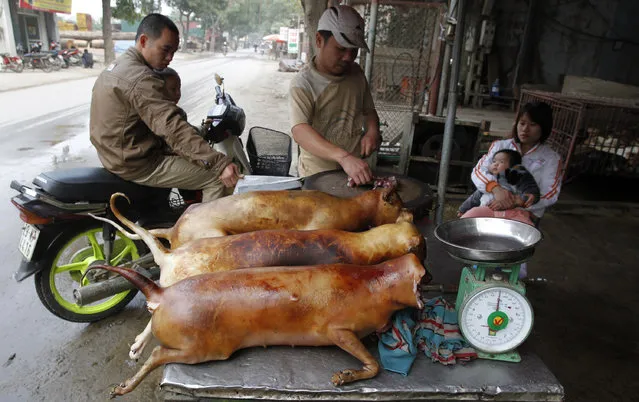
A vendor (C) cuts slaughtered dogs for sale at his roadside stall in Duong Noi village, outside Hanoi December 16, 2011. While animal rights activists have condemned eating dog meat as cruel treatment of the animals, it is still an accepted popular delicacy for some Vietnamese, as well in some other Asian countries. (Photo by Reuters/Kham)

A vendor (C) cuts slaughtered dogs for sale at his roadside stall in Duong Noi village, outside Hanoi December 16, 2011. While animal rights activists have condemned eating dog meat as cruel treatment of the animals, it is still an accepted popular delicacy for some Vietnamese, as well in some other Asian countries. Duong Noi is well-known as a dog-meat village, where hundreds of dogs are killed each day for sale as popular traditional food. Dog-eating as a custom is rooted in Vietnam and was developed as a result of poverty. One kilogram of dog meat costs about 130,000 dongs ($6.2). (Photo by Reuters/Kham)
Details
16 Jul 2013 11:40:00
Isabel Schmalenbach, an environmental scientist with the Helgoland Biological Institute (Biologische Anstalt Helgoland), part of the Alfred Wegener Institute for Polar and Marine Research, holds a one-year old baby European lobster (Homarus gammarus) raised at the institute on August 3, 2013 on Helgoland Island, Germany. (Photo by Sean Gallup/Getty Images)

Isabel Schmalenbach, an environmental scientist with the Helgoland Biological Institute (Biologische Anstalt Helgoland), part of the Alfred Wegener Institute for Polar and Marine Research, holds a one-year old baby European lobster (Homarus gammarus) raised at the institute on August 3, 2013 on Helgoland Island, Germany. Later in the day Schmalenbach and her colleagues released a total of 415 one-year old lobsters into the North Sea as part of an effort to repopulate the lobster population around Helgoland (also called Heligoland). In the 19th century local fishermen caught up to 80,000 lobsters a year in the surrounding waters, combined with the heavy allied bombing of the island during and after World War II, as well as other environmental factors, decimated the lobster population. (Photo by Sean Gallup)
Details
05 Aug 2013 08:39:00