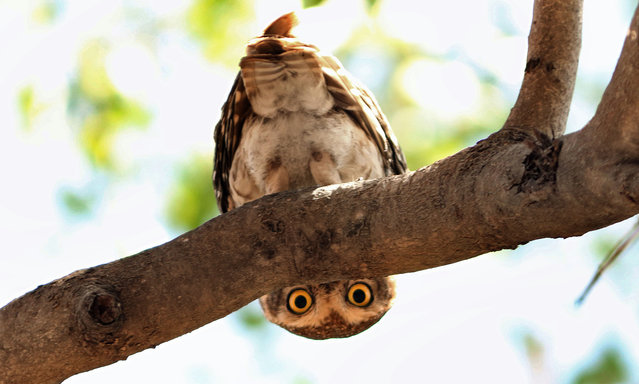
A spotted owlet appears to be playing peek-a-boo near Rancharda Lake in Ahmedabad, India on February 9, 2016. The species is common across the Indian subcontinent. (Photo by Caters News Agency)
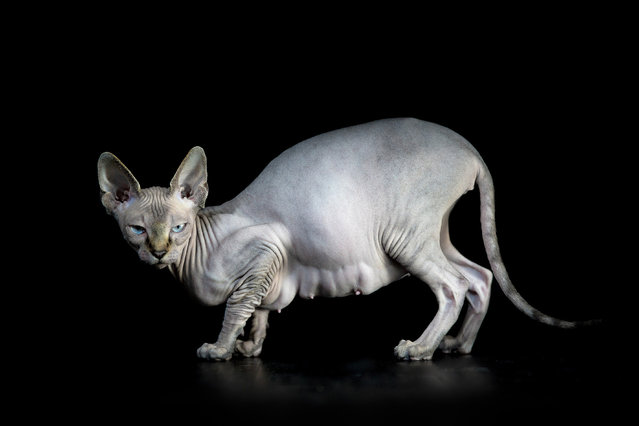
A photographer has captured the bizarre beauty of sphynx cats in a series of intriguing portraits. Creative Alicia Rius snapped them from different angles showing off their unusual flesh, colourings and bones. In the images the cats can be seen curiously playing, observing their surroundings and even grooming themselves. (Photo by Alicia Rius/Caters News)
A roadside ice-cream vendor waits for customers at a market in New Delhi, India, April 7, 2016. The Indian economy is characterized by the existence of a vast majority of informal or unorganized labor employment. (Photo by Altaf Qadri/AP Photo)
Hamar women dance before a bull jumping ceremony in Ethiopia's southern Omo Valley region near Turmi on September 19, 2016. The Hamar are a Nilotic ethnic group in Ethiopia. The construction of the Gibe III dam, the third largest hydroelectric plant in Africa, and large areas of very “thirsty” cotton and sugar plantations and factories along the Omo river are impacting heavily on the lives of tribes living in the Omo Valley who depend on the river for their survival and way of life. (Photo by Carl De Souza/AFP Photo)
A staff member removes a coffin from a room of the “Corpse Hotel” in Kawasaki, Japan, April 20, 2016. Many so-called corpse hotels have emerged as a flourishing business in the city following a crunch in crematoriums. Families can rent a room in Sousou on a daily charge of 9,000 Japanese yen (£58, €74, $84) to keep the body of the deceased relative for up to four days until they find a crematorium. (Photo by Thomas Peter/Reuters)
Circus artists perform at the International Circus Show started in Avenue Habib Bourguiba in Tunis, Tunisia on June 23, 2022. (Photo by Yassine Gaidi/Anadolu Agency via Getty Images)
A handout photo made available by the NASA shows the United Launch Alliance Delta IV Heavy rocket launches NASA's Parker Solar Probe to touch the Sun, from Launch Complex 37 at Cape Canaveral Air Force Station, Florida, USA, 12 August 2018. Parker Solar Probe is humanity’s first-ever mission into a part of the Sun’s atmosphere called the corona. Here it will directly explore solar processes that are key to understanding and forecasting space weather events that can impact life on Earth. (Photo by Bill Ingalls/EPA-EFE/NASA)