Loading...
Done
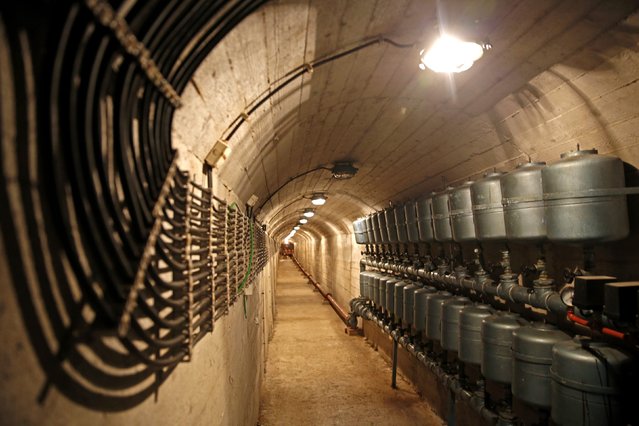
A tunnel with electric switches are seen in Josip Broz Tito's underground secret bunker (ARK) in Konjic, October 16, 2014. (Photo by Dado Ruvic/Reuters)

A tunnel with electric switches are seen in Josip Broz Tito's underground secret bunker (ARK) in Konjic, October 16, 2014. In the early 1950s, Josip Broz Tito, the late leader of the former Yugoslavia, ordered the building of the secret bunker, located 900 feet (270 m) underground and near the Bosnian town of Konjic, to safeguard the country's ruling class in case of a nuclear attack. Construction at the complex, which had a cost equivalent price tag of $4.6 billion, continued until 1979, the year before Tito died. (Photo by Dado Ruvic/Reuters)
Details
28 Nov 2014 12:14:00
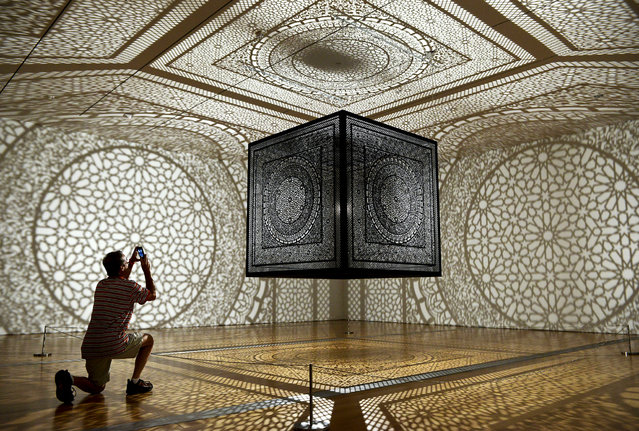
A man photographs Anila Quayyum Agha's “Intersections” art work on the first day of ArtPrize at the Grand Rapids Art Museum in Grand Rapids, Mich. on Wednesday, September 24, 2014. (Photo by Emily Rose Bennett/AP Photo/The Grand Rapids Press)

A man photographs Anila Quayyum Agha's “Intersections” art work on the first day of ArtPrize at the Grand Rapids Art Museum in Grand Rapids, Mich. on Wednesday, September 24, 2014. (Photo by Emily Rose Bennett/AP Photo/The Grand Rapids Press)
Details
27 Sep 2014 12:04:00
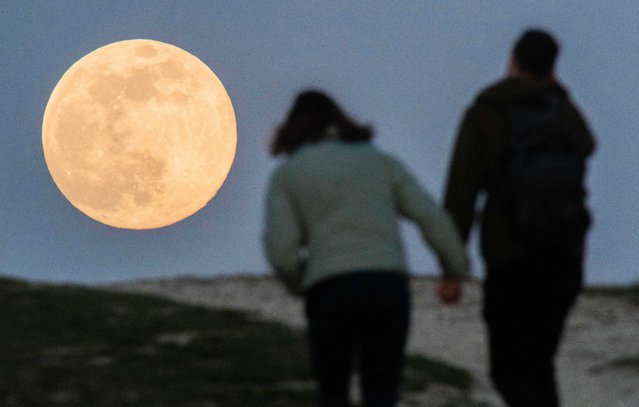
A couple is walking hand-held up Kronsberg, just outside Hanover, Germany on April 7, 2020, when the moon rises on the horizon as the so-called supermoon. The moon reaches its perigee, i.e. the point closest to the Earth's orbit, on the night of 7-8 April as a full moon and therefore appears particularly large to the human observer. (Photo by Julian Stratenschulte/dpa via ZUMA Press)

A couple is walking hand-held up Kronsberg, just outside Hanover, Germany on April 7, 2020, when the moon rises on the horizon as the so-called supermoon. The moon reaches its perigee, i.e. the point closest to the Earth's orbit, on the night of 7-8 April as a full moon and therefore appears particularly large to the human observer. (Photo by Julian Stratenschulte/dpa via ZUMA Press)
Details
09 Apr 2020 00:07:00
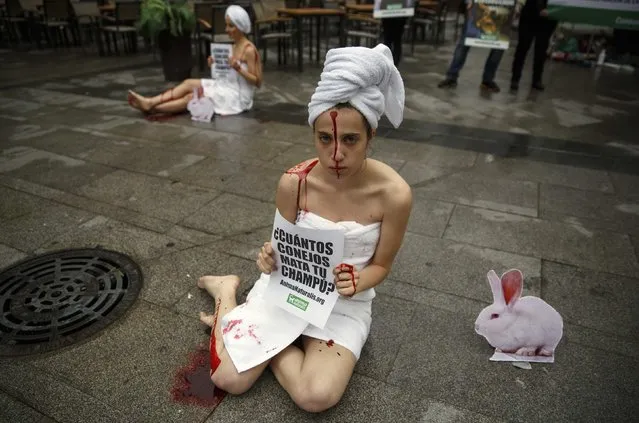
Animal rights activists covered with fake blood sit on the floor during a protest against the use of animals in research to mark World Day for Animals in Laboratories in central Madrid April 24, 2014. The sign reads, “How many rabbits do your shampoo kill?”. (Photo by Andrea Comas/Reuters)

Animal rights activists covered with fake blood sit on the floor during a protest against the use of animals in research to mark World Day for Animals in Laboratories in central Madrid April 24, 2014. The sign reads, “How many rabbits do your shampoo kill?”. (Photo by Andrea Comas/Reuters)
Details
26 Apr 2014 11:44:00
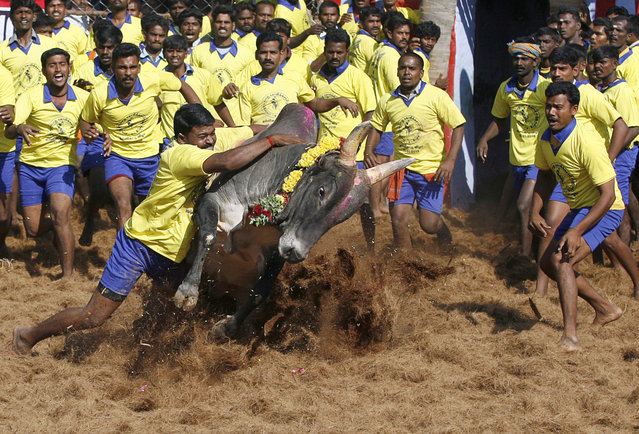
Bull tamers try to control a bull during the bull-taming sport called Jallikattu, in Palamedu, about 575 kilometers (359 miles) south of Chennai, India, Tuesday, Jan. 15, 2013. (Photo by Arun Sankar K./AP Photo)

“Jallikattu is a bull taming sport played in Tamil Nadu as a part of Pongal celebrations on Mattu Pongal day. Annually, jallikattu is held from January to July, played first in world-famous Palamedu, near Madurai on January 15 followed by “Alanganallur-jallikattu” in Alanganallur, near Madurai on 16 January. There is a specific breed of cattle bred for this purpose known as Jellicut and from the place of a big breeder Pulikulam”. – Wikipedia. Photo: Bull tamers try to control a bull during the bull-taming sport called Jallikattu, in Palamedu, about 575 kilometers (359 miles) south of Chennai, India, Tuesday, January 15, 2013. (Photo by Arun Sankar K./AP Photo)
Details
17 Jan 2014 10:06:00
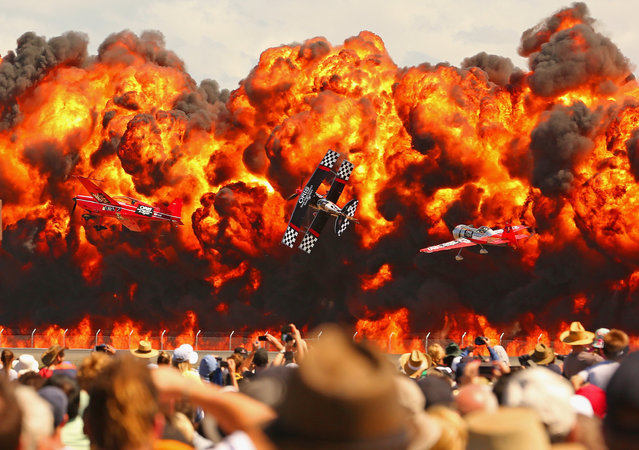
The crowd watches as stunt pilots Melissa Pemberton, Jurgis Kairys and Skip Stewart of The Immortals fly past pyrotechnics as they perform at The Australian International Airshow on March 1, 2015 in Avalon, Australia. (Photo by Scott E. Barbour/Getty Images)

The crowd watches as stunt pilots Melissa Pemberton, Jurgis Kairys and Skip Stewart of The Immortals fly past pyrotechnics as they perform at The Australian International Airshow on March 1, 2015 in Avalon, Australia. (Photo by Scott E. Barbour/Getty Images)
Details
11 May 2015 12:05:00
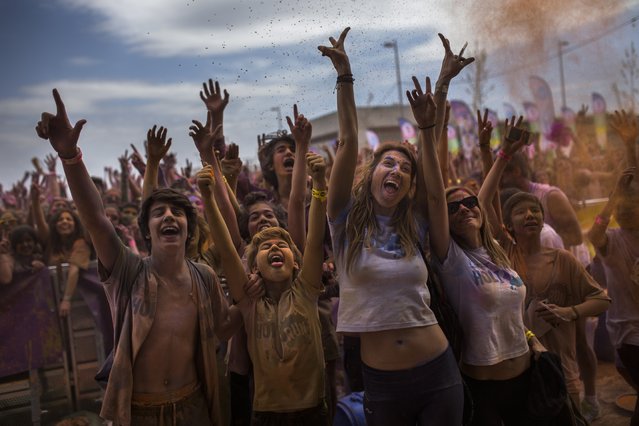
Revelers, covered in coloured powder, celebrate, during a Holi Run Festival in Madrid, Spain, Sunday, April 12, 2015. Thousands of revelers took part in the festival that includes a mini marathon. The festivals are fashioned after the Hindu spring festival Holi, which is mainly celebrated in the north and east of India. (Photo by Andres Kudacki/AP Photo)

Revelers, covered in coloured powder, celebrate, during a Holi Run Festival in Madrid, Spain, Sunday, April 12, 2015. Thousands of revelers took part in the festival that includes a mini marathon. The festivals are fashioned after the Hindu spring festival Holi, which is mainly celebrated in the north and east of India. (Photo by Andres Kudacki/AP Photo)
Details
18 Apr 2015 09:38:00


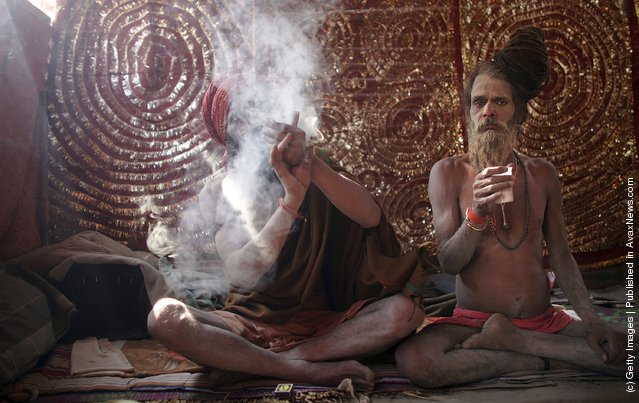
“Kumbh Mela is a mass Hindu pilgrimage in which Hindus gather at the Ganges river. The normal Kumbh Mela is celebrated every 3 years, the Ardh (half) Kumbh Mela is celebrated every six years at Haridwar and Prayag, the Purna (complete) Kumbh takes place every twelve years, at four places (Prayag (Allahabad), Haridwar, Ujjain, and Nashik). The Maha (great) Kumbh Mela which comes after 12 “Purna Kumbh Melas”, or 144 years, is held at Allahabad.

The last Ardh Kumbh Mela was held over a period of 45 days beginning in January 2007, more than 70 million Hindu pilgrims took part in the Ardh Kumbh Mela at Prayag, and on January 15, the most auspicious day of the festival of Makar Sankranti, more than 5 million participated. The previous Maha Kumbh Mela, held in 2001, was attended by around 60 million people, making it at the time the largest gathering anywhere in the world in recorded history”. – Wikipedia

Photo: Sadhus (holy men) smoke at their camp near the ritual site at Sangam, the confluence of the Ganges, Yamuna and mythical Saraswati rivers during the Ardh Kumbh Mela festival (Half Pitcher festival) January 18, 2007 in Allahabad, India. Millions of Hindu pilgrims have flocked to the largest religious gathering in the world which lasts for 45 days in northern India. The festival commemorates the mythical conflict between gods and demons over a pitcher filled with the “nectar of immortality”. Devotees believe that taking a holy dip in the Ganges at this time washes away their sins and paves the path to salvation. (Photo by Mario Tama/Getty Images)

Details
30 Jun 2011 10:27:00