Loading...
Done
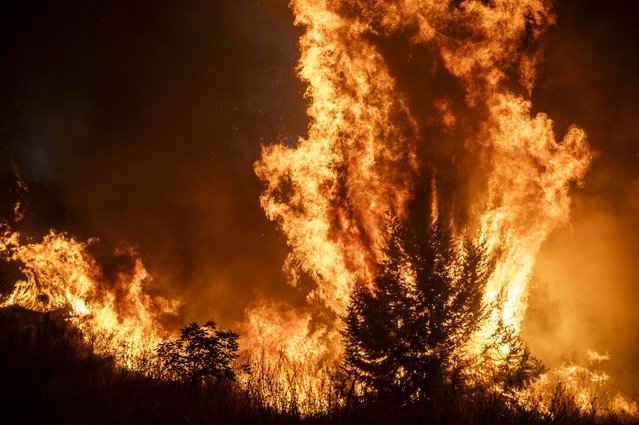
Fire ravages vegetation during the Cerro de los Pinos wildfire on August 04, 2025 in Cáceres, Spain. Firefighters from Cáceres and INFOEX forest firefighters are battling fires, as high temperatures continue to put the Extremadura region at extreme risk of further wildfires. (Photo by Carlos Gil Andreu/Getty Images)

Fire ravages vegetation during the Cerro de los Pinos wildfire on August 04, 2025 in Cáceres, Spain. Firefighters from Cáceres and INFOEX forest firefighters are battling fires, as high temperatures continue to put the Extremadura region at extreme risk of further wildfires. (Photo by Carlos Gil Andreu/Getty Images)
Details
21 Aug 2025 03:30:00
Germany's Darja Varfolomeev competes with a ribbon during the individual apparatus final at the 41st FIG Rhythmic Gymnastics World Championships at Carioca Arena, in Rio de Janeiro, Sunday, August 24, 2025. (Photo by Bruna Prado/AP Photo)

Germany's Darja Varfolomeev competes with a ribbon during the individual apparatus final at the 41st FIG Rhythmic Gymnastics World Championships at Carioca Arena, in Rio de Janeiro, Sunday, August 24, 2025. (Photo by Bruna Prado/AP Photo)
Details
01 Sep 2025 02:46:00
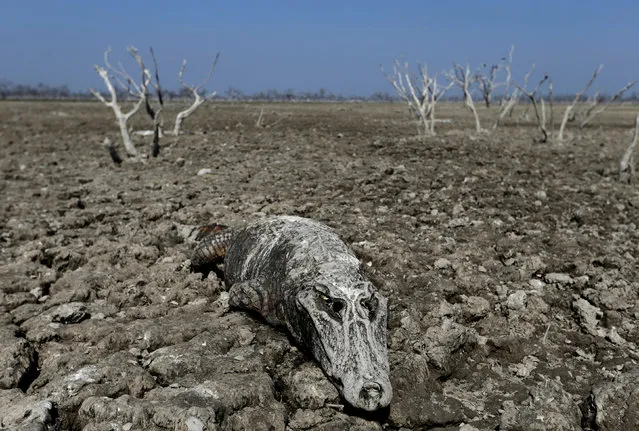
The carcass of a yacare caiman lies in the dried-up river bed of the Pilcomayo river in Boqueron, Paraguay, August 14, 2016. In Paraguay, alongside the Pilcomayo River, black vultures flew over a shrinking pond where a group of crocodilian reptiles known as yacare caimans sought refuge. Water from the river, which divides Paraguay and Argentina in the area of the Gran Chaco, was scarce. This is not an uncommon sight in the region of General Diaz, about 700 kilometres (435 miles) northwest of the country's capital Asuncion, where the Pilcomayo's waters form lakes and streams that give life to capybaras, birds and caimans. “The river's situation is critical. No water is forecast to enter the basin until December, as happens every year”, said Alcides Gonzalez, a resident of the area. (Photo by Jorge Adorno/Reuters)

The carcass of a yacare caiman lies in the dried-up river bed of the Pilcomayo river in Boqueron, Paraguay, August 14, 2016. In Paraguay, alongside the Pilcomayo River, black vultures flew over a shrinking pond where a group of crocodilian reptiles known as yacare caimans sought refuge. Water from the river, which divides Paraguay and Argentina in the area of the Gran Chaco, was scarce. This is not an uncommon sight in the region of General Diaz, about 700 kilometres (435 miles) northwest of the country's capital Asuncion, where the Pilcomayo's waters form lakes and streams that give life to capybaras, birds and caimans. (Photo by Jorge Adorno/Reuters)
Details
03 Nov 2016 12:40:00
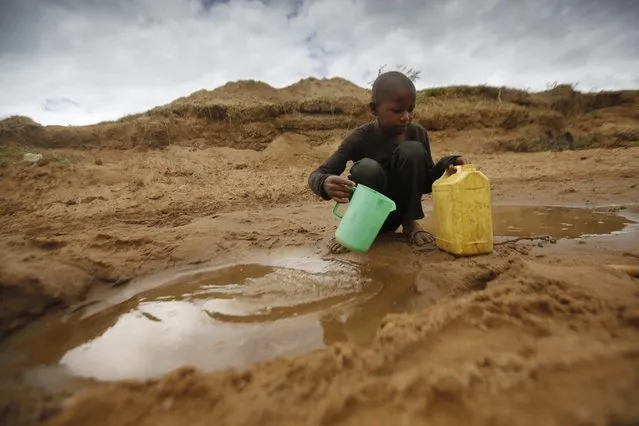
A young boy scoops water from a hand-dug well in the dry riverbed near Matinyani, in the semi-arid Kitui County in southeastern Kenya, 22 March 2015, the World Water Day. Residents of Kitui County and other arid and semi-arid areas of the country have been hard-hit by extremely poor rainfall this year while the government said in previous month that some 1.6 million people countrywide are facing acute starvation due to the drought and will need relief food over the next six months. (Photo by Dai Kurokawa/EPA)

A young boy scoops water from a hand-dug well in the dry riverbed near Matinyani, in the semi-arid Kitui County in southeastern Kenya, 22 March 2015, the World Water Day. Residents of Kitui County and other arid and semi-arid areas of the country have been hard-hit by extremely poor rainfall this year while the government said in previous month that some 1.6 million people countrywide are facing acute starvation due to the drought and will need relief food over the next six months. Residents of Matinyani say they haven't seen a drop of rain in nearly four months. Thousands of Kenyans in rural areas walk tens of kilometers just to fetch water to drink and to be used in their homes. According to an estimate by UNESCO (United Nations Educational, Scientific and Cultural Organization), 17 million people lack access to safe water in Kenya, where the drought is a perennial problem. (Photo by Dai Kurokawa/EPA)
Details
23 Mar 2015 11:01:00
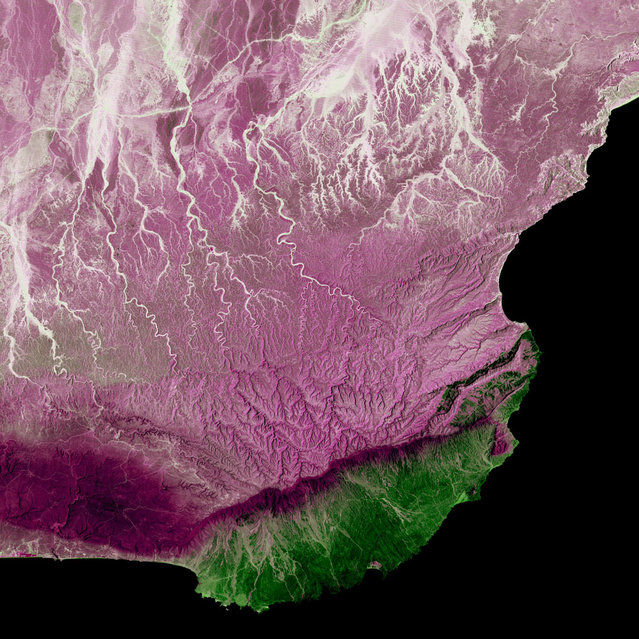
Dhofar Region, Oman. Much of Oman is desert, but the Arabian Sea coast in the Dhofar region represents a startling difference in climate. This coastal region catches the monsoon rains, or khareef, during the summer months. Drenching rains fall primarily on the mountainous ridge that separates the lush, fertile areas along the coast from the arid interior, recharging streams, waterfalls and springs that provide plentiful water supplies in the fertile lowlands for the remainder of the year. Image taken by Landsat 5 on April 2, 2005. (Photo by USGS/NASA)

Dhofar Region, Oman. Much of Oman is desert, but the Arabian Sea coast in the Dhofar region represents a startling difference in climate. This coastal region catches the monsoon rains, or khareef, during the summer months. Drenching rains fall primarily on the mountainous ridge that separates the lush, fertile areas along the coast from the arid interior, recharging streams, waterfalls and springs that provide plentiful water supplies in the fertile lowlands for the remainder of the year. Image taken by Landsat 5 on April 2, 2005. (Photo by USGS/NASA)
Details
25 Dec 2012 11:13:00
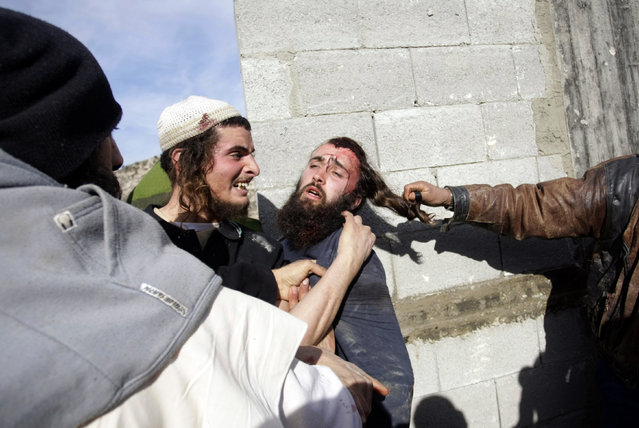
Palestinians hit injured Israeli settlers, center, detained by Palestinian villagers in a building under construction near the West Bank village of Qusra, southeast of the city of Nablus, Tuesday, January 7, 2014. (Photo by Nasser Ishtayeh/AP Photo)

Palestinians hit injured Israeli settlers, center, detained by Palestinian villagers in a building under construction near the West Bank village of Qusra, southeast of the city of Nablus, Tuesday, January 7, 2014. Palestinians held more than a dozen Israeli settlers for about two hours Tuesday in retaliation for the latest in a string of settler attacks on villages in the area, witnesses said. The military said the chain of events apparently began after Israeli authorities removed an illegally built structure in Esh Kodesh, a rogue Israeli settlement in the area. In recent years, militant settlers have often responded to any attempts by the Israeli military to remove parts of dozens of rogue settlements, or outposts, by attacking Palestinians and their property. The tactic, begun in 2008, is known as “price tag”. (Photo by Nasser Ishtayeh/AP Photo)

Details
10 Jan 2014 11:32:00
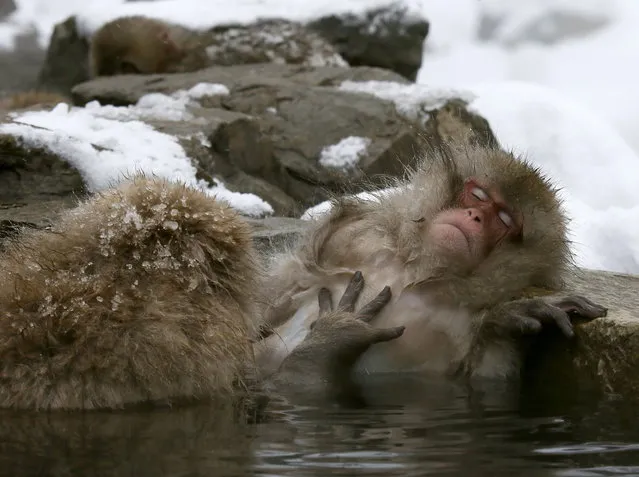
Japanese Macaque monkeys soak in the warmth of mountain hotsprings at Jigokudani Monkey Park, in Yamanouchi, central Japan, 19 January 2014. The Japanese Macaques (Macaca fuscata), also referred to as Snow Monkeys, live freely in this area that is covered by snow one third of the year. (Photo by Kimimasa Mayama/EPA)

Japanese Macaque monkeys soak in the warmth of mountain hotsprings at Jigokudani Monkey Park, in Yamanouchi, central Japan, 19 January 2014. The Japanese Macaques (Macaca fuscata), also referred to as Snow Monkeys, live freely in this area that is covered by snow one third of the year. Jigokudani is the only known place in the world where monkeys bathe in natural hot springs. As a habit, they come down from the mountains where they spend the night and bath during the day. (Photo by Kimimasa Mayama/EPA)
Details
21 Jan 2014 11:36:00
This combination of August 30, 2005 and July 29, 2015 aerial photos shows downtown New Orleans and the Superdome flooded by Hurricane Katrina and the same area a decade later. Katrina's powerful winds and driving rain bore down on Louisiana on August 29, 2005. (Photo by David J. Phillip/Gerald Herbert/AP Photo)

This combination of August 30, 2005 and July 29, 2015 aerial photos shows downtown New Orleans and the Superdome flooded by Hurricane Katrina and the same area a decade later. Katrina's powerful winds and driving rain bore down on Louisiana on August 29, 2005. The storm caused major damage to the Gulf Coast from Texas to central Florida while powering a storm surge that breached the system of levees that were built to protect New Orleans from flooding. (Photo by David J. Phillip/Gerald Herbert/AP Photo)
Details
29 Aug 2015 11:22:00