Loading...
Done
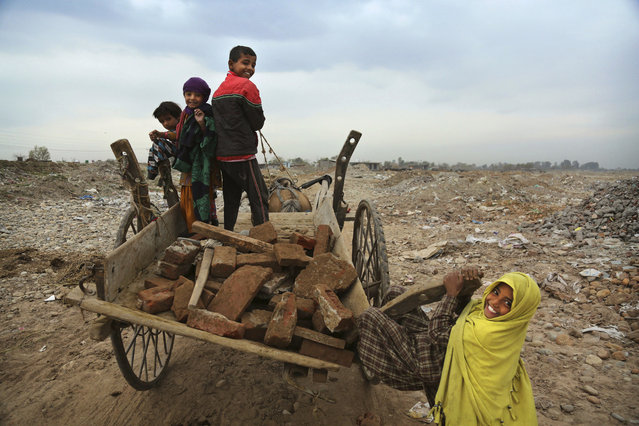
An Indian nomadic Gujjar girl hangs on to a horse cart after collecting bricks from debris on the outskirts of Jammu, India, Tuesday, March 7, 2017. The Gujjar tribal communities are considered by some to be economically and socially backward and the lack of care by the state government has led to resentment amongst the community. The tribe moves to the plains from the hills to escape the cold winters. (Photo by Channi Anand/AP Photo)

An Indian nomadic Gujjar girl hangs on to a horse cart after collecting bricks from debris on the outskirts of Jammu, India, Tuesday, March 7, 2017. The Gujjar tribal communities are considered by some to be economically and socially backward and the lack of care by the state government has led to resentment amongst the community. The tribe moves to the plains from the hills to escape the cold winters. (Photo by Channi Anand/AP Photo)
Details
09 Jun 2017 06:36:00
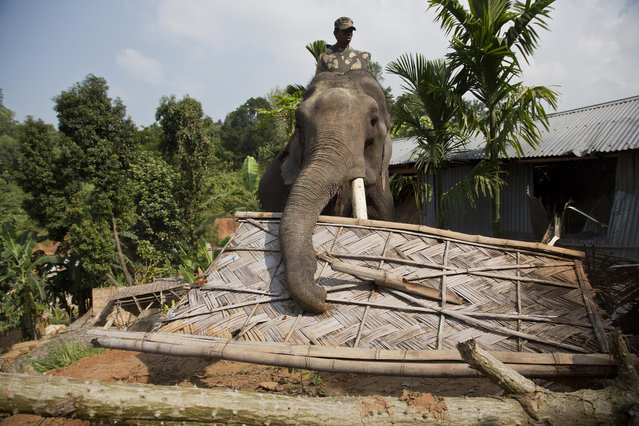
An elephant is used to demolish a house during an eviction drive inside Amchang Wildlife Sanctuary on the outskirts of Gauhati, Assam, India, Monday, November 27, 2017. Indian police on Monday took the unusual step of using elephants in an attempt to evict hundreds of people living illegally in the protected forest area in the country's remote northeast. Police used bulldozers and the elephants in a show of force, and the forest dwellers responded by hurling rocks. (Photo by Anupam Nath/AP Photo)

An elephant is used to demolish a house during an eviction drive inside Amchang Wildlife Sanctuary on the outskirts of Gauhati, Assam, India, Monday, November 27, 2017. Indian police on Monday took the unusual step of using elephants in an attempt to evict hundreds of people living illegally in the protected forest area in the country's remote northeast. Police used bulldozers and the elephants in a show of force, and the forest dwellers responded by hurling rocks. (Photo by Anupam Nath/AP Photo)
Details
29 Nov 2017 09:13:00
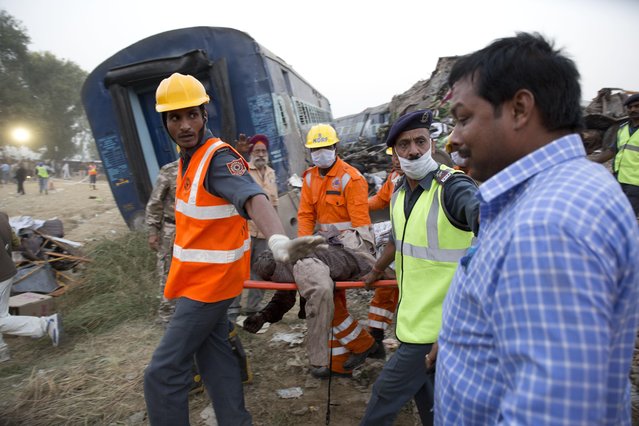
A relative, right, breaks down as rescuers carry the body of a victim after 14 coaches of an overnight passenger train rolled off the track near Pukhrayan village Kanpur Dehat district, Uttar Pradesh state, India, Sunday, November 20, 2016. Dozens were killed and dozens more were injured in the accident. (Photo by Rajesh Kumar Singh/AP Photo)

A relative, right, breaks down as rescuers carry the body of a victim after 14 coaches of an overnight passenger train rolled off the track near Pukhrayan village Kanpur Dehat district, Uttar Pradesh state, India, Sunday, November 20, 2016. Dozens were killed and dozens more were injured in the accident. (Photo by Rajesh Kumar Singh/AP Photo)
Details
21 Nov 2016 10:16:00
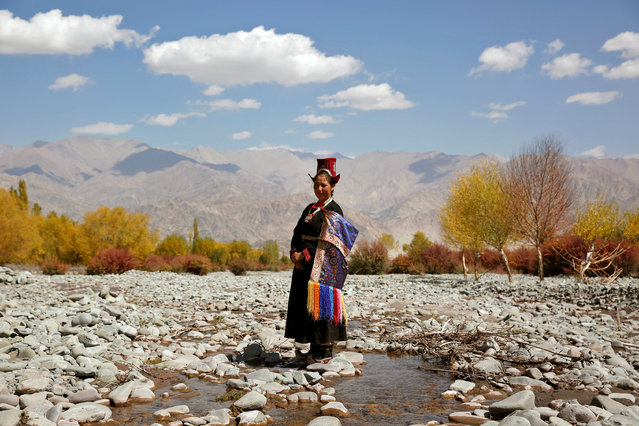
Tsewang Dolma, 33, a farmer and housewife poses for a photograph in Matho, a village nestled high in the Indian Himalayas, India September 29, 2016. When asked how living in the world's fastest growing major economy had affected life, Dolma replied: “Our culture is spoiled now. We don't wear our traditional dress”. (Photo by Cathal McNaughton/Reuters)

Tsewang Dolma, 33, a farmer and housewife poses for a photograph in Matho, a village nestled high in the Indian Himalayas, India September 29, 2016. When asked how living in the world's fastest growing major economy had affected life, Dolma replied: “Our culture is spoiled now. We don't wear our traditional dress”. (Photo by Cathal McNaughton/Reuters)
Details
13 Oct 2016 11:32:00
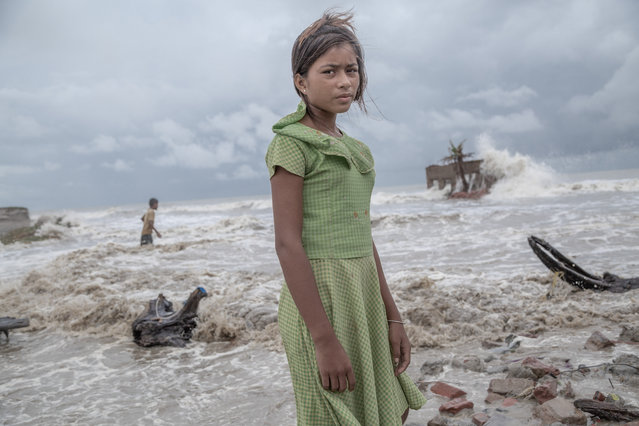
A girl, standing before her tea shop, which is completely ruined by sea water in Frazerganj, Sundarbans, India on August 18, 2020. After Cyclone Aila struck the Sundarbans in 2009, it became clear that frequent cyclonic events will turn the residents of Sundarbans into climate refugees. Within May 5, 2019 – May 25, 2021, Sundarbans faced cyclones- Fani, Bulbul, Amphan & Yaas – each devastating enough to justify the fear of mass displacement. (Photo by Supratim Bhattacharjee/Mangrove Photography Awards)

A girl, standing before her tea shop, which is completely ruined by sea water in Frazerganj, Sundarbans, India on August 18, 2020. After Cyclone Aila struck the Sundarbans in 2009, it became clear that frequent cyclonic events will turn the residents of Sundarbans into climate refugees. Within May 5, 2019 – May 25, 2021, Sundarbans faced cyclones- Fani, Bulbul, Amphan & Yaas – each devastating enough to justify the fear of mass displacement. (Photo by Supratim Bhattacharjee/Mangrove Photography Awards)
Details
26 Sep 2024 03:06:00
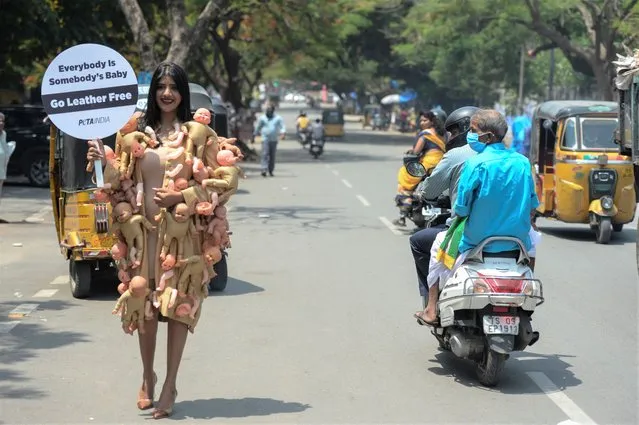
An activist of People for the Ethical Treatment of Animals (PETA) stands along a road wearing a coat with baby dolls to raise awareness about the leather industry, in Hyderabad on May 6, 2022. (Photo by Noah Seelam/AFP Photo)

An activist of People for the Ethical Treatment of Animals (PETA) stands along a road wearing a coat with baby dolls to raise awareness about the leather industry, in Hyderabad, India on May 6, 2022. (Photo by Noah Seelam/AFP Photo)
Details
07 May 2022 05:32:00
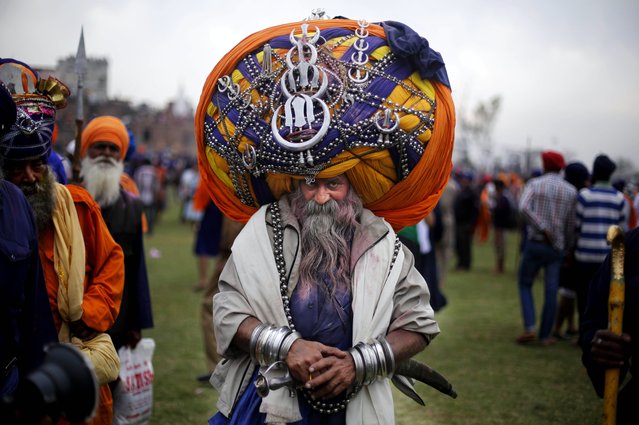
A Sikh warrior, wearing a huge turban attends the annual fair of “Hola Mohalla” in Anandpur Sahib, in the northern Indian state of Punjab, Monday, March 17, 2014. Believers from various parts of northern India collect at the religious fair to celebrate the festival of Holi in a tradition set by the tenth Sikh guru Guru Gobind Singh in the seventeenth century. Nihangs, or Sikh warriors, display their martial skills and attire during the fair, believed to be maintained in the exact tradition as set by the Guru. (Photo by Altaf Qadri/AP Photo)

A Sikh warrior, wearing a huge turban attends the annual fair of “Hola Mohalla” in Anandpur Sahib, in the northern Indian state of Punjab, Monday, March 17, 2014. Believers from various parts of northern India collect at the religious fair to celebrate the festival of Holi in a tradition set by the tenth Sikh guru Guru Gobind Singh in the seventeenth century. Nihangs, or Sikh warriors, display their martial skills and attire during the fair, believed to be maintained in the exact tradition as set by the Guru. (Photo by Altaf Qadri/AP Photo)
Details
22 Mar 2014 13:31:00
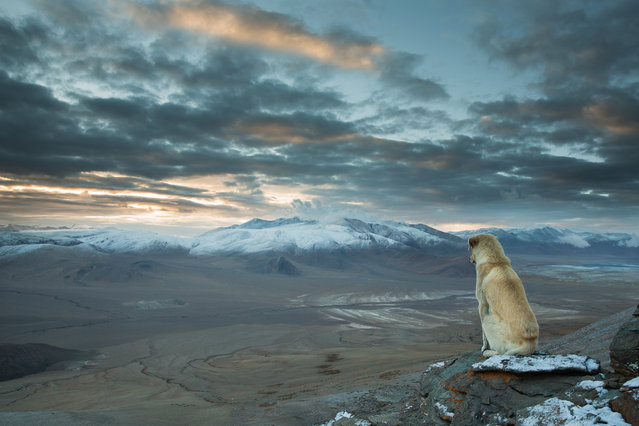
“Himalayan Dog”. This dog just appeared out of nowhere and followed us for an entire week during our trekking trip in the Himalayan outback. He always used to sleep in front of our tent and guarded us in the nights. When I decided to get up at 4 a.m. to climb the next 5000 m peak for sunrise he accompanied me as well. On the top he was sitting for the entire 30 minutes on this place looking straight into the countryside. Photo location: Ladakh, India. (Photo and caption by Sebastian Wahlhuetter/National Geographic Photo Contest)

“Himalayan Dog”. This dog just appeared out of nowhere and followed us for an entire week during our trekking trip in the Himalayan outback. He always used to sleep in front of our tent and guarded us in the nights. When I decided to get up at 4 a.m. to climb the next 5000 m peak for sunrise he accompanied me as well. On the top he was sitting for the entire 30 minutes on this place looking straight into the countryside. Photo location: Ladakh, India. (Photo and caption by Sebastian Wahlhuetter/National Geographic Photo Contest)
Details
01 Apr 2014 10:47:00