Loading...
Done
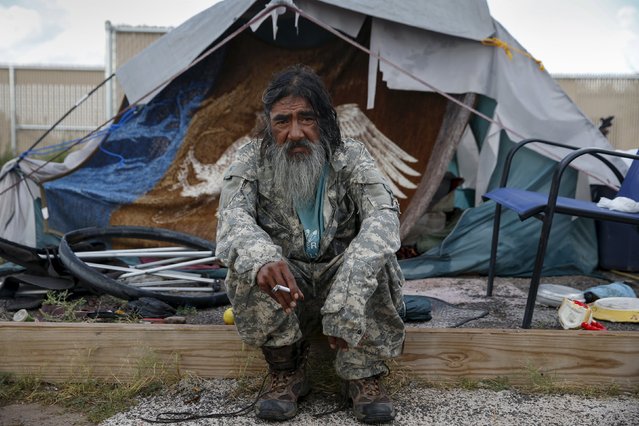
Daniel J. Wabsey, a 58-year-old war veteran, sits outside his tent at Camp Hope in Las Cruces, New Mexico October 6, 2015. “I've been traveling for 35 or 38 years. Getting inside would take a while to get used to. I just want to be able to eat, sleep and be safe. We all get along and understand in Camp Hope. We've all been there. With common sense you can survive out here”, Wabsey said. Camp Hope describe themselves as an “alternative transitional living project for the homeless”. Around 50 people live at the camp. (Photo by Shannon Stapleton/Reuters)

Daniel J. Wabsey, a 58-year-old war veteran, sits outside his tent at Camp Hope in Las Cruces, New Mexico October 6, 2015. “I've been traveling for 35 or 38 years. Getting inside would take a while to get used to. I just want to be able to eat, sleep and be safe. We all get along and understand in Camp Hope. We've all been there. With common sense you can survive out here”, Wabsey said. Camp Hope describe themselves as an “alternative transitional living project for the homeless”. Around 50 people live at the camp. (Photo by Shannon Stapleton/Reuters)
Details
19 Dec 2015 08:05:00
From Britain to China to Mali, new maps showing travel times to the nearest urban centre reveal huge differences between countries. Using Open Street Map and Google, a University of Oxford team have created a visual breakdown that suggests major inequalities when it comes to commuting. Here: China. The dataset used for China was unique as it relied solely on Open Street Map, due to restrictions on accessing Google data. The population is densely concentrated in the east and accessibility is increased, whereas rural provinces in the west remain remote. (Photo by Daniel Weiss/Jennifer Rozier/Malaria Atlas Project/University of Oxford )

From Britain to China to Mali, new maps showing travel times to the nearest urban centre reveal huge differences between countries. Using Open Street Map and Google, a University of Oxford team have created a visual breakdown that suggests major inequalities when it comes to commuting. Here: China. The dataset used for China was unique as it relied solely on Open Street Map, due to restrictions on accessing Google data. The population is densely concentrated in the east and accessibility is increased, whereas rural provinces in the west remain remote. (Photo by Daniel Weiss/Jennifer Rozier/Malaria Atlas Project/University of Oxford)
Details
12 Jan 2018 06:43:00
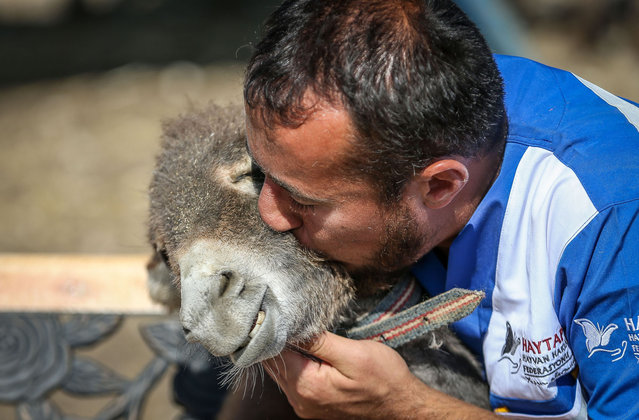
A worker caresses a donkey at the Retired Animals Farm in Turkey's Bursa on October 01, 2020. Animal Rights Federation in Turkey (HAYTAP) established a “Retired Animals Farm” in Bursa for animals that were tortured, thrown out by their owners, injured and in need of assistance for similar reasons. Built in the neighborhood of Baskoy in Nilufer district after long term efforts, the farm provides a home to animals of many species, such as horse, donkey, cow, sheep, chicken from all around Turkey. The farm project receives support from various institutions and organizations. (Photo by Sergen Sezgin/Anadolu Agency via Getty Images)

A worker caresses a donkey at the Retired Animals Farm in Turkey's Bursa on October 01, 2020. Animal Rights Federation in Turkey (HAYTAP) established a “Retired Animals Farm” in Bursa for animals that were tortured, thrown out by their owners, injured and in need of assistance for similar reasons. Built in the neighborhood of Baskoy in Nilufer district after long term efforts, the farm provides a home to animals of many species, such as horse, donkey, cow, sheep, chicken from all around Turkey. The farm project receives support from various institutions and organizations. (Photo by Sergen Sezgin/Anadolu Agency via Getty Images)
Details
22 Oct 2020 00:01:00
Van cats, relatively large, have a chalky white coat, sometimes with ruddy coloration on the head and hindquarters, and have blue or amber eyes or have heterochromia, are seen at “Cat Villa”, established to protect the cats in Van, Turkey on January 20, 2021. Internationally valid “health certificate” is prepared for Van cats, visited by local and foreign tourists, within a project to protect their generations and increasing their numbers. Health certificates with information such as name, breed, gender, eye color, date of birth, tail feature, color, hearing status and identity are given to people who want to adopt cats. (Photo by Mesut Varol/Anadolu Agency via Getty Images)

Van cats, relatively large, have a chalky white coat, sometimes with ruddy coloration on the head and hindquarters, and have blue or amber eyes or have heterochromia, are seen at “Cat Villa”, established to protect the cats in Van, Turkey on January 20, 2021. Internationally valid “health certificate” is prepared for Van cats, visited by local and foreign tourists, within a project to protect their generations and increasing their numbers. Health certificates with information such as name, breed, gender, eye color, date of birth, tail feature, color, hearing status and identity are given to people who want to adopt cats. (Photo by Mesut Varol/Anadolu Agency via Getty Images)
Details
29 Jan 2021 09:43:00
In this July 23, 2013 photo, sand fills an abandoned house in Kolmanskop, Namibia. Kolmanskop, was a diamond mining town south of Namibia, build in 1908 and deserted in 1956. SInce then, the desert slowly reclaims its territory, with sand invading the buildings where 350 German colonists and more than 800 local workers lived during its hay-days of the 1920s. (Photo by Jerome Delay/AP Photo)

In this July 23, 2013 photo, sand fills an abandoned house in Kolmanskop, Namibia. Kolmanskop, was a diamond mining town south of Namibia, build in 1908 and deserted in 1956. SInce then, the desert slowly reclaims its territory, with sand invading the buildings where 350 German colonists and more than 800 local workers lived during its hay-days of the 1920s. (Photo by Jerome Delay/AP Photo)
Details
14 Nov 2014 14:34:00
Hook, an indigenous Moken man, holds a three-pronged throwing spear and searches for fish in the waters of Ko Surin National Park. March 1, 2013 – Ko Surin, Thailand. (Photo by Taylor Weidman/zReportage via ZUMA Press)

“For centuries, the Moken sea nomads have traveled the islands between Thailand and Myanmar fishing and foraging for food on the sea floor. Throughout the Mergui Archipelago, Moken migrate in flotillas of Kabangs (traditional boat of the Moken people), stopping at different islands and beaches. Expert freedivers, the Moken have adapted physically to an aquatic life, developing unique characteristics that let them see better and hold their breath longer while underwater”. – Taylor Weidman. Photo: Hook, an indigenous Moken man, holds a three-pronged throwing spear and searches for fish in the waters of Ko Surin National Park. March 1, 2013 – Ko Surin, Thailand. (Photo by Taylor Weidman/zReportage via ZUMA Press)
Details
24 Mar 2014 06:45:00
A finished Fender Stratocaster is adjusted by Kenneth Maas in the Fender Custom Shop in Corona, Calif. on Tuesday, October 15, 2013. Leo Fender developed the instrument in a small workshop in Fullerton, Calif. six decades ago. (Photo by Matt York/AP Photo)

“Jimi Hendrix made it shriek. Buddy Holly made it swing. Stevie Ray Vaughn made it snarl. Some of the most legendary guitarists in music history have elicited unforgettable sounds from the Fender Stratocaster, the distinctive double-cutaway guitar born in a small Fullerton, Calif., workshop 60 years ago this month”. – Associated Press. Photo: A finished Fender Stratocaster is adjusted by Kenneth Maas in the Fender Custom Shop in Corona, Calif. on Tuesday, October 15, 2013. Leo Fender developed the instrument in a small workshop in Fullerton, Calif. six decades ago. (Photo by Matt York/AP Photo)
Details
22 Apr 2014 10:52:00
A Tibetan mastiff dog is displayed for sale at a mastiff show in Baoding, Hebei province, south of Beijing on March 9, 2013. Fetching prices up to around 750,000 USD, mastiffs have become a prized status-symbol amongst China's wealthy, with rich buyers across the country sending prices skyrocketing. Owners say the mastiffs, descendents of dogs used for hunting by nomadic tribes in central Asia and Tibet are fiercely loyal and protective. (Photo by Ed Jones/AFP Photo)

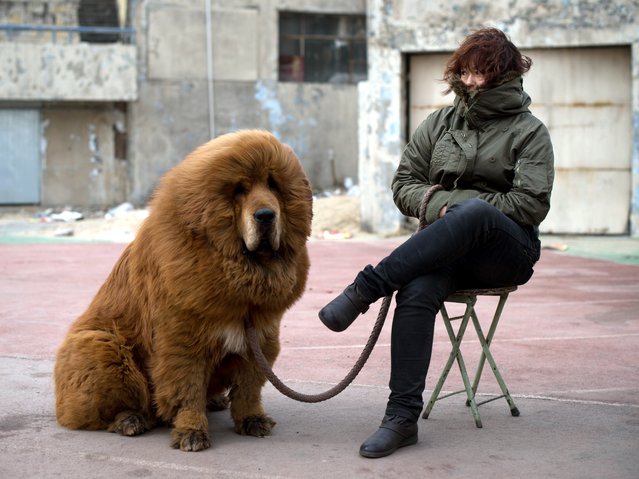
A Tibetan mastiff dog is displayed for sale at a mastiff show in Baoding, Hebei province, south of Beijing on March 9, 2013. Fetching prices up to around 750,000 USD, mastiffs have become a prized status-symbol amongst China's wealthy, with rich buyers across the country sending prices skyrocketing. Owners say the mastiffs, descendents of dogs used for hunting by nomadic tribes in central Asia and Tibet are fiercely loyal and protective. Breeders still travel to the Himalayan plateau to collect young puppies, although many are unable to adjust to the low altitudes and die during the journey. (Photo by Ed Jones/AFP Photo)
Details
02 May 2014 09:40:00