Loading...
Done
Layers of breathtaking colour streak the rolling hills of this vast desert, making the landscape appear as though it has been tie-dyed. The natural phenomenon, nicknamed the “Painted Desert”, was formed when the area was once a river floodplain. (Photo by Mark Brodkin/Solent News/SIPA Press)

Layers of breathtaking colour streak the rolling hills of this vast desert, making the landscape appear as though it has been tie-dyed. The natural phenomenon, nicknamed the “Painted Desert”, was formed when the area was once a river floodplain. Each colour corresponds to a different underground geological feature – rocks which have seemingly dyed the layers of earth above. Formed from volcanic activity, the hills at the John Day Fossil Beds National Monument in East Central Oregon, USA, are almost bursting with colour. Pictured: The colourful hills at the John Day Fossil Beds National Monument in East Central Oregon, USA. (Photo by Mark Brodkin/Solent News/SIPA Press)
Details
30 Jul 2014 11:00:00
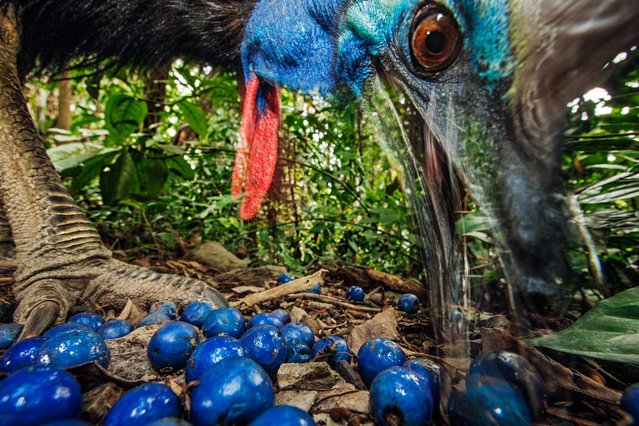
“Cassowaries are large, flightless birds related to emus and (more distantly) to ostriches, rheas, and kiwis”, writes Olivia Judson in the September issue of National Geographic magazine. (Photo by Christian Ziegler/National Geographic)

“Cassowaries are large, flightless birds related to emus and (more distantly) to ostriches, rheas, and kiwis”, writes Olivia Judson in the September issue of National Geographic magazine. How large? People-size: Adult males stand well over five foot five and top 110 pounds. Females are even taller, and can weigh more than 160 pounds. Dangerous when roused, they’re shy and peaceable when left alone. But even birds this big and tough are prey to habitat loss. The dense New Guinea and Australia rain forests where they live have dwindled. Today cassowaries might number 1,500 to 2,000. And because they help shape those same forests – by moving seeds from one place to another – “if they vanish”, Judson writes, “the structure of the forest would gradually change” too. (Photo by Christian Ziegler/National Geographic)
Details
06 Jan 2014 12:21:00
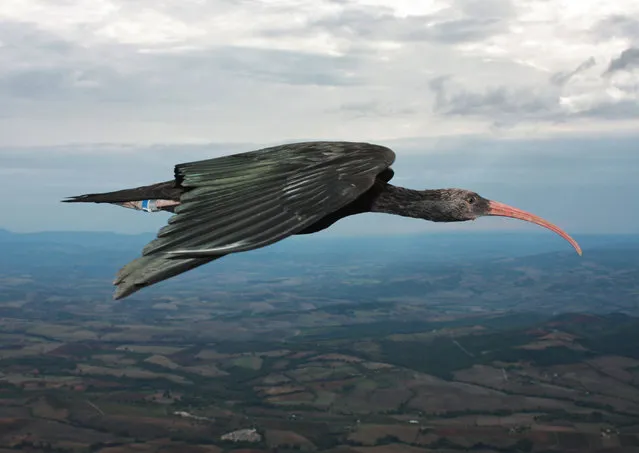
In this undated photo made available by journal Nature on January 15, 2014, a northern bald ibis (Geronticus eremita) flies in Tuscany, Italy. A new study released Wednesday, January 15, 2014 says the birds choreograph the flapping of their wings, getting a boost from an updraft of air in the wake of the flapping wings by flying behind the first bird and off to the side. When a flock of birds take advantage of these aerodynamics, they form a V. (Photo by Markus Unsöld/AP Photo)

In this undated photo made available by journal Nature on January 15, 2014, a northern bald ibis (Geronticus eremita) flies in Tuscany, Italy. A new study released Wednesday, January 15, 2014 says the birds choreograph the flapping of their wings, getting a boost from an updraft of air in the wake of the flapping wings by flying behind the first bird and off to the side. When a flock of birds take advantage of these aerodynamics, they form a V. (Photo by Markus Unsöld/AP Photo)
Details
18 Jan 2014 13:54:00
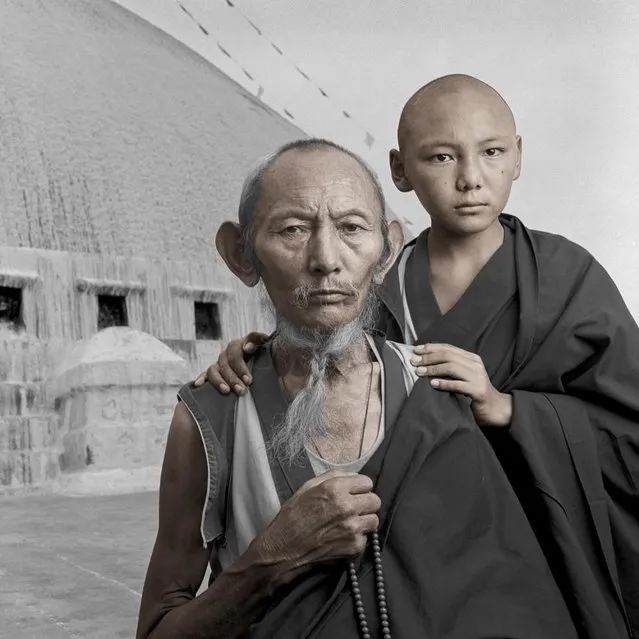
“Lobsang and 66 fellow monks were imprisoned in 1959. When released 21 years later, he was one of only three survivors. While in prison his best friend, a rinpoche, died in his arms. Tensin was later discovered to be the reincarnation of that friend. Lobsang said there are so many characteristics of his old friend in the young boy”. (Phil Borges)

“Lobsang and 66 fellow monks were imprisoned in 1959. When released 21 years later, he was one of only three survivors. While in prison his best friend, a rinpoche, died in his arms. Tensin was later discovered to be the reincarnation of that friend. Lobsang said there are so many characteristics of his old friend in the young boy”. (Photo and caption by Phil Borges)
Details
06 Mar 2014 14:01:00
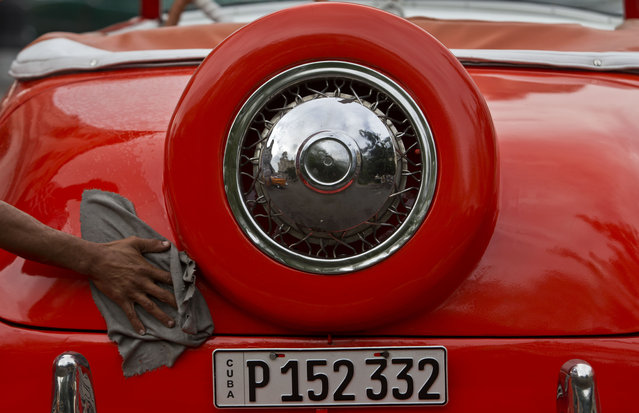
In this October 16, 2014 photo, a man cleans his American classic car before going to work in Havana, Cuba. While the U.S. embargo that took effect in 1961 stopped the flow of new cars, and most parts, a few Cubans now manage to bring in replacement parts when friends or family visit from the U.S. (Photo by Franklin Reyes/AP Photo)

In this October 16, 2014 photo, a man cleans his American classic car before going to work in Havana, Cuba. While the U.S. embargo that took effect in 1961 stopped the flow of new cars, and most parts, a few Cubans now manage to bring in replacement parts when friends or family visit from the U.S. (Photo by Franklin Reyes/AP Photo)
Details
20 Oct 2014 09:01:00
A general view showing the shipwrecked cruise ship Costa Concordia in an upright position after the salvage operations in Giglio island, Italy, 17 September 2013. Salvage crews pulled off a major engineering feat when they straightened the listed Costa Concordia cruise ship from the rocks it had been wedged against for the past 20 months. The delicate operation took 19 hours and was completed at 4 am (0200 GMT). The vessel ran aground near the island of Giglio, in Tuscany, in an accident that made world-wide news. (Photo by Angelo Carconi/EPA)

A general view showing the shipwrecked cruise ship Costa Concordia in an upright position after the salvage operations in Giglio island, Italy, 17 September 2013. Salvage crews pulled off a major engineering feat when they straightened the listed Costa Concordia cruise ship from the rocks it had been wedged against for the past 20 months. The delicate operation took 19 hours and was completed at 4 am (0200 GMT). The vessel ran aground near the island of Giglio, in Tuscany, in an accident that made world-wide news. (Photo by Angelo Carconi/EPA)
Details
18 Sep 2013 09:27:00
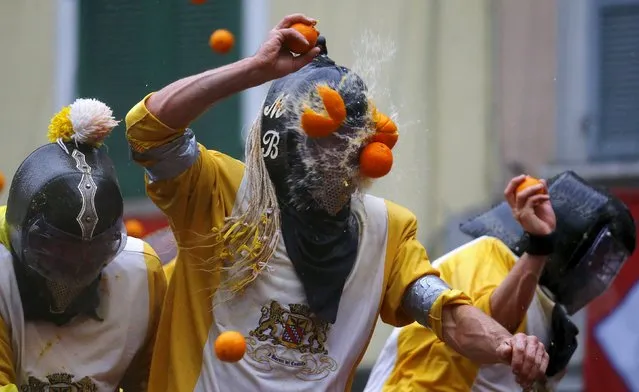
A participant is hit by an orange during an annual carnival battle in the northern Italian town of Ivrea February 7, 2016. Dressed up as Middle Age kings' guards, a group of men ride in a horse-drawn carriage and pelt “foot soldiers” with oranges as thousands of people gather to re-enact a Middle Age battle when the townsfolk of Ivrea overthrew an evil king. In a strange twist, instead of swords and cross bows, these days the weapons of choice are oranges. (Photo by Stefano Rellandini/Reuters)

A participant is hit by an orange during an annual carnival battle in the northern Italian town of Ivrea February 7, 2016. Dressed up as Middle Age kings' guards, a group of men ride in a horse-drawn carriage and pelt “foot soldiers” with oranges as thousands of people gather to re-enact a Middle Age battle when the townsfolk of Ivrea overthrew an evil king. In a strange twist, instead of swords and cross bows, these days the weapons of choice are oranges. (Photo by Stefano Rellandini/Reuters)
Details
08 Feb 2016 12:03:00
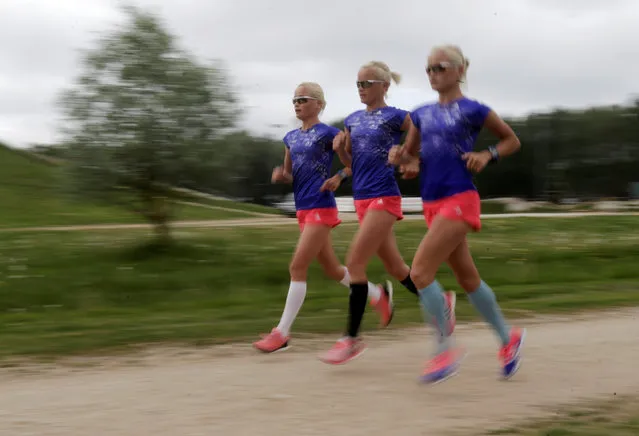
Estonia's olympic team female marathon runners triplets (L-R) Lily, Liina and Leila Luik run during a training session in Tartu, Estonia, May 26, 2016. Leila, Liina and Lily Luik will make Olympics history as the first identical triplets to compete against each other when they cross the start line for the women's marathon in Rio. (Photo by Ints Kalnins/Reuters)

Estonia's olympic team female marathon runners triplets (L-R) Lily, Liina and Leila Luik run during a training session in Tartu, Estonia, May 26, 2016. Leila, Liina and Lily Luik will make Olympics history as the first identical triplets to compete against each other when they cross the start line for the women's marathon in Rio. (Photo by Ints Kalnins/Reuters)
Details
27 May 2016 13:04:00