Loading...
Done
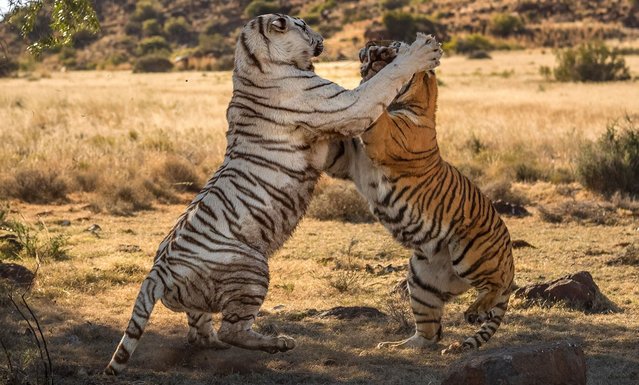
Dont get catty. These roar-some images show the moment two female tigers came to blows in a bitter dispute over territory. Rarely ever seen in the wild let alone on camera, the dramatic images show a white Siberian tiger and orange-coloured tiger slashing ferociously at each others face and eyes. (Photo by Alex Kirichko/Caters News/SIPA Press)

Dont get catty. These roar-some images show the moment two female tigers came to blows in a bitter dispute over territory. Rarely ever seen in the wild let alone on camera, the dramatic images show a white Siberian tiger and orange-coloured tiger slashing ferociously at each others face and eyes. The intense altercation erupted into violence when the smallest of the pair, the orange striped tiger known as Shadow, attempted to expand its hunting ground. But white tiger, TiBo, wasnt willing to give up the ground without a fight and was forced to use its size and weight to put Shadow firmly back in her place. (Photo by Alex Kirichko/Caters News/SIPA Press)
Details
26 Dec 2014 15:28:00
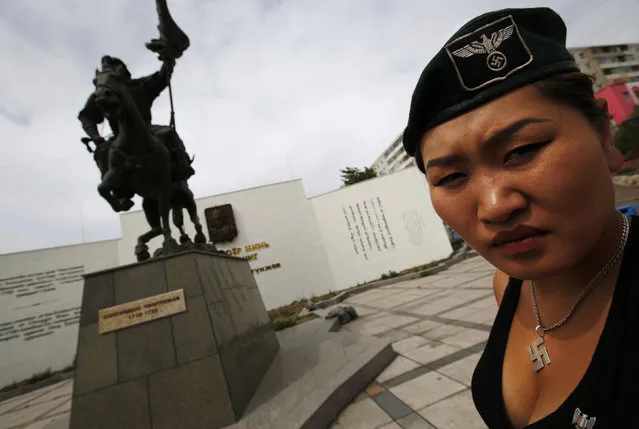
Uranjargal, a leader of the Mongolian neo-Nazi group Tsagaan Khass, stands next to a statue of Chingunjav, a Mongolian national hero, in Ulan Bator June 22, 2013. (Photo by Carlos Barria/Reuters)

Uranjargal, a leader of the Mongolian neo-Nazi group Tsagaan Khass, stands next to a statue of Chingunjav, a Mongolian national hero, in Ulan Bator June 22, 2013. The group has rebranded itself as an environmentalist organisation fighting pollution by foreign-owned mines, seeking legitimacy as it sends Swastika-wearing members to check mining permits. Over the past years, ultra-nationalist groups have expanded in the country and among those garnering attention is Tsagaan Khass, which has recently shifted its focus from activities such as attacks on women it accuses of consorting with foreign men to environmental issues, with the stated goal of protecting Mongolia from foreign mining interests. This ultra-nationalist group was founded in the 1990s and currently has 100-plus members. (Photo by Carlos Barria/Reuters)
Details
09 Jul 2013 07:23:00
Giant's Causeway

Legend has it that the Irish warrior Fionn mac Cumhaill (Finn McCool) built the causeway to walk to Scotland to fight his Scottish counterpart Benandonner. One version of the legend tells that Fionn fell asleep before he got to Scotland. When he did not arrive, the much larger Benandonner crossed the bridge looking for him. To protect Fionn, his wife Oonagh laid a blanket over him so he could pretend that he was actually their baby son. In a variation, Fionn fled after seeing Benandonner's great bulk, and asked his wife to disguise him as the baby. In both versions, when Benandonner saw the size of the 'infant', he assumed the alleged father, Fionn, must be gigantic indeed. Therefore, Benandonner fled home in terror, ripping up the Causeway in case he was followed by Fionn.
Details
11 May 2015 10:45:00
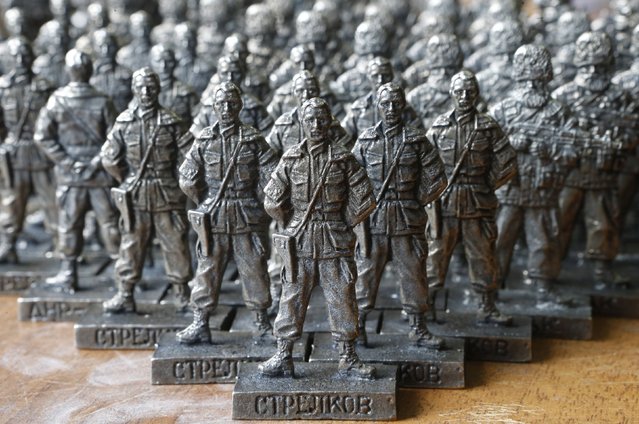
Figurines of former pro-Russian separatist commander Igor Strelkov from the collection entitled “Toy Soldiers of Novorossiya” are on display at a workshop in Moscow August 29, 2014. (Photo by Sergei Karpukhin/Reuters)

Figurines of former pro-Russian separatist commander Igor Strelkov from the collection entitled “Toy Soldiers of Novorossiya” are on display at a workshop in Moscow August 29, 2014. A Moscow-based maker of toy soldiers has sought inspiration for his creations from Ukrainian rebels fighting government troops in the east of Ukraine. Toy soldier maker, Timur Zamilov, displayed his new collection of rebel fighters cast in metal on Friday, before they are due to go on sale. His new collection is entitled “Toy Soldiers of Novorossiya” (New Russia), a reference to regions in eastern Ukraine where pro-Russian separatist fighters want full independence. Zamilov's selection includes models of Cossack soldiers, volunteers, soldiers bearing anti-aircraft missiles and even a miniature of prominent rebel leader Igor Strelkov. (Photo by Sergei Karpukhin/Reuters)
Details
01 Sep 2014 10:21:00
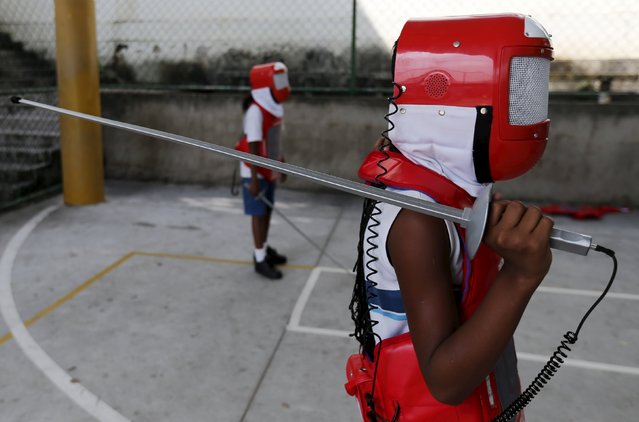
A child, from Municipal school Parana, poses during the project “Fencing School” in Rio de Janeiro, Brazil, March 30, 2016. (Photo by Sergio Moraes/Reuters)

A child, from Municipal school Parana, poses during the project “Fencing School” in Rio de Janeiro, Brazil, March 30, 2016. Children in Rio de Janeiro lift their sights and their swords to new idols, as a round of fencing workshops takes to public schools. The International Fencing Federation, together with the Brazilian and state federations, will reach 40 public schools in March and April. The aim is to whip up a following for the Olympic sport, little known in the soccer-mad nation, as Rio sets the stage for the Summer Games in August. (Photo by Sergio Moraes/Reuters)
Details
02 Apr 2016 09:25:00
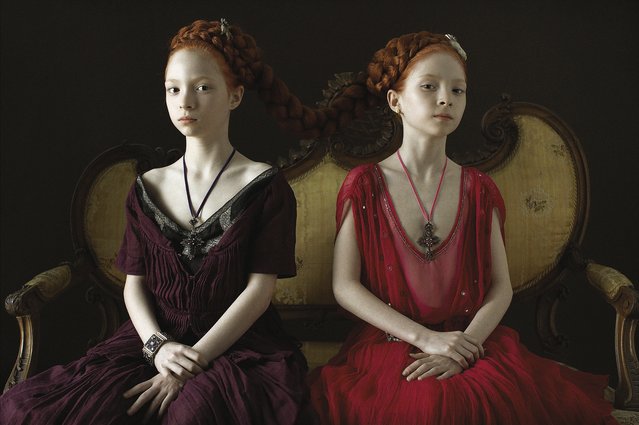
Photograph: Sandrine Kerfante.

Sandrine Kerfante has had a fascination with “doubles” ever since meeting her mother’s twin as a child. In 2012, this lifelong captivation inspired her to create a blog called twin-niwt, which celebrates photographs of doubles in all their forms. “I’m fascinated by the idea of the duo, repetition, symmetry, reflection, mirror games and all the symbolism associated with it”, she says. “I think it’s a topic often present in photography, more or less consciously”. (Photo by Sandrine Kerfante/The Guardian)
Details
21 Aug 2016 11:01:00
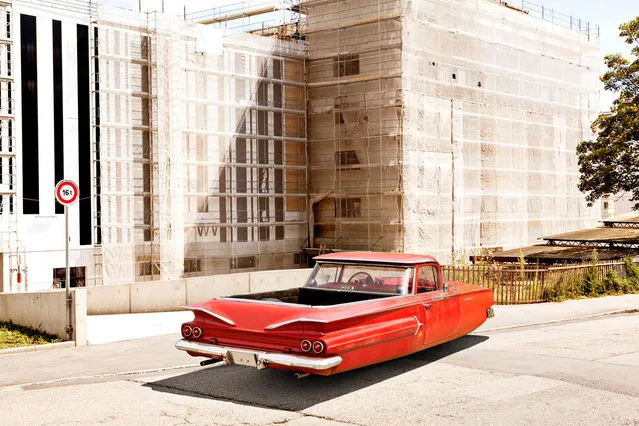
‘‘Air Drive’’ by Photographer Renaud Marion

Τhe hovering car without wheels, also called the hovercar, is a constant fixture in science fiction films, video games and comic books, and a long-standing dream for car lovers and technology fans alike. This dream is also shared by French photographer Renaud Marion, who creates images depicting hovering cars in everyday urban settings. In his ongoing photographic project titled ‘‘Air Drive’’, Marion combines retro car designs with futuristic technology, a project driven by his childhood visions of how the world was going to look like in the future. (Photo by Renaud Marion)
Details
13 Jul 2014 10:43:00
barbarian-art

To produce the images that convey his fatalistic and ironic approach to life, tinged with hope, he needed the environment and knowledge of Mother Russia, oiled with a bit of bribery to certain circus trainers. Enter the Great Russian Bear, the personification of Russia for the last several centuries, onto center stage and into his studio. The bear is recognized as both brutish and cute – Misha was the mascot for the 1980 Olympic Games – and has remained a symbol of Russia since Tsarist times. In 2009 it is the symbol of the United Russia Party.
Details
13 Apr 2015 09:10:00