Loading...
Done
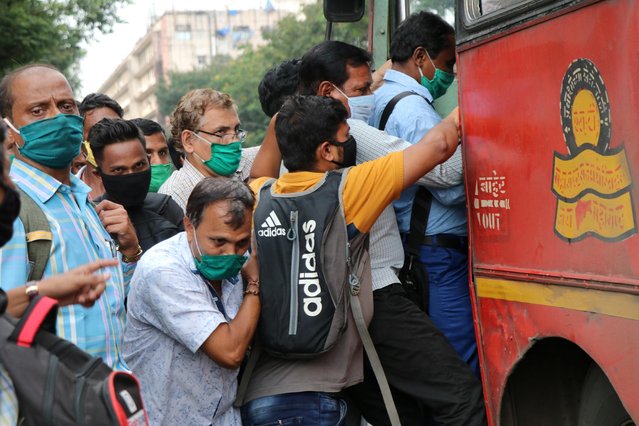
People board a passenger bus during rush hour at a bus terminal, amidst the coronavirus disease (COVID-19) outbreak, in Mumbai, India, September 9, 2020. (Photo by Niharika Kulkarni/Reuters)

People board a passenger bus during rush hour at a bus terminal, amidst the coronavirus disease (COVID-19) outbreak, in Mumbai, India, September 9, 2020. (Photo by Niharika Kulkarni/Reuters)
Details
15 Sep 2020 00:05:00
A zoo performer smiles as he puts his head between the jaws of a crocodile during a performance for tourists at the Sriracha Tiger Zoo, in Chonburi province, east of Bangkok,Thailand, June 7, 2016. (Photo by Chaiwat Subprasom/Reuters)

A zoo performer smiles as he puts his head between the jaws of a crocodile during a performance for tourists at the Sriracha Tiger Zoo, in Chonburi province, east of Bangkok,Thailand, June 7, 2016. (Photo by Chaiwat Subprasom/Reuters)
Details
08 Jun 2016 10:35:00
Green Bay Packers' Johnathan Calvin rides a bike to NFL football training camp on July 27, 2017, in Green Bay, Wis. (Photo by Morry Gash/AP Photo)

Green Bay Packers' Johnathan Calvin rides a bike to NFL football training camp on July 27, 2017, in Green Bay, Wis. (Photo by Morry Gash/AP Photo)
Details
21 Dec 2017 06:44:00
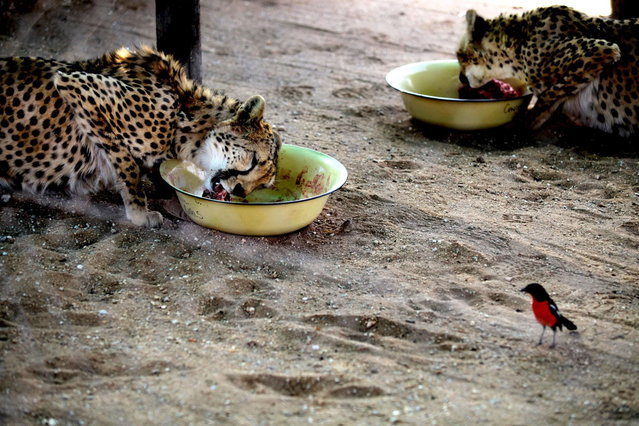
Young cheetahs eat meat at The Cheetah Conservation Fund (CCF) center in Otjiwarongo, Namibia, on August 13, 2013. The CCF started breeding Anatolian livestock dogs to promote cheetah-friendly farming after some 10,000 big cats – the current total worldwide population – were killed or moved off farms in the 1980s.  Up to 1,000 cheetahs were being killed a year, mostly by farmers who saw them as livestock killers. But the use of dogs has slashed losses for sheep and goat farmers and led to less retaliation against the vulnerable cheetah. (Photo by Jennifer Bruce/AFP Photo)

Young cheetahs eat meat at The Cheetah Conservation Fund (CCF) center in Otjiwarongo, Namibia, on August 13, 2013. The CCF started breeding Anatolian livestock dogs to promote cheetah-friendly farming after some 10,000 big cats – the current total worldwide population – were killed or moved off farms in the 1980s. Up to 1,000 cheetahs were being killed a year, mostly by farmers who saw them as livestock killers. But the use of dogs has slashed losses for sheep and goat farmers and led to less retaliation against the vulnerable cheetah. (Photo by Jennifer Bruce/AFP Photo)
Details
29 Aug 2013 10:56:00
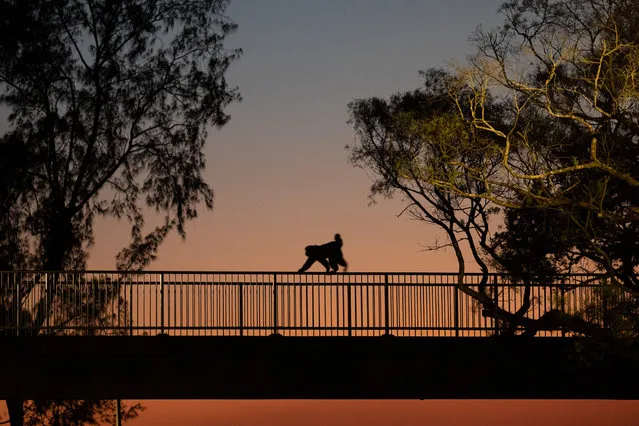
A macaque crosses a pedestrian overpass in Hong Kong, China, 08 November 2021. According the Agriculture, Fisheries and Conservation Department, AFCD, the total population of wild monkeys in Hong Kong is about 1,800, distributed in 30 social troops. (Photo by Jerome Favre/EPA/EFE)

A macaque crosses a pedestrian overpass in Hong Kong, China, 08 November 2021. According the Agriculture, Fisheries and Conservation Department, AFCD, the total population of wild monkeys in Hong Kong is about 1,800, distributed in 30 social troops. (Photo by Jerome Favre/EPA/EFE)
Details
15 Nov 2021 08:44:00
Volunteers throw a mixture of water, neem herb and turmeric as an alleged natural disinfectant on a street in a residential area during a government-imposed nationwide lockdown as a preventive measure against the COVID-19 coronavirus, in Chennai on April 7, 2020. (Photo by Arun Sankar/AFP Photo)

Volunteers throw a mixture of water, neem herb and turmeric as an alleged natural disinfectant on a street in a residential area during a government-imposed nationwide lockdown as a preventive measure against the COVID-19 coronavirus, in Chennai on April 7, 2020. (Photo by Arun Sankar/AFP Photo)
Details
20 Apr 2020 00:03:00
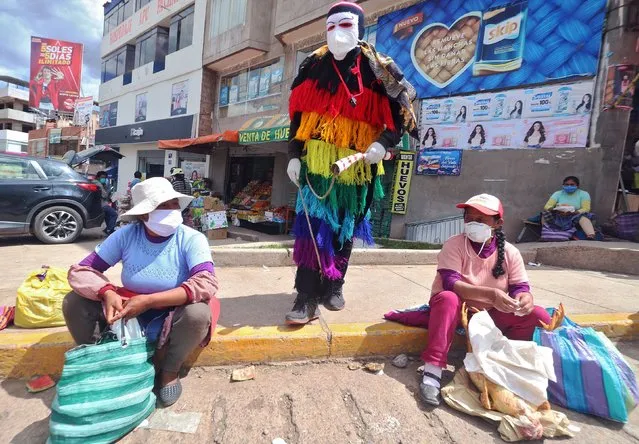
A man dressed in Andean attire as “Ukukus” or “Pabluchas”, a traditional character that acts as a vigilante imposing social order, uses a whip as a threat to force people to maintain their distance and remind them to wear face masks and gloves as a preventive measure against the novel coronavirus COVID-19, in the Vinocanchon market area in San Jeronimo district, close to the Peruvian Andean city of Cusco, on May 2, 2020. The government has identified public markets as major hotspots of the new coronavirus in Peru, where 40,459 confirmed cases and 1,124 deaths were reported on May 1. (Photo by Jose Carlos Angulo/AFP Photo)

A man dressed in Andean attire as “Ukukus” or “Pabluchas”, a traditional character that acts as a vigilante imposing social order, uses a whip as a threat to force people to maintain their distance and remind them to wear face masks and gloves as a preventive measure against the novel coronavirus COVID-19, in the Vinocanchon market area in San Jeronimo district, close to the Peruvian Andean city of Cusco, on May 2, 2020. The government has identified public markets as major hotspots of the new coronavirus in Peru, where 40,459 confirmed cases and 1,124 deaths were reported on May 1. (Photo by Jose Carlos Angulo/AFP Photo)

Details
04 May 2020 00:07:00
A woman makes use of a still day on Inle Lake in Burma on January 16, 2020 by drying newly-dyed threads made out of lotus stems. (Photo by Sabina Akter/Solent News)

A woman makes use of a still day on Inle Lake in Burma on January 16, 2020 by drying newly-dyed threads made out of lotus stems. (Photo by Sabina Akter/Solent News)
Details
20 Jun 2020 00:05:00