Loading...
Done
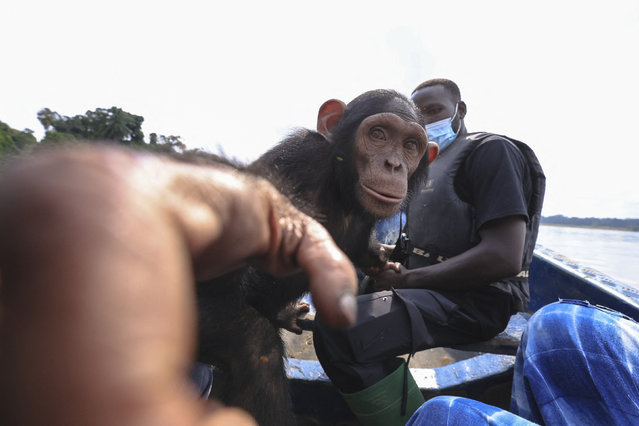
A young chimpanzee reacts on a pirogue with Rohmay Ndoulek, from the Papaye International association, during an outing in the Douala-Edea Natural Park in Marienberg on December 15, 2024. In the heart of Douala-Edea Natural Park, dedicated Cameroonian caretakers tend to and rehabilitate chimpanzees, victims of poaching and deforestation, at Papaye International, a sanctuary dubbed a “monkey paradise”. Founded in 2001, the association funded by 30 million friends and the Brigitte Bardot Foundation regularly receives eco-volunteers from all over the world. (Photo by Daniel Beloumou Olomo/AFP Photo)

A young chimpanzee reacts on a pirogue with Rohmay Ndoulek, from the Papaye International association, during an outing in the Douala-Edea Natural Park in Marienberg on December 15, 2024. In the heart of Douala-Edea Natural Park, dedicated Cameroonian caretakers tend to and rehabilitate chimpanzees, victims of poaching and deforestation, at Papaye International, a sanctuary dubbed a “monkey paradise”. Founded in 2001, the association funded by 30 million friends and the Brigitte Bardot Foundation regularly receives eco-volunteers from all over the world. (Photo by Daniel Beloumou Olomo/AFP Photo)
Details
12 Jan 2025 04:28:00
The picture dated January 30, 2025 shows the Red Arrows swooping through the skies as they carry out a winter training session over RAF Waddington in Lincolnshire. The team made the most of the sunny weather to practice their signature moves, with plenty of twists and turns in the blue skies. They train in the UK until mid-Spring when they move overseas to a location with more predictable, settled weather to maximise flying hours. (Photo by Caroline Haycock/Bav Media)

The picture dated January 30, 2025 shows the Red Arrows swooping through the skies as they carry out a winter training session over RAF Waddington in Lincolnshire. The team made the most of the sunny weather to practice their signature moves, with plenty of twists and turns in the blue skies. They train in the UK until mid-Spring when they move overseas to a location with more predictable, settled weather to maximise flying hours. (Photo by Caroline Haycock/Bav Media)
Details
21 Mar 2025 03:42:00
American actress and singer Rachel Zegler sings “Don't Cry For Me Argentina” from the balcony of the London Palladium on June 17, 2025. The show sees Rachel come out onto the balcony to sing to the audience below, and by the third night of the show's limited run the streets have already had to be cordoned off with extra security brought in because the crowds are so big. (Photo by Raphael Pour-Hashemi/The Mega Agency)

American actress and singer Rachel Zegler sings “Don't Cry For Me Argentina” from the balcony of the London Palladium on June 17, 2025. The show sees Rachel come out onto the balcony to sing to the audience below, and by the third night of the show's limited run the streets have already had to be cordoned off with extra security brought in because the crowds are so big. (Photo by Raphael Pour-Hashemi/The Mega Agency)
Details
06 Jul 2025 03:29:00
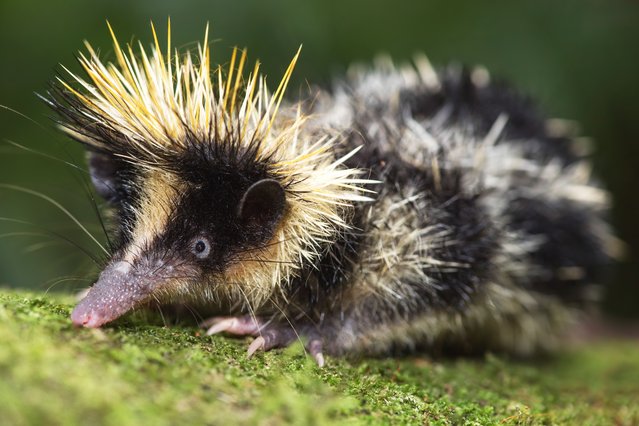
This spiky tenrec was spotted in Madagascar’s Mantadia National Park in the last decade of September 2025. Mostly nocturnal and rarely seen, it puffs out its spines when threatened. Spiky tenrecs are excellent swimmers — unlike most spiny mammals, some species of tenrec can forage in streams and rivers, using their spines for protection while hunting aquatic insects and small prey. (Photo by Dale Morris/Solent News & Photo Agency)

This spiky tenrec was spotted in Madagascar’s Mantadia National Park in the last decade of September 2025. Mostly nocturnal and rarely seen, it puffs out its spines when threatened. Spiky tenrecs are excellent swimmers — unlike most spiny mammals, some species of tenrec can forage in streams and rivers, using their spines for protection while hunting aquatic insects and small prey. (Photo by Dale Morris/Solent News & Photo Agency)
Details
05 Oct 2025 04:02:00
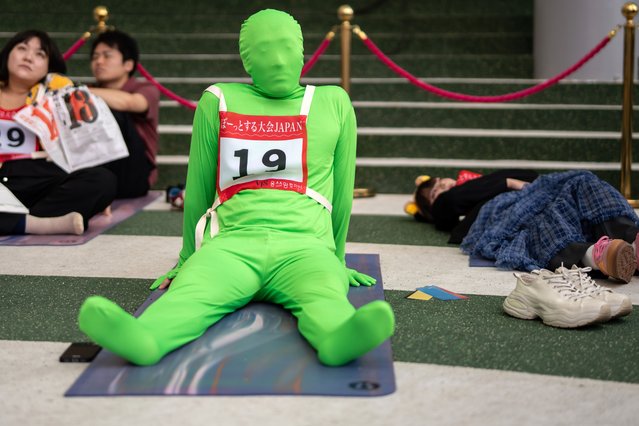
Participants compete to do nothing during the Space-out competition at World Expo 2025 on September 27, 2025 in Osaka, Japan. For 90 minutes, participants sat in silence, trying to remain in a dazed state without distraction. The winner was determined not by activity but by calmness maintaining the most stable heart rate amid the lively crowds of the Osaka Expo site. (Photo by Tomohiro Ohsumi/Getty Images)

Participants compete to do nothing during the Space-out competition at World Expo 2025 on September 27, 2025 in Osaka, Japan. For 90 minutes, participants sat in silence, trying to remain in a dazed state without distraction. The winner was determined not by activity but by calmness maintaining the most stable heart rate amid the lively crowds of the Osaka Expo site. (Photo by Tomohiro Ohsumi/Getty Images)
Details
25 Nov 2025 05:19:00
Isabel Schmalenbach, an environmental scientist with the Helgoland Biological Institute (Biologische Anstalt Helgoland), part of the Alfred Wegener Institute for Polar and Marine Research, holds a one-year old baby European lobster (Homarus gammarus) raised at the institute on August 3, 2013 on Helgoland Island, Germany. (Photo by Sean Gallup/Getty Images)

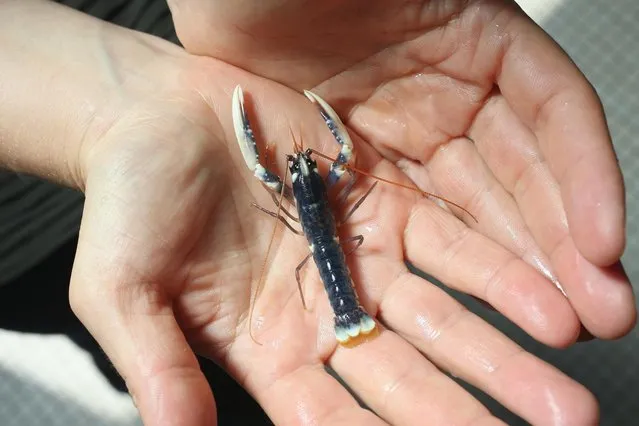
Isabel Schmalenbach, an environmental scientist with the Helgoland Biological Institute (Biologische Anstalt Helgoland), part of the Alfred Wegener Institute for Polar and Marine Research, holds a one-year old baby European lobster (Homarus gammarus) raised at the institute on August 3, 2013 on Helgoland Island, Germany. Later in the day Schmalenbach and her colleagues released a total of 415 one-year old lobsters into the North Sea as part of an effort to repopulate the lobster population around Helgoland (also called Heligoland). In the 19th century local fishermen caught up to 80,000 lobsters a year in the surrounding waters, combined with the heavy allied bombing of the island during and after World War II, as well as other environmental factors, decimated the lobster population. (Photo by Sean Gallup)
Details
05 Aug 2013 08:39:00
Tridacna Gigas, or Giant Clams

“The giant clam, Tridacna gigas (known as pā’ua in Cook Islands Māori), is the largest living bivalve mollusc. T. gigas is one of the most endangered clam species. It was mentioned as early as 1825 in scientific reports. One of a number of large clam species native to the shallow coral reefs of the South Pacific and Indian oceans, they can weigh more than 200 kilograms (440 lb) measure as much as 120 cm (47 in) across, and have an average lifespan in the wild of 100 years or more”. – Wikipedia

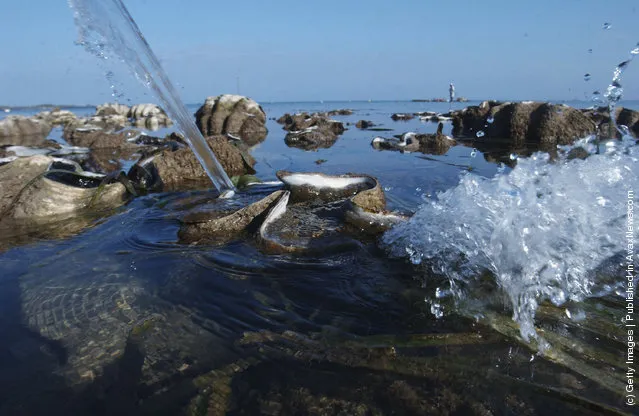
Photo: Tridacna Gigas, or Giant Clams spew water as a traditional fisherman passes by a small sanctuary on January 23, 2004 near Bolinao in the Northern Philippines. The clams, prime builders for coral reefs and providing shelter for spawning fish and other marine life, are exposed by low tides in the sanctuary. Overfishing and pollution throughout the country are not only threatening food security, but are also starting to choke one of the few working clam sanctuaries in the world. (Photo by David Greedy/Getty Images)
Details
01 Oct 2011 13:10:00
A member of the Indian company Margi Kathakali theatre performs during “Kijote Kathakali”, a Kathakali recital based on the Spanish classic “Don Quixote”, at the Niemeyer Center in Aviles, northern Spain, July 29, 2016. The performance and text captured the essence of the novel while sticking to the format of Kathakali. Kathakali is one of the major forms of classical Indian dance. It is another “story play” genre of art, but one distinguished by its elaborately colorful make-up, costumes and face masks wearing actor-dancers, who have traditionally been all males. (Photo by Eloy Alonso/Reuters)

A member of the Indian company Margi Kathakali theatre performs during “Kijote Kathakali”, a Kathakali recital based on the Spanish classic “Don Quixote”, at the Niemeyer Center in Aviles, northern Spain, July 29, 2016. The performance and text captured the essence of the novel while sticking to the format of Kathakali. Kathakali is one of the major forms of classical Indian dance. (Photo by Eloy Alonso/Reuters)
Details
31 Jul 2016 11:02:00