Loading...
Done
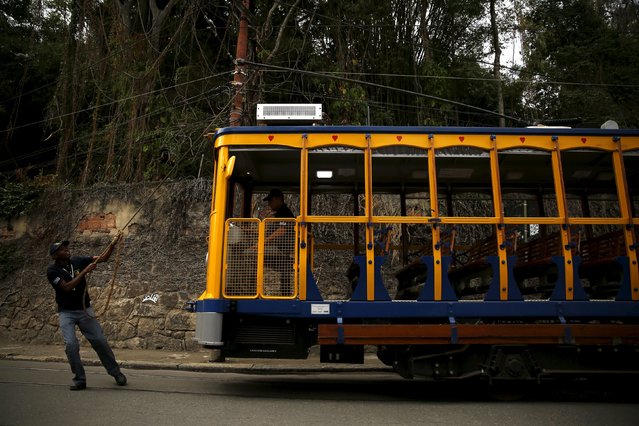
A worker manually changes the direction of the bonde, the typical tram line in Santa Teresa neighborhood, using a rope in Rio de Janeiro, Brazil, September 9, 2015. (Photo by Pilar Olivares/Reuters)

A worker manually changes the direction of the bonde, the typical tram line in Santa Teresa neighborhood, using a rope in Rio de Janeiro, Brazil, September 9, 2015. The Santa Teresa bonde, called “Bondinho” in Portuguese, is running with passengers as a part of a test period, after the service was suspended in 2011 following an accident that killed six people, according to residents. (Photo by Pilar Olivares/Reuters)
Details
11 Sep 2015 12:53:00
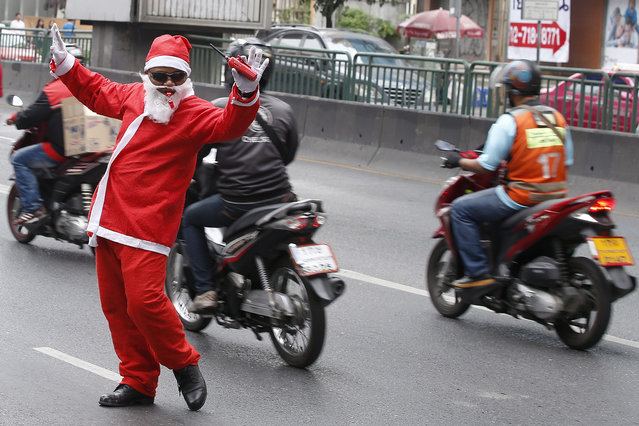
A Thai traffic security guard wears a Santa Claus costume as he directs the traffic on a street during Christmas celebrations outside a shopping mall in Bangkok, Thailand, 22 December 2011. The campaign of a shopping mall is held to celebrate the upcoming Christmas season and to attract shoppers. (Photo by Narong Sangnak/EPA)

A Thai traffic security guard wears a Santa Claus costume as he directs the traffic on a street during Christmas celebrations outside a shopping mall in Bangkok, Thailand, 22 December 2015. The campaign of a shopping mall is held to celebrate the upcoming Christmas season and to attract shoppers. (Photo by Narong Sangnak/EPA)
Details
25 Dec 2015 08:01:00
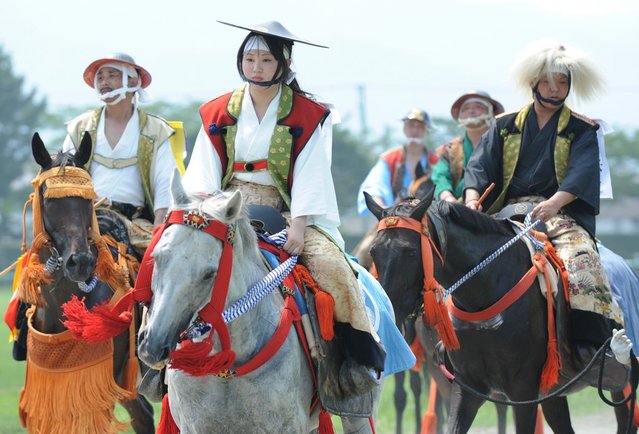
A young woman (C) clad in samurai costume leads other local poeple as she rides her horse during a parade at the annual Soma Nomaoi festival in Minamisoma, Fukushima Prefecture, on July 28, 2012.  The traditional full-scale festival kicked off for the first time after the accident of the Fukushima Dai-ichi Nuclear Power Plant following the massive earthquake and the tsunami on March 11, 2011. (Photo by Toru Yamanaka/AFP Photo)

Soma-Nomaoi is a festival that recreates a battle scene from more than 1,000 years ago. It is annually held for 4 days from July 22 to 25 in Haramachi City, Fukushima Prefecture, in the eastern part of Japan. In this historical event, 600 mounted samurai in traditional Japanese armor, with long swords at their side and ancestral flagstaffs streaming from their backs, ride across open fields. Soma-Nomaoi has been designated an Important Intangible Folk Cultural Property.

Photo: A young woman (C) clad in samurai costume leads other local poeple as she rides her horse during a parade at the annual Soma Nomaoi festival in Minamisoma, Fukushima Prefecture, on July 28, 2012. The traditional full-scale festival kicked off for the first time after the accident of the Fukushima Dai-ichi Nuclear Power Plant following the massive earthquake and the tsunami on March 11, 2011. (Photo by Toru Yamanaka/AFP Photo)
Details
02 Aug 2012 12:59:00


“The Trabant is a car that was produced by former East German auto maker VEB Sachsenring Automobilwerke Zwickau in Zwickau, Sachsen. It was the most common vehicle in East Germany, and was also exported to countries both inside and outside the communist bloc. The main selling points was that it had room for four adults and luggage in a compact, light and durable shell and that it was fast (when introduced) and durable. With its mediocre performance, smoky two-stroke engine, and production shortages, the Trabant is often cited as an example of the disadvantages of centralized planning; on the other hand, it is regarded with derisive affection as a symbol of the failed former East Germany and of the fall of communism (in former West Germany, as many East Germans streamed into West Berlin and West Germany in their Trabants after the opening of the Berlin Wall in 1989). It was in production without any significant changes for nearly 30 years with 3,096,099 Trabants produced in total”. – Wikipedia

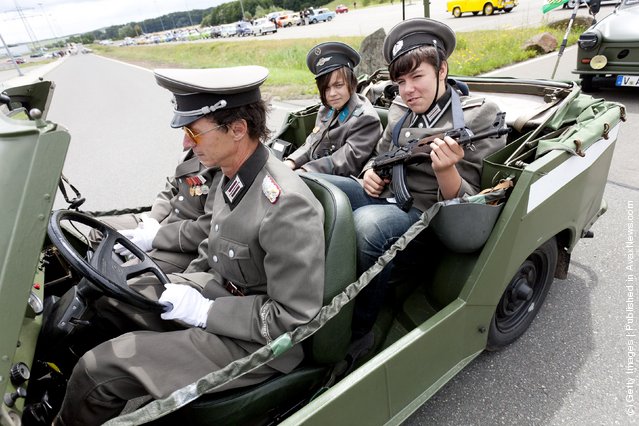
Photo: Enthusiasts weared in uniforms of the former eastern german army trive in a military Trabant car as fans and owners of East German-era Trabant cars gather at the 2011 International Trabantfahrer Treffen (International Trabant Drivers Meeting) on June 26, 2011 in Zwickau, Germany. The Trabant, also known as the Trabi, was among the main cars produced in communist East Germany and built by VEB Sachsenring Automobilwerke in Zwickau for 30 years until 1989. Today the car has cult status for many followers and one company, IndiKar, is even seeking to revive the brand in a modern, electric version. (Photo by Carsten Koall/Getty Images)

Details
27 Jun 2011 12:21:00


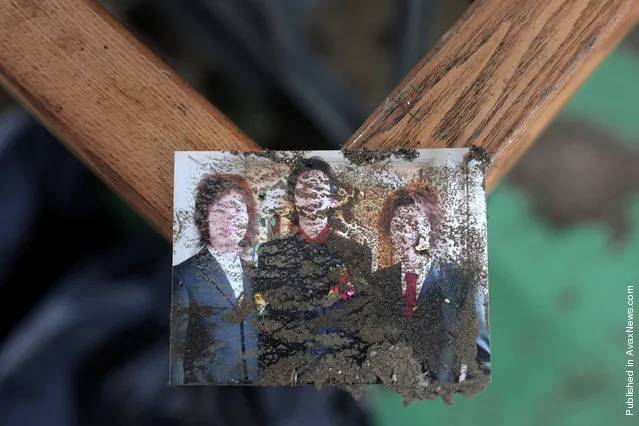
A muddied family photograph sits on a hallway stairwell in an apartment block on March 17, 2011 in Kensennuma, Japan. Residents were allowed back to their homes today and began the massive cleanup operation caused by a 9.0 magnitude strong earthquake that struck on March 11 off the coast of north-eastern Japan. The quake triggered a tsunami wave of up to 10 metres which engulfed large parts of north-eastern Japan. The death toll has risen past 5000 with at least 8600 people still missing. (Photo by Chris McGrath/Getty Images)
Details
17 Mar 2011 12:29:00


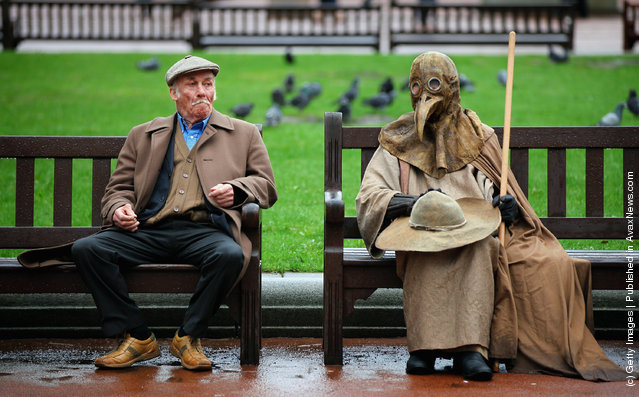
Glasgow based artist dressed Frank To dressed in a medieval Plague Doctor costume sits beside 72-year-old Willie Kennedy from Glasgow on March 31, 2011 in Glasgow, Scotland. The artist is promoting his first major exhibition in two years, “The Human Condition”, which opens tomorrow at the Leith Gallery in Edinburgh. The artist is showing a series of pictures which depict Mediaeval Plague Doctors, which have fascinated the artist for the last three years. (Photo by Jeff J Mitchell/Getty Images)
Details
01 Apr 2011 13:37:00


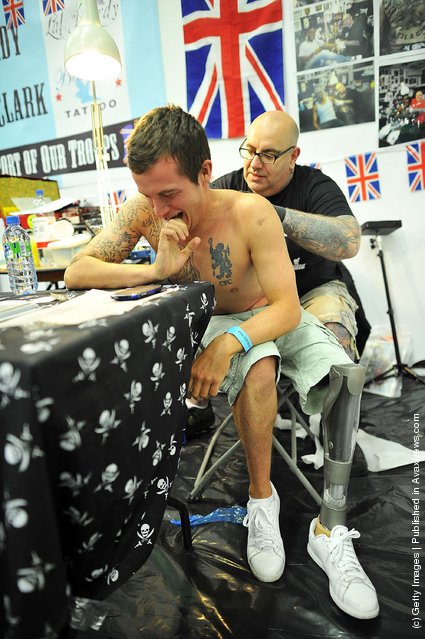
Shephen Shine, 27, who lost a leg when serving in Iraq in 2007, is tattood with a regimental tattoo reading “Their Sacrifice – Our Freedom” during the Ink For Heroes event on June 18, 2011 in Catterick, England. Ink For Heroes is a charity event to raise money and awareness of the soldiers that get injured during service, with all proceeds going to both “Help The Heroes” and “The British Legion”. Injured soldiers can also get tattooed for free during the event. (Photo by Bethany Clarke/Getty Images)
Details
19 Jun 2011 09:36:00


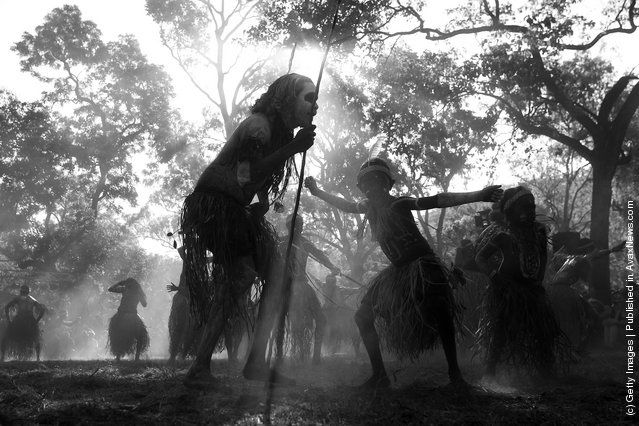
Dancers from the Yarrabah community perform during the Laura Aboriginal Dance Festival on June 18, 2011 in Laura, Australia. The Laura Aboriginal Dance Festival is a celebration of aboriginal dance and culture that takes place Biennially in Cape York Peninsula at the site of a traditional Bora ground that is sacred to the aboriginal community and surrounded by some of the oldest rock art in the world. Over 5000 visitors attend the festival, offering a unique insight into the community and providing an opportunity to spread cultural traditions to new generations. The festival takes place June 17-19. (Photo by Mark Kolbe/Getty Images for Tourism Queensland)
Details
22 Jun 2011 11:10:00