Loading...
Done
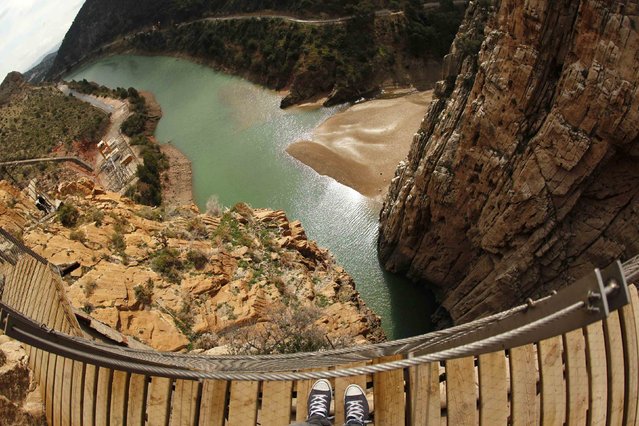
Journalists (L) walk along the new Caminito del Rey (The King's Little Pathway) in El Chorro-Alora, near Malaga, southern Spain March 15, 2015. (Photo by Jon Nazca/Reuters)

Journalists (L) walk along the new Caminito del Rey (The King's Little Pathway) in El Chorro-Alora, near Malaga, southern Spain March 15, 2015. Dubbed by many media outlets as the world's scariest pathway, the three-kilometre long pathway, which was built at about 100 metres (330 ft) above the gorge of Los Gaitanes between the years of 1901 and 1905, was closed in 2001 after five people died. A new walkway has then been built over the old walkway and will open to the public on March 28, 2015. (Photo by Jon Nazca/Reuters)
Details
16 Mar 2015 09:56:00
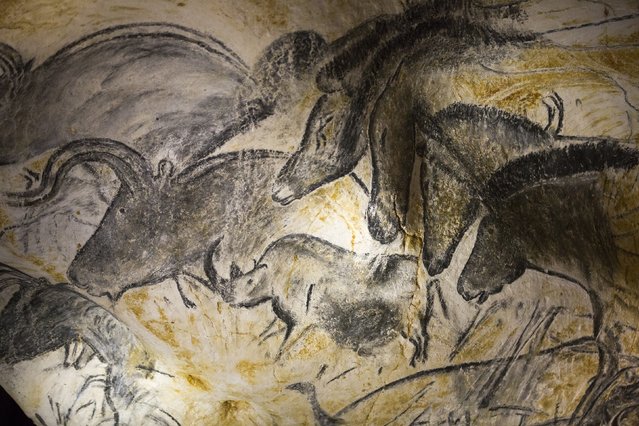
A replica of pre-historic drawings showing horses, rhinoceros and aurochs is seen on a wall during a press visit at the site of the Cavern of Pont-d'Arc project in Vallon Pont d'Arc April 8, 2015. (Photo by Robert Pratta/Reuters)

A replica of pre-historic drawings showing horses, rhinoceros and aurochs is seen on a wall during a press visit at the site of the Cavern of Pont-d'Arc project in Vallon Pont d'Arc April 8, 2015. The Cavern of Pont-d'Arc project is a replica of the pre-historic Decorated Cave of Pont-d'Arc known as Grotte Chauvet, in Vallon Pont-d'Arc in the Ardeche region, containing the world's earliest known art which was recently named a UNESCO World Heritage site. The facsimile cavern, which condenses some 8000m² of the original site into 3000m², will display faithful reproductions of paintings and engravings and will be inaugurated on April 10 and will open to the public on April 25. (Photo by Robert Pratta/Reuters)
Details
09 Apr 2015 14:23:00
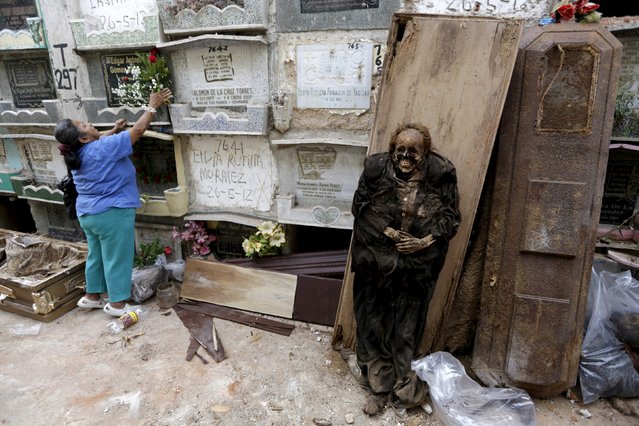
A woman (L) places flowers at a grave next to a mummified body during exhumation works at the General Cemetery in Guatemala City, April 15, 2015. (Photo by Jorge Dan Lopez/Reuters)

A woman (L) places flowers at a grave next to a mummified body during exhumation works at the General Cemetery in Guatemala City, April 15, 2015. If a lease on a grave has expired or not been paid, grave cleaners will break open the crypts to remove and rebury the bodies. Any remains that have not been claimed are packed into plastic bags, labeled and stored in mass graves. Bodies that have been stored in the upper crypt are exposed to dry and sunny conditions which means they do not decompose and instead become mummified. (Photo by Jorge Dan Lopez/Reuters)
Details
16 Apr 2015 13:01:00
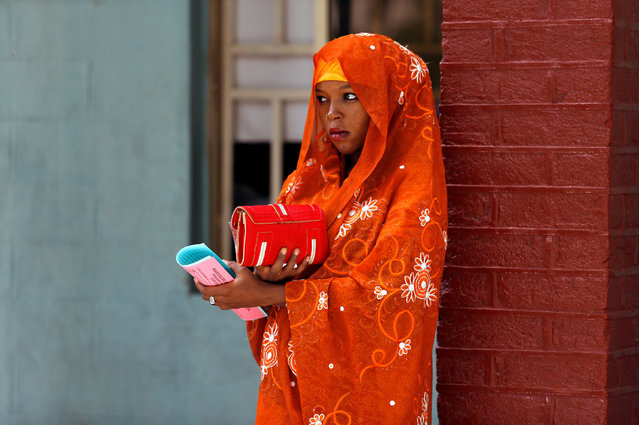
A woman waits at a polio immunisation health centre, in Maiduguri, Borno State, Nigeria, August 29, 2016. Nigeria's military has liberated large swathes of land from Boko Haram but a ride with an army convoy, all guns firing for fear of ambush, shows how far the northeast is from normality after a brutal Islamist insurgency that has displaced millions. The moment military convoys leave the relative safety of Bama, Borno state's second town, soldiers in the lead vehicle open fire with a heavy cannon into the scrub along the road to pre-empt attacks by remaining fighters from the Islamist group. (Photo by Afolabi Sotunde/Reuters)

A woman waits at a polio immunisation health centre, in Maiduguri, Borno State, Nigeria, August 29, 2016. Nigeria's military has liberated large swathes of land from Boko Haram but a ride with an army convoy, all guns firing for fear of ambush, shows how far the northeast is from normality after a brutal Islamist insurgency that has displaced millions. (Photo by Afolabi Sotunde/Reuters)
Details
08 Sep 2016 09:45:00
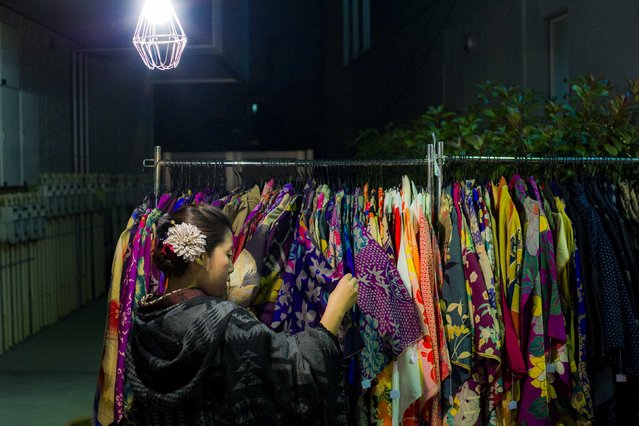
A woman browses through kimonos for sale at Boroichi flea market in Tokyo December 15, 2014. In the 16th century, Boroichi was a place for farmers to buy and sell rags, known as boro, for mending clothes and weaving sandals. Now in its 436th year, the original spirit lingers, with about 700 stands hawking fabric, used clothes and piles of rags. Others sell kitchen tools, pottery, seaweed and spices. (Photo by Thomas Peter/Reuters)

A woman browses through kimonos for sale at Boroichi flea market in Tokyo December 15, 2014. In the 16th century, Boroichi was a place for farmers to buy and sell rags, known as boro, for mending clothes and weaving sandals. Now in its 436th year, the original spirit lingers, with about 700 stands hawking fabric, used clothes and piles of rags. Others sell kitchen tools, pottery, seaweed and spices. About 200,000 people flock to the market, which is only open for four mid-winter days a year – two in December and two in January. (Photo by Thomas Peter/Reuters)
Details
19 Dec 2014 12:50:00
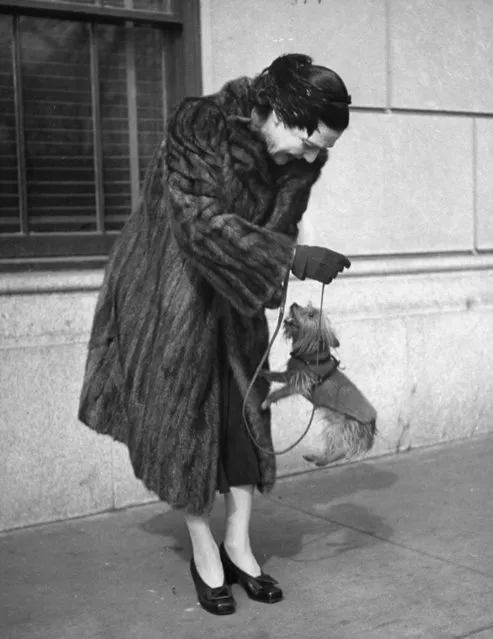
Author Fannie Hurst clad in mink coat, enjoying the jumping antics of her Yorkshire terrier Orphan Annie on the street. (Photo by Nina Leen/Pix Inc./The LIFE Picture Collection/Getty Images)

Nina Leen, one of the first female photographers to work for Life, took pictures for the magazine from 1940 to 1972. In the mid-1940s, her essay, “City Dogs”, featured actors and artists with their pets on the streets of New York City. In late-March, Daniel Cooney Fine Art in New York City, is opening a solo exhibition of Leen’s work that features images from that essay and others. Here: author Fannie Hurst clad in mink coat, enjoying the jumping antics of her Yorkshire terrier Orphan Annie on the street. (Photo by Nina Leen/Pix Inc./The LIFE Picture Collection/Getty Images)
Details
30 Mar 2015 12:48:00
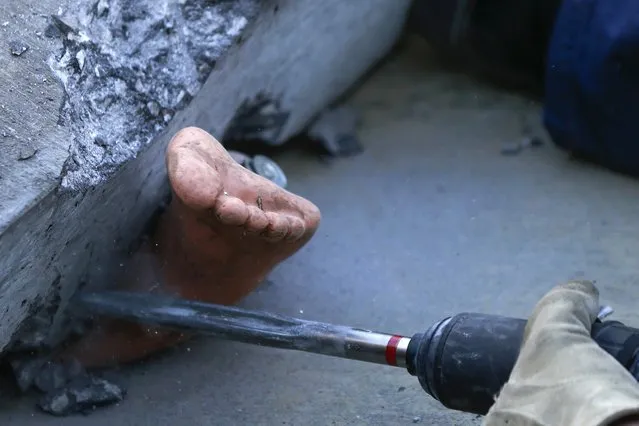
Rescue specialists for USA-1 drill through a concrete slab to rescue a victim from the scene of a mock disaster area during a training exercise at the Guardian Center in Perry, Georgia, March 25, 2014. (Photo by Shannon Stapleton/Reuters)

Rescue specialists for USA-1 drill through a concrete slab to rescue a victim from the scene of a mock disaster area during a training exercise at the Guardian Center in Perry, Georgia, March 25, 2014. A week of field training, the first of its kind at the 830-acre training site, to be open to the media, began Monday with the arrival of USA-1 from Fairfax, Virginia along with its sister team in Los Angeles, California. USA-1 has been deployed by the U.S. Agency for International Development to 30 foreign disasters, including earthquakes in Haiti, Armenia and Iran, the tsunami in Japan and the typhoon in the Philippines. (Photo by Shannon Stapleton/Reuters)
Details
27 Mar 2014 07:05:00
Dan surrounded by seven days of her own rubbish in Pasadena, California. (Photo by Gregg Segal/Barcroft Media)

Dan surrounded by seven days of her own rubbish in Pasadena, California. If you've never thought about how much rubbish you throw away an honest photographic series will open your eyes. Men, women, couples and families with young children have been photographed lying on their backs surrounded by a week's worth of their own rubbish – from old cartons of milk, used nappies and even tampons. The startling series “Seven Days of Garbage” by Californian photographer Gregg Segal is an unforgettable reminder of the amount of waste a human collects in just seven days. (Photo by Gregg Segal/Barcroft Media)
Details
16 Jul 2014 14:41:00