Loading...
Done
Electric cars sit charging in a parking garage at the University of California, Irvine January 26, 2015. “The Irvine Smart Grid Demonstration”, a $79 million project funded half by federal stimulus money and half by Edison and partners like UC Irvine, was launched in 2010. (Photo by Lucy Nicholson/Reuters)

Electric cars sit charging in a parking garage at the University of California, Irvine January 26, 2015. “The Irvine Smart Grid Demonstration”, a $79 million project funded half by federal stimulus money and half by Edison and partners like UC Irvine, was launched in 2010. The $12 billion utility's research team Southern California Edison is testing everything from charging electronic vehicles via cell phone to devices that smooth out the power created by rooftop solar panels. Those are some of the roughly 60 projects in the works at Edison's Advanced Technology division. It has a small $19 million annual budget, but its influence far exceeds that. (Photo by Lucy Nicholson/Reuters)
Details
28 Jan 2015 11:50:00
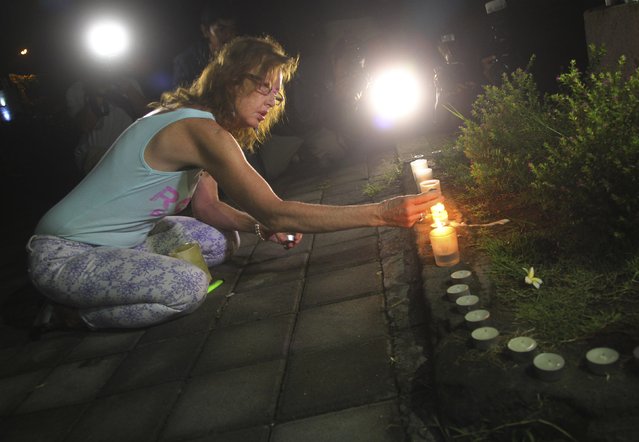
A woman lights a candle before praying in front of Kerobokan prison, before the transfer of the two Australian death row prisoners, Myuran Sukumaran and Andrew Chan, to the airport in Denpasar, on the Indonesian island of Bali March 4, 2015. REUTERS/Zul Edoardo

A woman lights a candle before praying in front of Kerobokan prison, before the transfer of the two Australian death row prisoners, Myuran Sukumaran and Andrew Chan, to the airport in Denpasar, on the Indonesian island of Bali March 4, 2015. The two convicted Australian drug smugglers were being transferred on Wednesday from a Bali prison to an island for execution along with other foreigners, underlining Indonesia's determination to use the death penalty despite international criticism. The planned executions of Myuran Sukumaran, 33, and Andrew Chan, 31, have ratcheted up diplomatic tensions between Australia and Indonesia following repeated pleas of mercy for the pair, who are among 11 death row convicts scheduled to go before a firing squad. REUTERS/Zul Edoardo
Details
05 Mar 2015 13:00:00
Afghan boys ride on donkey cart transporting plastic bottles for recycling, on the outskirts of Kabul, Afghanistan, on 16 September 2020. Nearly 19 years after the fall of the Taliban regime and the United States invasion, the Afghan government and insurgents on 12 September, began peace negotiations in Doha. Unlike the Taliban team, the 21-member negotiating group sent by Kabul includes four women, who – among other things – will look to safeguard the progress on women's rights since the fall of the Taliban regime that had prevented girls from going to schools and confined women to their homes. (Photo by Hedayatullah Amid/EPA/EFE)

Afghan boys ride on donkey cart transporting plastic bottles for recycling, on the outskirts of Kabul, Afghanistan, on 16 September 2020. Nearly 19 years after the fall of the Taliban regime and the United States invasion, the Afghan government and insurgents on 12 September, began peace negotiations in Doha. (Photo by Hedayatullah Amid/EPA/EFE)
Details
14 Oct 2020 00:01:00
Ahmad Sayed Rahman, a five-year-old Afghan boy who lost his right leg when he was hit by a bullet in the crossfire of a battle, dances with his prosthetic leg at the International Committee of the Red Cross (ICRC) hospital for war victims and the disabled, in Kabul on May 7, 2019. With his hands in the air and an infectious grin spreading from ear to ear, a young Afghan boy whirls around a Kabul hospital room on his new prosthetic leg. The boy, five-year-old Ahmad Sayed Rahman, has become a social media star in Afghanistan and beyond after a short video of him effortlessly dancing on his new limb was published this week on Twitter. (Photo by Wakil Kohsar/AFP Photo)

Ahmad Sayed Rahman, a five-year-old Afghan boy who lost his right leg when he was hit by a bullet in the crossfire of a battle, dances with his prosthetic leg at the International Committee of the Red Cross (ICRC) hospital for war victims and the disabled, in Kabul on May 7, 2019. (Photo by Wakil Kohsar/AFP Photo)
Details
10 Jun 2019 00:03:00
Screenshot of Krystle and Hernan, taken on a foot mounted GoPro. (Photo by Krystle Wright/Caters News)

“Daredevil photographer Krystle Wright suffered a catalogue of injuries after an accident on a shoot in Pakistan. The 26-year-old was left with internal bruising, tendon damage, two fractures, a torn ligament and 10 stitches above her eye following the horrific fall in the Himalayas. Wright took to the air on a dual paraglider and flew at a stomach-churning 18,000 feet to capture the incredible images. But as she neared the end of her trip Wright hit a bolder and blacked out following a bad take-off. The keen photographer, from Queensland, Australia, has travelled the world shooting some of the most awe-inspiring extreme sport stunts”. – Caters News. Photo: Screenshot of Krystle and Hernan, taken on a foot mounted GoPro. (Photo by Krystle Wright/Caters News)
Details
10 Dec 2013 07:45:00
“Cassowaries are large, flightless birds related to emus and (more distantly) to ostriches, rheas, and kiwis”, writes Olivia Judson in the September issue of National Geographic magazine. (Photo by Christian Ziegler/National Geographic)

“Cassowaries are large, flightless birds related to emus and (more distantly) to ostriches, rheas, and kiwis”, writes Olivia Judson in the September issue of National Geographic magazine. How large? People-size: Adult males stand well over five foot five and top 110 pounds. Females are even taller, and can weigh more than 160 pounds. Dangerous when roused, they’re shy and peaceable when left alone. But even birds this big and tough are prey to habitat loss. The dense New Guinea and Australia rain forests where they live have dwindled. Today cassowaries might number 1,500 to 2,000. And because they help shape those same forests – by moving seeds from one place to another – “if they vanish”, Judson writes, “the structure of the forest would gradually change” too. (Photo by Christian Ziegler/National Geographic)
Details
06 Jan 2014 12:21:00
During the recession and looking for work she began sketching birds on the inside of books, seeing the practice as a creative way to mutate the pages into something fresh. Bluebird drawing on an AT&T bill. (Photo by Paula Swisher/Caters News)

“Artist Paula Swisher has come up with a quirky way of lessening the stress of household bills - by doodling highly intricate birds on each one. Swisher, 37, has drawn hundreds of birds in her lifetime and puts her love of ornithology down to the nature walks she went on as a youngster. Looking for work during the recession, she began sketching birds on the inside of books, seeing the practice as a creative way to mutate the pages into something fresh. But now she's made the transition from books to bills – while admittedly making a playful commentary on the predatory banking businesses”. – Caters News. (Photo by Paula Swisher/Caters News)
Details
02 May 2014 11:36:00
Salon equipment inside a sanatorium in New York. Daniel said: “We visited five states and several major cities, from New York City to Pittsburgh. It got pretty wild at times, so much so that in the more destitute areas, our guide carried a Glock”. (Photo by Daniel Barter/Caters News)

“These creepy pictures of abandoned asylums, prisons and schools give a sense of what life was like in institutions of 20th century America. Photographer Daniel Barter, 30, captured on film bowling alleys, theatres and hairdressing salons all completely intact. The Londoner was on travelling through Americas north eastern states when he had the chance to explore the derelict public buildings left untouched since their last inhabitants shut the doors”. – Caters News. Photo: Salon equipment inside a sanatorium in New York. (Photo by Daniel Barter/Caters News)
Details
09 May 2014 09:25:00