Loading...
Done
Animals Yawning

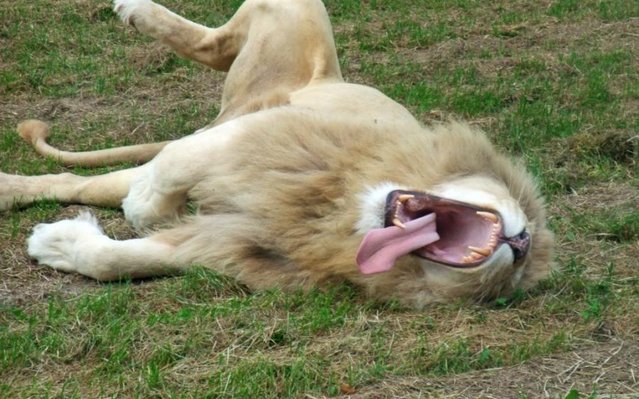
In animals, yawning can serve as a warning signal. For example, Charles Darwin, in his book The Expression of the Emotions in Man and Animals, mentioned that baboons yawn to threaten their enemies, possibly by displaying large canine teeth. Similarly, Siamese fighting fish yawn only when they see a conspecific (same species) or their own mirror-image, and their yawn often accompanies aggressive attack. Guinea pigs also yawn in a display of dominance or anger, displaying their impressive incisor teeth. This is often accompanied by teeth chattering, purring and scent marking.

Details
11 Aug 2012 09:12:00


United States Marines perform a fighting demonstration in Times Square as part of Fleet Week festivities May 27, 2011 in New York City. Fleet Week, which has been held in New York since 1984, brings thousands of military members to the city where they engage the public with numerous activities, demonstrations, tours and contests. Fleet Week concludes on Memorial Day with a military flyover to honor those killed while serving in the military. (Photo by Spencer Platt/Getty Images)
Details
28 May 2011 09:03:00
A couple kiss in front of a barricade set by demonstrators during clashes with police following a protest condemning the arrest of rap singer Pablo Hasél in Barcelona, Spain, Thursday, February 18, 2021. (Photo by Emilio Morenatti/AP Photo)

A couple kiss in front of a barricade set by demonstrators during clashes with police following a protest condemning the arrest of rap singer Pablo Hasél in Barcelona, Spain, Thursday, February 18, 2021. Protests over the imprisonment of a rapper convicted for insulting the Spanish monarchy and praising terrorist violence have morphed for the third night in a row into rioting. Pablo Hasél began this week to serve a 9-month sentence in a northeastern prison. (Photo by Emilio Morenatti/AP Photo)
Details
19 Feb 2021 09:32:00
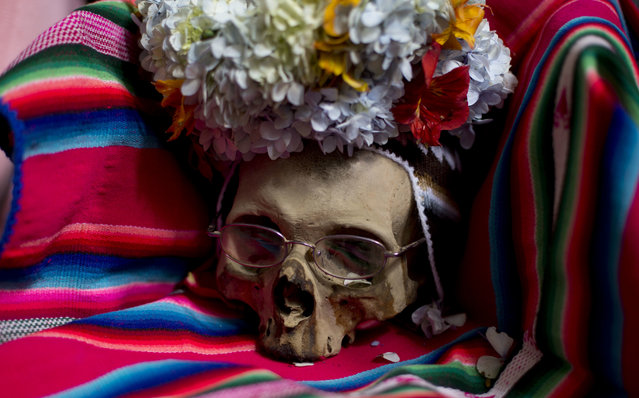
A  decorated human skull or “natitas”, sits on a blanket inside the Cementerio General chapel, during the Natitas Festival celebrations, in La Paz, Bolivia, Tuesday, November 8, 2016. (Photo by Juan Karita/AP Photo)

A decorated human skull or “natitas”, sits on a blanket inside the Cementerio General chapel, during the Natitas Festival celebrations, in La Paz, Bolivia, Tuesday, November 8, 2016. The “natitas” are cared for and decorated by faithful who use them as amulets believing they serve as protection, the tradition marks the end of the Catholic All Saints holiday, but is not recognized by the Catholic church. (Photo by Juan Karita/AP Photo)
Details
09 Nov 2016 06:25:00
A member of the 324 Squadron during the Anzac Day dawn service at Coogee Beach in Sydney, Australia on 23 April 2019.(Photo by Steven Saphore/Australian Associated Press)

A member of the 324 Squadron during the Anzac Day dawn service at Coogee Beach in Sydney, Australia on 23 April 2019. Anzac Day, held annually on 25 April, is a national day of remembrance across Australia and New Zealand, which commemorates the people who lost their lives or served in wars and conflicts. The day coincides with the first landing of the Anzacs at Gallipoli, Turkey, in World War One. (Photo by Steven Saphore/Australian Associated Press)
Details
26 Apr 2019 00:03:00
Swordfish are sold at the fish pavilion in Rungis International food market as buyers prepare for the Christmas holiday season in Rungis, south of Paris, December 11, 2015. (Photo by Philippe Wojazer/Reuters)

Rungis is a commune in the southern suburbs of Paris, France. It is best known as the location of the large wholesale food market serving the Paris metropolitan area and beyond, the Marché d'Intérêt National de Rungis, said to be the largest food market in the world. The name Rungis was recorded for the first time in a royal charter of 1124 as Rungi Villa. Here: swordfish are sold at the fish pavilion in Rungis International food market as buyers prepare for the Christmas holiday season in Rungis, south of Paris, December 11, 2015. (Photo by Philippe Wojazer/Reuters)
Details
13 Dec 2015 08:02:00
Moscow Metro

The is a rapid transit system serving Moscow and the neighbouring town of Krasnogorsk. Opened in 1935 with one 11-kilometre (6.8 mi) line and 13 stations, it was the first underground railway system in the Soviet Union. As of 2011, the Moscow Metro has 185 stations and its route length is 305.7 kilometres (190.0 mi). The system is mostly underground, with the deepest section 84 metres (276 ft) at the Park Pobedy station. The Moscow Metro is the world's second most heavily used rapid transit system after Tokyo's twin subway.
Details
13 Jun 2012 09:17:00


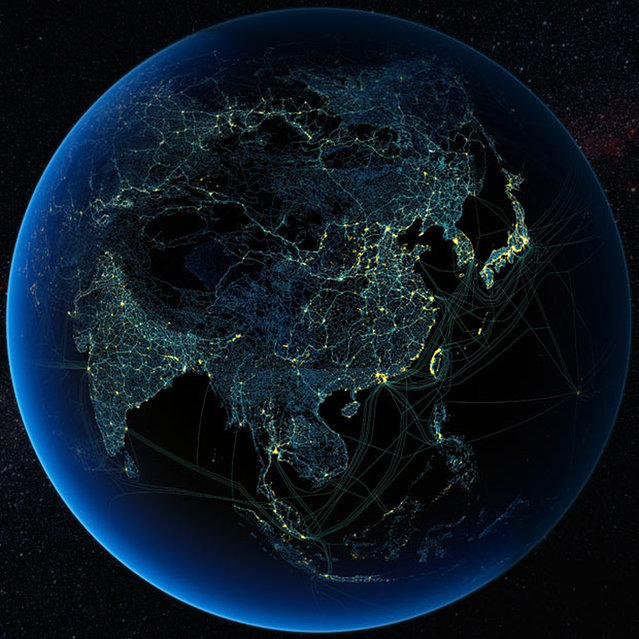
Defined according to wikipedia it is “a recent and informal geologic chronological term that serves to mark the evidence and extent of human activities that have had a significant global impact on the Earth’s ecosystems. The term was coined by ecologist Eugene Stoermer but has been widely popularized by the Nobel Prize-winning atmospheric chemist Paul Crutzen.”

The images here where created by Felix Pharand-Deschenes depicting how various human influences, from road and rail, to internet cables and airlines create significant patterns covering the Earth. What can we learn from these patterns in how they are influencing the environment
Details
19 Aug 2012 10:40:00