Loading...
Done
A woman is helped with adorning her hair with jewelry, part of the traditional clothing known as “Pollera”, before the annual Thousand Polleras parade in Las Tablas, in the province of Los Santos January 10, 2015. According to local residents, the Pollera dates back to the 18th century and was worn by the Spanish lower classes. (Photo by Carlos Jasso/Reuters)

A woman is helped with adorning her hair with jewelry, part of the traditional clothing known as “Pollera”, before the annual Thousand Polleras parade in Las Tablas, in the province of Los Santos January 10, 2015. According to local residents, the Pollera dates back to the 18th century and was worn by the Spanish lower classes. Today, it has become the Panamanian national costume. The dress is made entirely by hand and the jewellery worn is pure gold and worth thousands of dollars. (Photo by Carlos Jasso/Reuters)
Details
12 Jan 2015 15:46:00
Dunnottar Castle In Scottish

Dunnottar Castleis a ruined medieval fortress located upon a rocky headland on the north-east coast of Scotland, about 3 kilometres (1.9 mi) south of Stonehaven. The surviving buildings are largely of the 15th and 16th centuries, but the site is believed to have been fortified in the Early Middle Ages. Dunnottar has played a prominent role in the history of Scotland through to the 18th-century Jacobite risings because of its strategic location and the strength of its situation. Dunnottar is best known as the place where the Honours of Scotland, the Scottish crown jewels, were hidden from Oliver Cromwell's invading army in the 17th century. The property of the Keiths from the 14th century, and the seat of the Earl Marischal, Dunnottar declined after the last Earl forfeited his titles by taking part in the Jacobite rebellion of 1715. The castle was restored in the 20th century and is now open to the public.
Details
13 Jan 2014 11:31:00
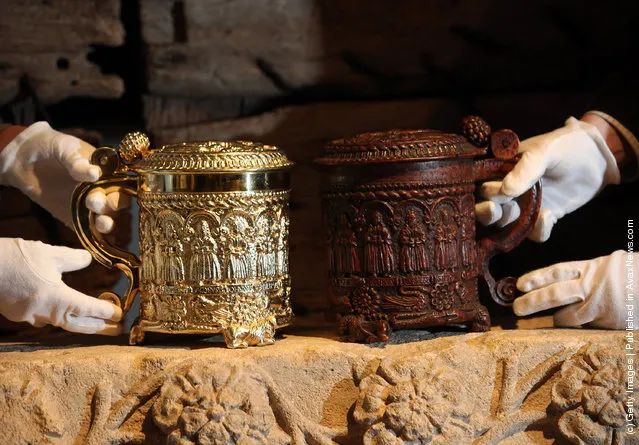
The Glastonbury Grace Cup Is Returned To Glastonbury Abbey After 125 Years

The Glastonbury Grace Cup, a rare carved oak tankard is and an 18th century replica in silver gilt (L), is held at Glastonbury Abbey for the first time in 125 years on December 12, 2011 in Glastonbury, England. (Photo by Matt Cardy/Getty Images)
Details
17 Dec 2011 13:13:00
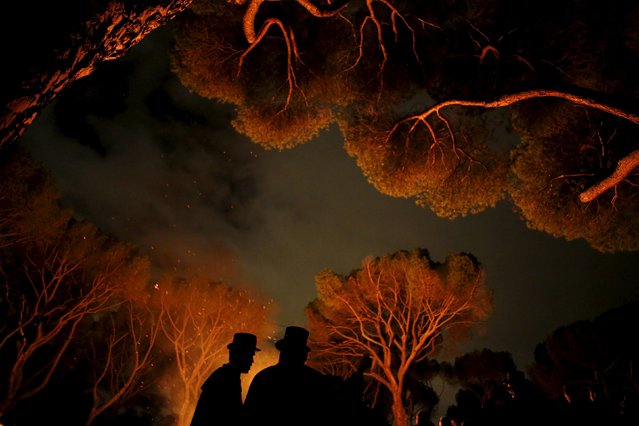
Belarussian villagers perform during a celebration of the "Tsary" rite in the village of Semezhevo, Belarus January 13, 2016. (Photo by Vasily Fedosenko/Reuters)

Belarussian villagers perform during a celebration of the “Tsary” rite in the village of Semezhevo, Belarus January 13, 2016. This unique rite originated from the 18th century, and now takes place only in this village marking the New Year, according to the Julian calendar, on January 13. (Photo by Vasily Fedosenko/Reuters)
Details
15 Jan 2016 08:06:00
Mortsafe - Protection From The Dead

Mortsafes were contraptions designed to protect graves from disturbance. Resurrectionists had supplied the schools of anatomy in Scotland since the early 18th century. This was due to the necessity for medical students to learn anatomy by attending dissections of human subjects, which was frustrated by the very limited allowance of dead bodies – for example the corpses of executed criminals – granted by the government, which controlled the supply.
Details
29 Nov 2013 12:03:00
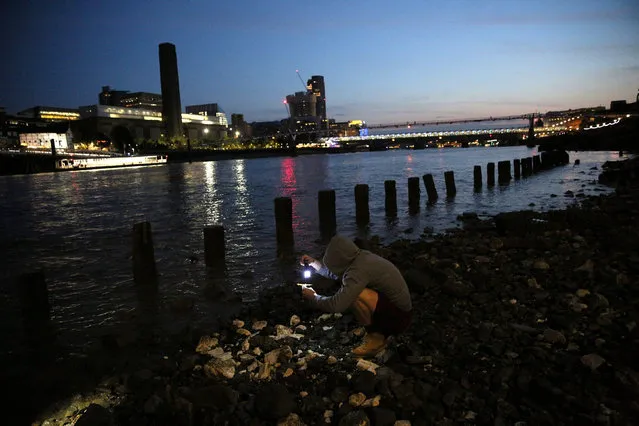
A mudlark uses a torch to look for items on the bank of the River Thames in London, Britain June 06, 2016. Mudlarking is believed to trace its origins to the 18th and 19th century, when scavengers searched the Thames' shores for items to sell. These days, history and archaeology fans are the ones hoping to find old relics such as coins, ceramics, artifacts or everyday items from across centuries. They wait for the low tide and then scour specific areas of exposed shores. "If you're in a field you could be out all day long, with the river you're restricted to about two or three hours," mudlark Nick Stevens said. While many just use the naked eye for their searches, others rely on metal detectors for which a permit from the Port of London Authority is needed. Digging also requires consent. (Photo by Neil Hall/Reuters)

A mudlark uses a torch to look for items on the bank of the River Thames in London, Britain June 06, 2016. Mudlarking is believed to trace its origins to the 18th and 19th century, when scavengers searched the Thames' shores for items to sell. These days, history and archaeology fans are the ones hoping to find old relics such as coins, ceramics, artifacts or everyday items from across centuries. their finds with the Portable Antiquities Scheme. Any item over 300 years old must be recorded. (Photo by Neil Hall/Reuters)
Details
27 Aug 2016 10:43:00
 Paper Anatomy By Lisa Nilsson

These pieces are made of Japanese mulberry paper and the gilded edges of old books. They are constructed by a technique of rolling and shaping narrow strips of paper called quilling or paper filigree. Quilling was first practiced by Renaissance nuns and monks who are said to have made artistic use of the gilded edges of worn out bibles, and later by 18th century ladies who made artistic use of lots of free time. I find quilling exquisitely satisfying for rendering the densely squished and lovely internal landscape of the human body in cross section.
Details
14 Apr 2013 11:07:00
People take part in the “The Burial of the Sardine” funeral procession, which marks the end of carnival festivities, in Madrid, Spain, February 10, 2016. (Photo by Juan Medina/Reuters)

People take part in the “The Burial of the Sardine” funeral procession, which marks the end of carnival festivities, in Madrid, Spain, February 10, 2016. “Mourners” carry a coffin with a mock sardine through the streets to celebrate the countdown to Lent. Spanish painter Francisco de Goya's painting “El entierro de la sardina” (The Burial of the Sardine) was inspired by this tradition, which started in Madrid in the 18th century, around the time of Spanish King Carlos III. (Photo by Juan Medina/Reuters)
Details
11 Feb 2016 12:29:00