Loading...
Done
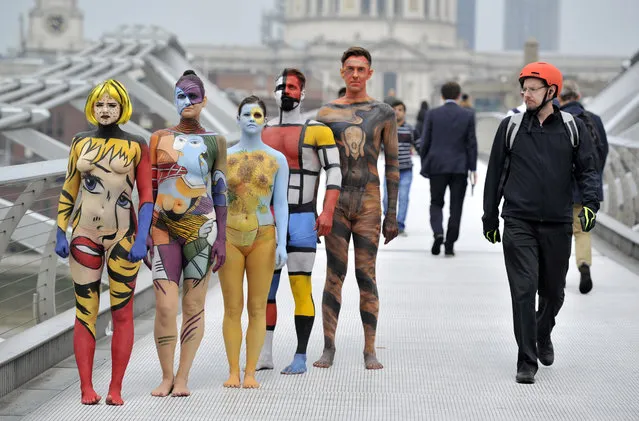
Human canvases modelling world famous artworks including Van Gogh's Sunflowers and Edvard Munch's The Scream take to the streets of London in a bid to mend Britain's disconnect with art on September 25, 2017. Award winning body paint artist Sarah Attwell was commissioned by online art platform Rise Art to show that great art is for everybody, following research that revealed 1 in 6 Brits have never set foot in an art gallery. (Photo by Imagewise Ltd/Rex Features/Shutterstock)

Human canvases modelling world famous artworks including Van Gogh's Sunflowers and Edvard Munch's The Scream take to the streets of London in a bid to mend Britain's disconnect with art on September 25, 2017. Award winning body paint artist Sarah Attwell was commissioned by online art platform Rise Art to show that great art is for everybody, following research that revealed 1 in 6 Brits have never set foot in an art gallery. (Photo by Imagewise Ltd/Rex Features/Shutterstock)
Details
26 Sep 2017 09:21:00
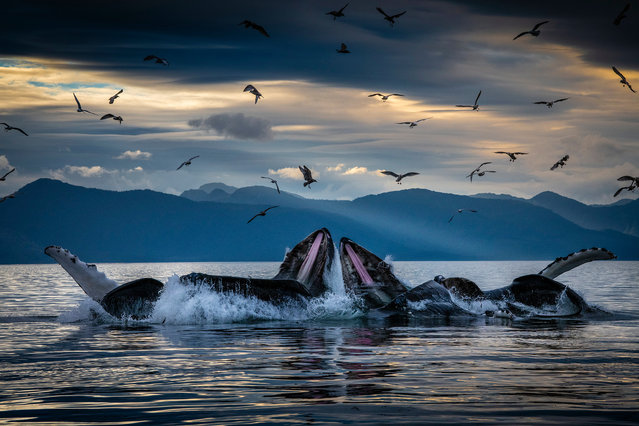
“Secrets of the Whales”. Skerry’s photographs celebrate the lives and culture of whales, illuminating recent research and their diverse behaviours. His latest work focuses on four key species: sperm whales, humpbacks, orca and beluga whales. Humpback whales bubble-net feeding off the coast of Alaska. They work cooperatively to feed on herring by blowing a perfect ring of bubbles underwater to form a net encircling the fish. The whales then swim up through the centre of the bubble net with their mouths open. (Photo by Brian Skerry/National Geographic Photo/Visa pour l'Image)

“Secrets of the Whales”. Skerry’s photographs celebrate the lives and culture of whales, illuminating recent research and their diverse behaviours. His latest work focuses on four key species: sperm whales, humpbacks, orca and beluga whales. Humpback whales bubble-net feeding off the coast of Alaska. They work cooperatively to feed on herring by blowing a perfect ring of bubbles underwater to form a net encircling the fish. The whales then swim up through the centre of the bubble net with their mouths open. (Photo by Brian Skerry/National Geographic Photo/Visa pour l'Image)
Details
04 Sep 2021 09:02:00
Five-year-old Julia cuddles a free teddy bear at a toy adoption station in a branch of Dobbies in Wallington, UK on December 4, 2023. Research shows almost half of parents (46%) in Britain plan to spend less on their children’s Christmas presents this year, and 47% believe their child would not mind receiving a preloved toy as a gift. (Photo by Michael Leckie/PA Wire Press Association)

Five-year-old Julia cuddles a free teddy bear at a toy adoption station in a branch of Dobbies in Wallington, UK on December 4, 2023. Research shows almost half of parents (46%) in Britain plan to spend less on their children’s Christmas presents this year, and 47% believe their child would not mind receiving a preloved toy as a gift. (Photo by Michael Leckie/PA Wire Press Association)
Details
27 Dec 2023 20:03:00
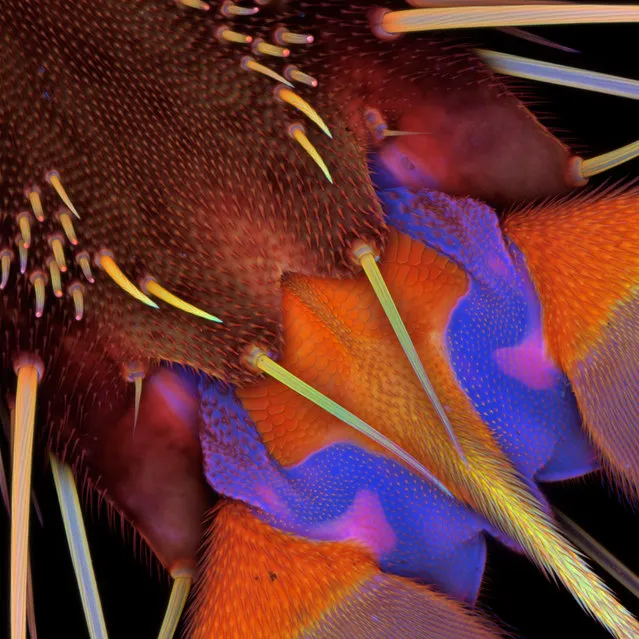
Pretarsus of the third leg of a female drone fly (Eristalis tenax), ventral view, by Dr. Jan Michels, Institute of Zoology, Christian-Albrechts-University of Kiel, Germany. (Photo by Olympus BioScapes)

“Microscope images forge an extraordinary bond between science and art, said Hidenao Tsuchiya, Olympus America's Vice President and General Manager for the Scientific Equipment Group. We founded this competition to focus on the fascinating stories coming out of today's life science research laboratories. The thousands of images that people have shared with the competition over the years reflect some of the most exciting work going on in research today – work that can help shed light on the living universe and ultimately save lives. We look at BioScapes and these beautiful images as sources of education and inspiration to us and the world”. – OlympusBioScapes

Photo: Pretarsus of the third leg of a female drone fly (Eristalis tenax), ventral view, by Dr. Jan Michels, Institute of Zoology, Christian-Albrechts-University of Kiel, Germany. (Photo by Olympus BioScapes)
Details
29 Jul 2012 09:20:00
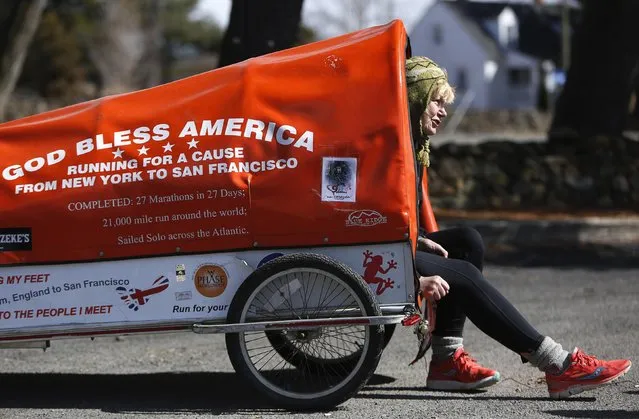
Sixty-eight year old cross-country runner Rosie Swale-Pope is interviewed while sitting in her cart, “The Icebird”, in Upperville, Virginia March 13, 2015. Swale-Pope, who is from Great Britain and once ran an unsupported 20,000 mile run around the globe,  is currently running across the United States from New York City to San Francisco in support of cancer research. (Photo by Gary Cameron/Reuters)

Sixty-eight year old cross-country runner Rosie Swale-Pope is interviewed while sitting in her cart, “The Icebird”, in Upperville, Virginia March 13, 2015. Swale-Pope, who is from Great Britain and once ran an unsupported 20,000 mile run around the globe, is currently running across the United States from New York City to San Francisco in support of cancer research. (Photo by Gary Cameron/Reuters)
Details
18 Mar 2015 11:05:00
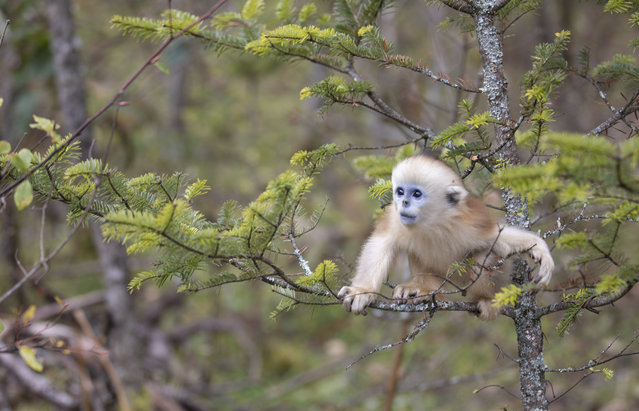
Photo taken on October 11, 2020 shows a golden monkey at Dalongtan Golden Monkey Research Center in Shennongjia National Park of central China's Hubei Province. With the efforts of local authority and improvement of the environment in the past many years, the number of golden monkeys in Shennongjia area reached nearly 1,500 nowadays. (Photo by Xinhua News Agency/Rex Features/Shutterstock)

Photo taken on October 11, 2020 shows a golden monkey at Dalongtan Golden Monkey Research Center in Shennongjia National Park of central China's Hubei Province. With the efforts of local authority and improvement of the environment in the past many years, the number of golden monkeys in Shennongjia area reached nearly 1,500 nowadays. (Photo by Xinhua News Agency/Rex Features/Shutterstock)
Details
18 Oct 2020 00:03:00
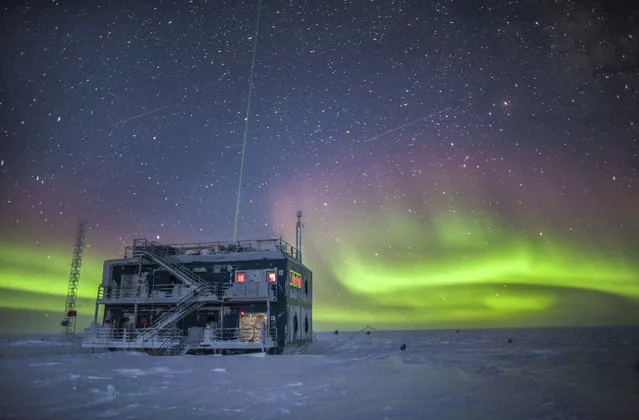
This undated photo provided by NOAA in May 2018 shows aurora australis near the South Pole Atmospheric Research Observatory in Antarctica. When a hole in the ozone formed over Antarctica, countries around the world in 1987 agreed to phase out several types of ozone-depleting chemicals called chlorofluorocarbons (CFCs). Production was banned, emissions fell and the hole shriveled. But according to a study released on Wednesday, May 16, 2018, scientists say since 2013, there’s more of a banned CFC going into the atmosphere. (Photo by Patrick Cullis/NOAA via AP Photo)

This undated photo provided by NOAA in May 2018 shows aurora australis near the South Pole Atmospheric Research Observatory in Antarctica. When a hole in the ozone formed over Antarctica, countries around the world in 1987 agreed to phase out several types of ozone-depleting chemicals called chlorofluorocarbons (CFCs). Production was banned, emissions fell and the hole shriveled. But according to a study released on Wednesday, May 16, 2018, scientists say since 2013, there’s more of a banned CFC going into the atmosphere. (Photo by Patrick Cullis/NOAA via AP Photo)
Details
15 Aug 2018 00:05:00
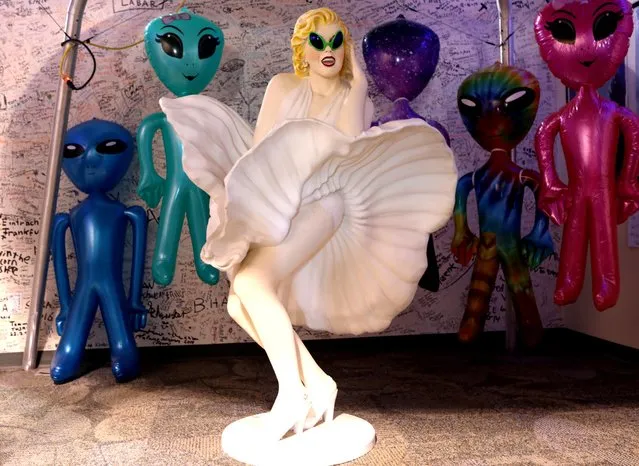
Alien-themed decorations are seen at the Alien Research Center in Hiko, September 19, 2019. Scores of UFO enthusiasts converged on rural Nevada for a pilgrimage of sorts to the U.S. installation known as Area 51, long rumored to house government secrets about alien life, as law enforcement officials beefed up security around the military base. (Photo by Jim Urquhart/Reuters)

Alien-themed decorations are seen at the Alien Research Center in Hiko, September 19, 2019. Scores of UFO enthusiasts converged on rural Nevada for a pilgrimage of sorts to the U.S. installation known as Area 51, long rumored to house government secrets about alien life, as law enforcement officials beefed up security around the military base. (Photo by Jim Urquhart/Reuters)
Details
21 Sep 2019 00:03:00