Loading...
Done
Centre of the Heart Nebula by Ivan Eder (Hungary). Situated 7500 light years away in the ‘W’-shaped constellation of Cassiopeia, the Heart Nebula is a vast region of glowing gas, energized by a cluster of young stars at its centre. The image depicts the central region, where dust clouds are being eroded and moulded into rugged shapes by the searing cosmic radiation. (Photo by Ivan Eder)

The competition, which is run by the Royal Observatory Greenwich in association with BBC Sky at Night Magazine, is now in its sixth year and has received over 2,500 entries. Photo: Centre of the Heart Nebula by Ivan Eder (Hungary). Situated 7500 light years away in the “W”-shaped constellation of Cassiopeia, the Heart Nebula is a vast region of glowing gas, energized by a cluster of young stars at its centre. The image depicts the central region, where dust clouds are being eroded and moulded into rugged shapes by the searing cosmic radiation. (Photo by Ivan Eder)
Details
03 Jul 2014 11:59:00
Participants wearing costumes and masks take part in the first day of the traditional carnival parade in Mohacs, Hungary, 23 February 2017. The carnival parade of so-called busos, dressed in costumes with frightening wooden masks and using various noisy wooden rattlers, is traditionally held on the seventh weekend before Easter to drive away winter. (Photo by Sandor Ujvari/EPA)

Participants wearing costumes and masks take part in the first day of the traditional carnival parade in Mohacs, Hungary, 23 February 2017. The carnival parade of so-called busos, dressed in costumes with frightening wooden masks and using various noisy wooden rattlers, is traditionally held on the seventh weekend before Easter to drive away winter. (Photo by Sandor Ujvari/EPA)
Details
25 Feb 2017 10:35:00
A herdsman stands on the back of a grey bull during a ceremony of driving sheep from their winter habitat to their summer pasture in the puszta or Hungarian steppe of Hortobagy, 183 kms east of Budapest, Hungary, 23 April 2016. Sheep are traditionally driven to their summer pasture at around St. George's Day in the Hortobagy region, because livestock breeding people traditionally consider St. George's Day the beginning of spring. (Photo by Zsolt Czegledi/EPA)

A herdsman stands on the back of a grey bull during a ceremony of driving sheep from their winter habitat to their summer pasture in the puszta or Hungarian steppe of Hortobagy, 183 kms east of Budapest, Hungary, 23 April 2016. Sheep are traditionally driven to their summer pasture at around St. George's Day in the Hortobagy region, because livestock breeding people traditionally consider St. George's Day the beginning of spring. (Photo by Zsolt Czegledi/EPA)
Details
24 Apr 2016 09:27:00
Members of the Mayossa folk dance group pour water on a young woman in Kiskunmajsa, Hungary on April 2, 2018. According to an old Hungarian tradition, celebrated for several hundred years, young men pour water on young women, who in exchange present their sprinklers with beautifully colored eggs on Easter Monday. (Photo by Sandor Ujvari/EPA/EFE/Rex Features/Shutterstock)

Members of the Mayossa folk dance group pour water on a young woman in Kiskunmajsa, Hungary on April 2, 2018. According to an old Hungarian tradition, celebrated for several hundred years, young men pour water on young women, who in exchange present their sprinklers with beautifully colored eggs on Easter Monday. (Photo by Sandor Ujvari/EPA/EFE/Rex Features/Shutterstock)
Details
08 Apr 2018 07:48:00
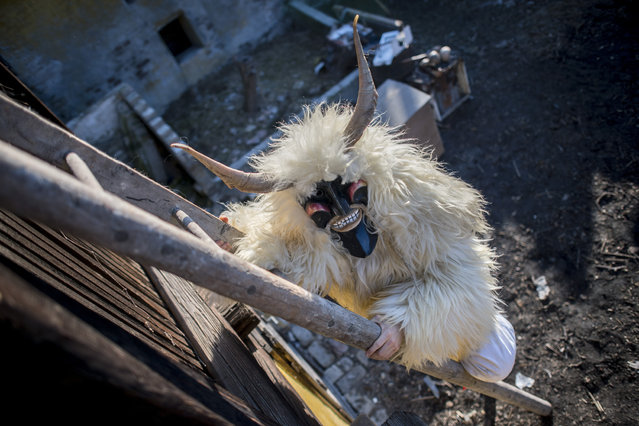
A man wears a busho mask and a costume made of sheep pelt while climbing up a ladder outside a barn in Mohacs, Hungary, 20 February 2020, on the first day of carnival. The traditional Busho carnival, which marks the end of winter, dates back to the 16th century. According to local legend, members of an ethnic South Slavic group living in Mohacs at the time dressed up in similar costumes and wore wooden masks to scare away Ottoman invaders, who mistook them for demons. (Photo by Tamas Soki/EPA/EFE)

A man wears a busho mask and a costume made of sheep pelt while climbing up a ladder outside a barn in Mohacs, Hungary, 20 February 2020, on the first day of carnival. The traditional Busho carnival, which marks the end of winter, dates back to the 16th century. According to local legend, members of an ethnic South Slavic group living in Mohacs at the time dressed up in similar costumes and wore wooden masks to scare away Ottoman invaders, who mistook them for demons. (Photo by Tamas Soki/EPA/EFE)
Details
23 Feb 2020 00:07:00
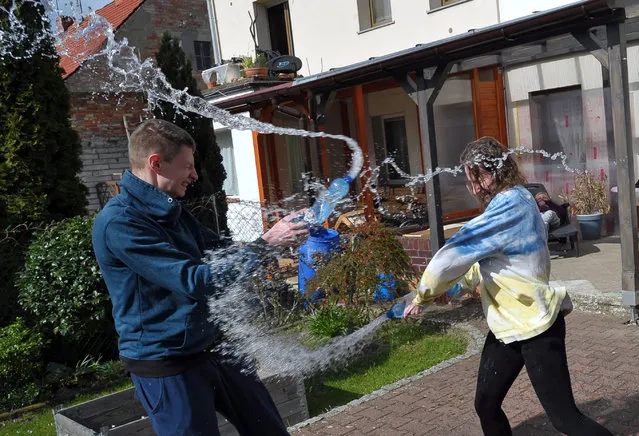
A Polish girl and a boy throw water over each other on Wet Monday in Szczecin, northwestern Poland, 13 April 2020. Wet Monday is a Catholic celebration held on Easter Monday mostly in Poland, but also in the Czech Republic, Slovakia, Hungary and some parts of western Ukraine. Due to the lockdown it is forbidden to celebrate this holiday in public. (Photo by Marcin Bielecki/EPA/EFE)

A Polish girl and a boy throw water over each other on Wet Monday in Szczecin, northwestern Poland, 13 April 2020. Wet Monday is a Catholic celebration held on Easter Monday mostly in Poland, but also in the Czech Republic, Slovakia, Hungary and some parts of western Ukraine. Due to the lockdown it is forbidden to celebrate this holiday in public. (Photo by Marcin Bielecki/EPA/EFE)
Details
15 Apr 2020 00:07:00
A meteorite of the swarm of meteorites Perseida flies above the Ujudvar TV Tower as seen from Ujudvar, Hungary, late Friday, August 13, 2021. Perseidas, one of the brightest meteorite swarms, consist of a multitude of stellar particles which due to their high speed glow up and burn by entering Earth's atmosphere. (Photo by Gyorgy Varga/MTI via AP Photo)

A meteorite of the swarm of meteorites Perseida flies above the Ujudvar TV Tower as seen from Ujudvar, Hungary, late Friday, August 13, 2021. Perseidas, one of the brightest meteorite swarms, consist of a multitude of stellar particles which due to their high speed glow up and burn by entering Earth's atmosphere. (Photo by Gyorgy Varga/MTI via AP Photo)
Details
21 Oct 2021 08:48:00
Ajka alumina plant accident

The photograph you see above isn’t the result of Photoshop or infrared photography. Captured by Spanish photographer Palíndromo Mészáros, it shows what the landscape of Ajka, Hungary looked like half a year after the Ajka alumina plant accident — an industrial disaster in which 35 million cubic feet of toxic waste flooded the land to a height of around 6.5 feet. Mészáros lined up the thick red line caused by the sludge with the horizon line to obtain this surreal image.
Details
13 Jul 2012 05:24:00