Loading...
Done
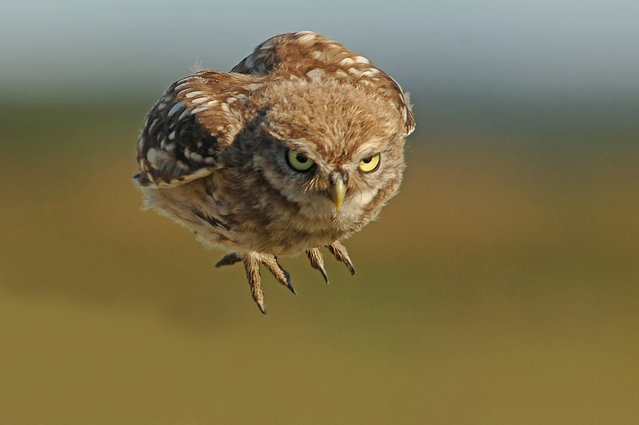
Little owl chicks in Northumberland, UK on August 19, 2018. Strutting up and down and barrelling through the air, these Little Owl chicks will soon be fending for themselves. The intense little birds were snapped by wildlife photographer Bill Doherty in his native Northumberland. The chicks have about seven or eight weeks to learn their survival skills before their parents drive them away to fend for themselves. (Photo by Bill Doherty/South West News Service)

Little owl chicks in Northumberland, UK on August 19, 2018. Strutting up and down and barrelling through the air, these Little Owl chicks will soon be fending for themselves. The intense little birds were snapped by wildlife photographer Bill Doherty in his native Northumberland. The chicks have about seven or eight weeks to learn their survival skills before their parents drive them away to fend for themselves. (Photo by Bill Doherty/South West News Service)
Details
26 Aug 2018 00:03:00
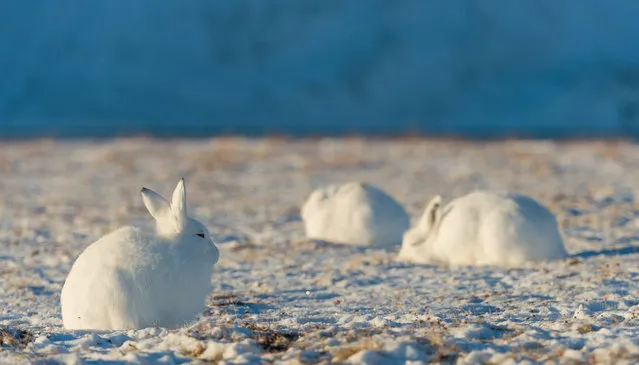
Arctic Hare

The arctic hare, or polar rabbit, is a species of hare which is adapted largely to polar and mountainous habitats. The arctic hare survives with a thick coat of fur and usually digs holes in the ground or under snow to keep warm and sleep. Arctic hares look like rabbits but have shorter ears, are taller when standing, and, unlike rabbits, can thrive in cold climates. They can travel together with many other hares, sometimes huddling with dozens or more, but are usually found alone, taking, in some cases, more than one partner. The arctic hare can run up to 60 kilometres per hour (40 mph). Its predators include the arctic wolf, arctic fox, and ermine.
Details
17 Mar 2014 13:56:00
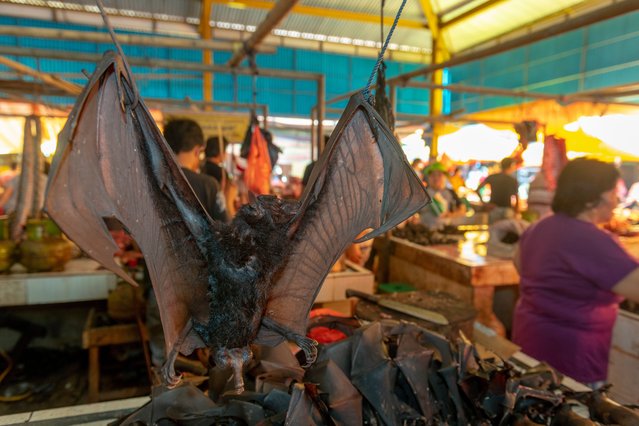
A food market shows off rows upon rows of dead animals, some of which have been beaten to death. Dogs and chickens can be seen lined up with their mouths hanging wide open. Shoppers even pick up some of the dogs and bats as they look for the best on the market. Retired biologist and amateur photographer Alf Jacob Nilsen took the shocking pictures of the market during a visit to Tomohon Village in Northern Sulawei, Indonesia. Pictured: Flying foxes (bats) for sale at the market. (Photo by Alf Jacob Nilsen/Solent News)

A food market shows off rows upon rows of dead animals, some of which have been beaten to death. Dogs and chickens can be seen lined up with their mouths hanging wide open. Shoppers even pick up some of the dogs and bats as they look for the best on the market. Retired biologist and amateur photographer Alf Jacob Nilsen took the shocking pictures of the market during a visit to Tomohon Village in Northern Sulawei, Indonesia. Pictured: Flying foxes (bats) for sale at the market. (Photo by Alf Jacob Nilsen/Solent News)
Details
15 May 2020 00:03:00
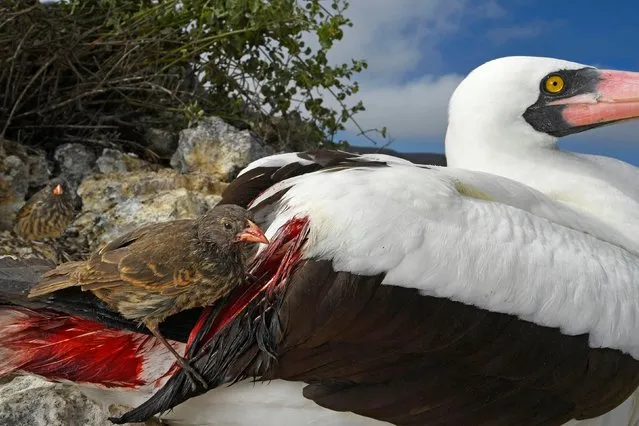
Bloodthirsty by Thomas P Peschak, Germany/South Africa — winner, Behaviour: birds. When rations run short on Wolf Island, in the remote northern Galápagos, the sharp-beaked ground finches become vampires. Their sitting targets are Nazca boobies and other large birds. The finches rely on a scant diet of seeds and insects, which regularly dries up, so they drink blood to survive. ‘I’ve seen more than half a dozen finches drinking from a single Nazca booby,’ says Tom. Rather than leave their nests the boobies tolerate the vampires, and the blood loss doesn’t seem to cause permanent harm. (Photo by Thomas P Peschak/2018 Wildlife Photographer of the Year)

Bloodthirsty by Thomas P. Peschak, Germany/South Africa — winner, Behaviour: birds. When rations run short on Wolf Island, in the remote northern Galápagos, the sharp-beaked ground finches become vampires. Their sitting targets are Nazca boobies and other large birds. The finches rely on a scant diet of seeds and insects, which regularly dries up, so they drink blood to survive. ‘I’ve seen more than half a dozen finches drinking from a single Nazca booby,’ says Tom. Rather than leave their nests the boobies tolerate the vampires, and the blood loss doesn’t seem to cause permanent harm. (Photo by Thomas P. Peschak/2018 Wildlife Photographer of the Year)
Details
19 Oct 2018 00:05:00
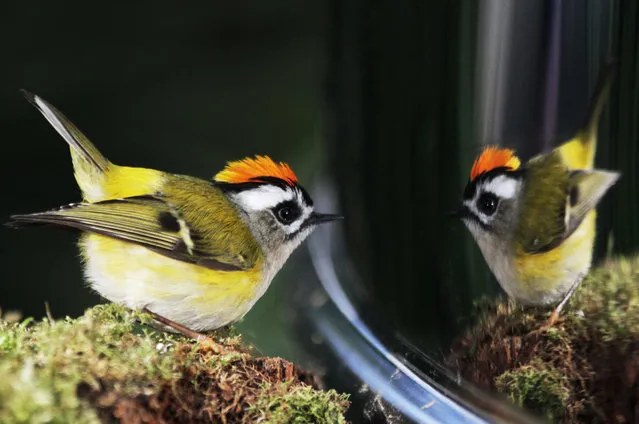
Golden-Crowned Kinglet

Golden-crowned Kinglets boldly bear their flashy lemon-yellow crest and a black eyebrow stripe. Taking a good look at them might be rather challenging, since they spend most of their time in the dense fir foliage or spruce. However, if you’re patient enough to find them, listen for their shrill, thin song. Though these “little Kings” are only a tad bit larger than a hummingbird, they can survive easily extreme cold by huddling close together. They breed in montane west and the far north and only visit North America during winter.
Details
21 Jan 2015 13:20:00
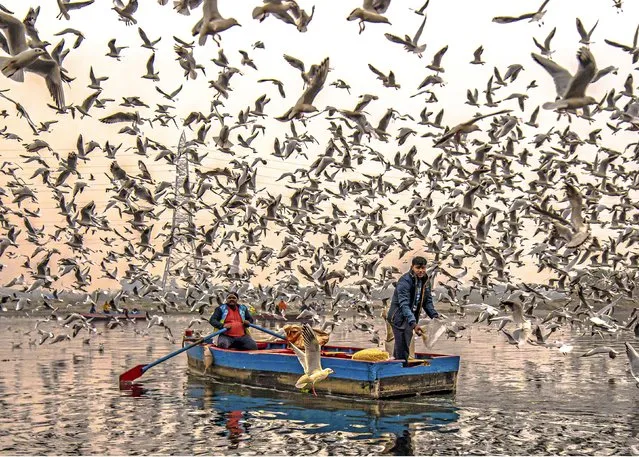
Flocks of seagulls swarm small fishing boats in the first decade of January 2024 like a scene from Alfred Hitchcock’s The Birds. Colonies of Heuglin’s gulls can be seen almost every morning on the Yamuna River in Delhi, India. (Photo by Raghav Rai Ralhan/Solent News)

Flocks of seagulls swarm small fishing boats in the first decade of January 2024 like a scene from Alfred Hitchcock’s The Birds. Colonies of Heuglin’s gulls can be seen almost every morning on the Yamuna River in Delhi, India. (Photo by Raghav Rai Ralhan/Solent News)
Details
20 Jan 2024 09:18:00
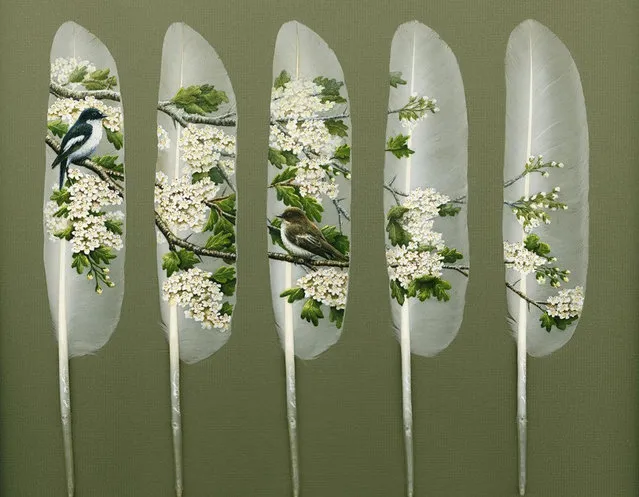
Feather Paintings By Julie Thompson

Many people have seen feathers as decorative items before. Today, ostrich, peacock and bird of paradise feathers can be seen in haute couture and in the costumes of indigenous peoples. They can be colorful and spectacular in their own right, but how much more stunning might they be when used as canvases for artists, eager to demonstrate their talent for the unusual? Alaskan-born and -bred artist Julie Thompson is an astounding exponent of this incredible art
form.
Details
10 Apr 2013 10:31:00
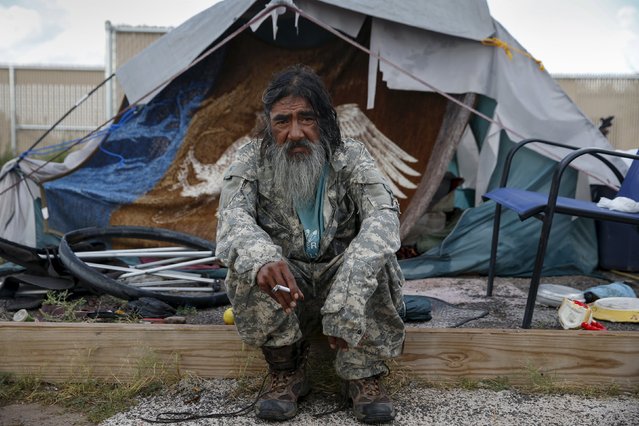
Daniel J. Wabsey, a 58-year-old war veteran, sits outside his tent at Camp Hope in Las Cruces, New Mexico October 6, 2015. “I've been traveling for 35 or 38 years. Getting inside would take a while to get used to. I just want to be able to eat, sleep and be safe. We all get along and understand in Camp Hope. We've all been there. With common sense you can survive out here”, Wabsey said. Camp Hope describe themselves as an “alternative transitional living project for the homeless”. Around 50 people live at the camp. (Photo by Shannon Stapleton/Reuters)

Daniel J. Wabsey, a 58-year-old war veteran, sits outside his tent at Camp Hope in Las Cruces, New Mexico October 6, 2015. “I've been traveling for 35 or 38 years. Getting inside would take a while to get used to. I just want to be able to eat, sleep and be safe. We all get along and understand in Camp Hope. We've all been there. With common sense you can survive out here”, Wabsey said. Camp Hope describe themselves as an “alternative transitional living project for the homeless”. Around 50 people live at the camp. (Photo by Shannon Stapleton/Reuters)
Details
19 Dec 2015 08:05:00