Loading...
Done
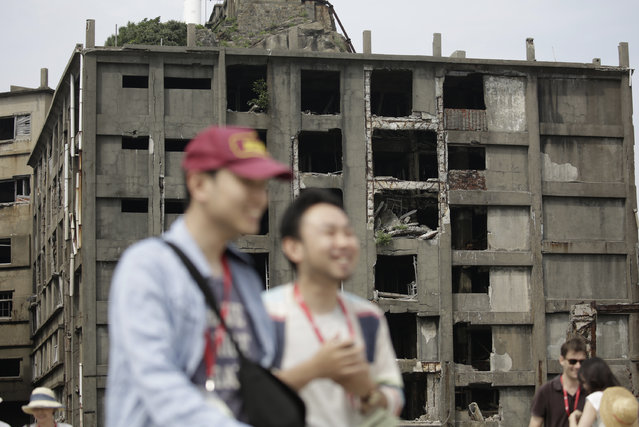
In this June 29, 2015 photo, forlorn buildings are seen at Hashima Island, commonly known as Gunkanjima, which means “Battleship Island”, off Nagasaki, Nagasaki Prefecture, southern Japan. (Photo by Eugene Hoshiko/AP Photo)

In this June 29, 2015 photo, forlorn buildings are seen at Hashima Island, commonly known as Gunkanjima, which means “Battleship Island”, off Nagasaki, Nagasaki Prefecture, southern Japan. The island is one of 23 old industrial facilities seeking UNESCO's recognition as world heritage “Sites of Japan's Meiji Industrial Revolution” meant to illustrate Japan's rapid transformation from a feudal farming society into an industrial power at the end of the 19th century. UNESCO's World Heritage Committee is expected to approve the proposal during a meeting being held in Bonn, Germany, through July 9. (Photo by Eugene Hoshiko/AP Photo)
Details
01 Jul 2015 13:41:00
Women are covered in dust after making it out of a building that collapsed after an earthquake in the Roma neighborhood of Mexico City, Tuesday, September 19, 2017. (Photo by Rebecca Blackwell/AP Photo)

Women are covered in dust after making it out of a building that collapsed after an earthquake in the Roma neighborhood of Mexico City, Tuesday, September 19, 2017. A powerful earthquake shook Mexico City on Tuesday, causing panic among the megalopolis' 20 million inhabitants on the 32nd anniversary of a devastating 1985 quake. The US Geological Survey put the quake's magnitude at 7.1 while Mexico's Seismological Institute said it measured 6.8 on its scale. The institute said the quake's epicenter was seven kilometers west of Chiautla de Tapia, in the neighboring state of Puebla. (Photo by Rebecca Blackwell/AP Photo)
Details
20 Sep 2017 08:06:00
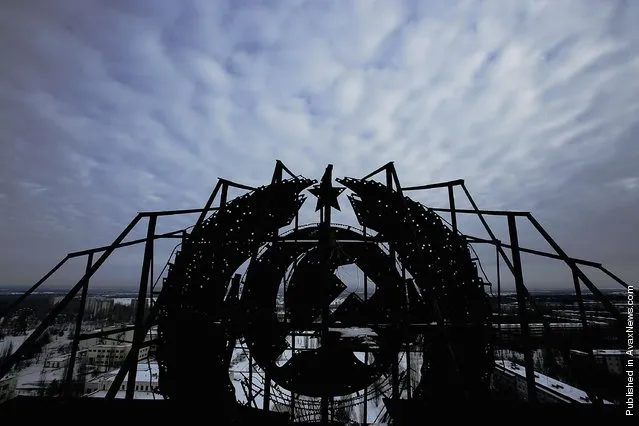
Chernobyl

Scaffolding holding a remnant of the Soviet Union, the hammer and sickle, is seen on a rooftop of an abandoned building in the town of Pripyat on January 25, 2006 near Chernobyl, Ukraine. The town of Pripyat, deserted since the 1986 catastrophe, once housed 30,000 people, the majority of being workers from the Chernobyl Nuclear Power Plant. Days after the catastrophe the inhabitants were relocated to other locations in the Soviet Union. The town of Pripyat has remained uninhabited since. Prypyat and the surrounding area will not be safe for human habitation for several centuries. Scientists estimate that the most dangerous radioactive elements will take up to 900 years to decay sufficiently to render the area safe.
Details
14 Mar 2011 10:20:00
People wrapped in blankets sit on the road as they are evacuated from a hotel after an earthquake in Kumamoto, southern Japan, in this photo taken by Kyodo April 14, 2016. (Photo by Reuters/Kyodo News)

People wrapped in blankets sit on the road as they are evacuated from a hotel after an earthquake in Kumamoto, southern Japan, in this photo taken by Kyodo April 14, 2016. A powerful earthquake with a magnitude of 6.5 knocked over buildings in southern Japan on Thursday evening, and police said people may be trapped underneath. (Photo by Reuters/Kyodo News)
Details
15 Apr 2016 10:35:00
In this Tuesday, August 2, 2016 photo released by Xinhua News Agency, people stand on a platform as the Transit Elevated Bus TEB-1 conducting a test run after it unveiled in Qinhuangdao, north China's Hebei Province. The 72-feet long and 25-feet wide Transit Elevated Bus (TEB) powered by electricity can carry more than hundreds passengers, is designed to go over the normal traffic to help ease traffic congestion without having to dig new tunnels or build elevated rail tracks. (Photo by Luo Xiaoguang/Xinhua via AP Photo)

In this Tuesday, August 2, 2016 photo released by Xinhua News Agency, people stand on a platform as the Transit Elevated Bus TEB-1 conducting a test run after it unveiled in Qinhuangdao, north China's Hebei Province. The 72-feet long and 25-feet wide Transit Elevated Bus (TEB) powered by electricity can carry more than hundreds passengers, is designed to go over the normal traffic to help ease traffic congestion without having to dig new tunnels or build elevated rail tracks. (Photo by Luo Xiaoguang/Xinhua via AP Photo)
Details
04 Aug 2016 10:32:00
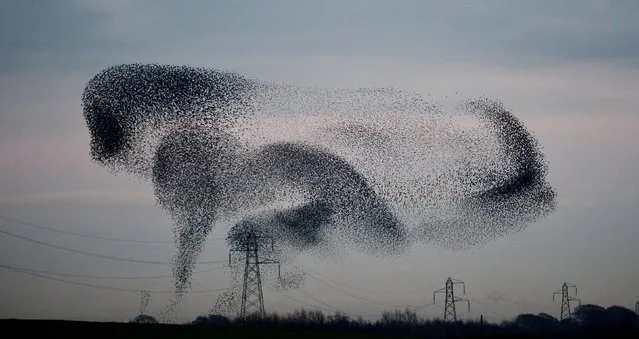
A murmuration of starlings above the  the small village of Rigg, near Gretna, in the Scottish Borders, on November 25, 2013. The weight of the resting birds on power lines caused some power localised power outages in the village. Still one of the commonest of garden birds, its decline elsewhere puts it on the Red List of endangered species. (Photo by Owen Humphreys/PA Wire)

A murmuration of starlings above the the small village of Rigg, near Gretna, in the Scottish Borders, on November 25, 2013. The weight of the resting birds on power lines caused some power localised power outages in the village. Still one of the commonest of garden birds, its decline elsewhere puts it on the Red List of endangered species. (Photo by Owen Humphreys/PA Wire)
Details
27 Nov 2013 11:00:00
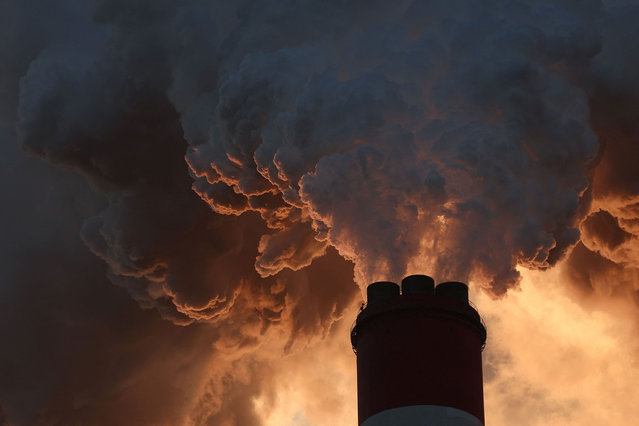
Smoke and steam billow from Belchatow Power Station, Europe's largest coal-fired power plant powered by lignite, operated by Polish utility PGE, in Rogowiec, Poland on November 22, 2023. (Photo by Kacper Pempel/Reuters)

Smoke and steam billow from Belchatow Power Station, Europe's largest coal-fired power plant powered by lignite, operated by Polish utility PGE, in Rogowiec, Poland on November 22, 2023. (Photo by Kacper Pempel/Reuters)
Details
01 Jun 2024 04:51:00
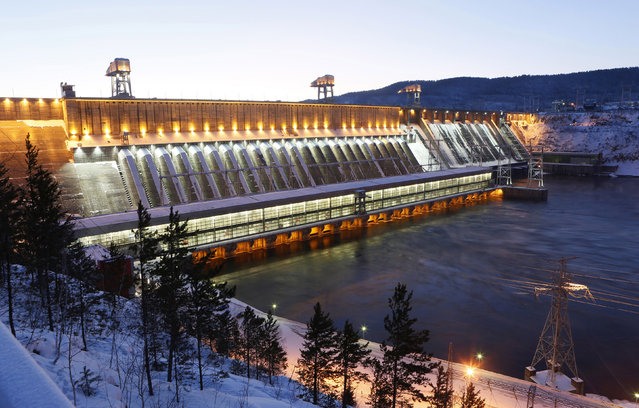
A general view shows the Krasnoyarsk hydro-electric power station on the Yenisei River near the Siberian city of Krasnoyarsk, Russia, January 13, 2016. The power plant, owned by EuroSibEnergo company, part of En+ Group, with a generating capacity of 6,000 megawatt (MW), has a ferro-concrete dam 124-metres high and 1065-metres long and is the second largest Russian hydroelectric power station. About 85% of the energy generated is intended for the Rusal Krasnoyarsk aluminium smelter, according to representatives of the power station. (Photo by Ilya Naymushin/Reuters)

A general view shows the Krasnoyarsk hydro-electric power station on the Yenisei River near the Siberian city of Krasnoyarsk, Russia, January 13, 2016. The power plant, owned by EuroSibEnergo company, part of En+ Group, with a generating capacity of 6,000 megawatt (MW), has a ferro-concrete dam 124-metres high and 1065-metres long and is the second largest Russian hydroelectric power station. About 85% of the energy generated is intended for the Rusal Krasnoyarsk aluminium smelter, according to representatives of the power station. (Photo by Ilya Naymushin/Reuters)
Details
16 Jan 2016 08:03:00