Loading...
Done
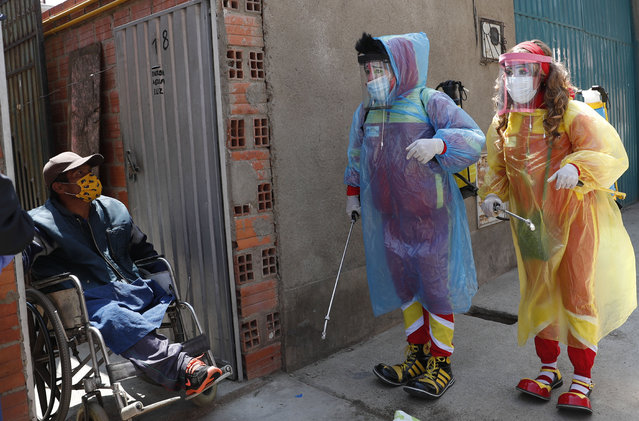
Clowns Perlita and Tapetito, wearing protective gear amid the new coronavirus pandemic, speak with resident Enrique Zeballos as they arrive to disinfect his home free of charge, in El Alto, Bolivia, Friday, September 11, 2020. The lack of traditional employment for the clowns due to the pandemic has led them towards other avenues of making money. But for people with limited income they provide their disinfection services free of charge. (Photo by Juan Karita/AP Photo)

Clowns Perlita and Tapetito, wearing protective gear amid the new coronavirus pandemic, speak with resident Enrique Zeballos as they arrive to disinfect his home free of charge, in El Alto, Bolivia, Friday, September 11, 2020. The lack of traditional employment for the clowns due to the pandemic has led them towards other avenues of making money. But for people with limited income they provide their disinfection services free of charge. (Photo by Juan Karita/AP Photo)
Details
13 Sep 2020 00:07:00
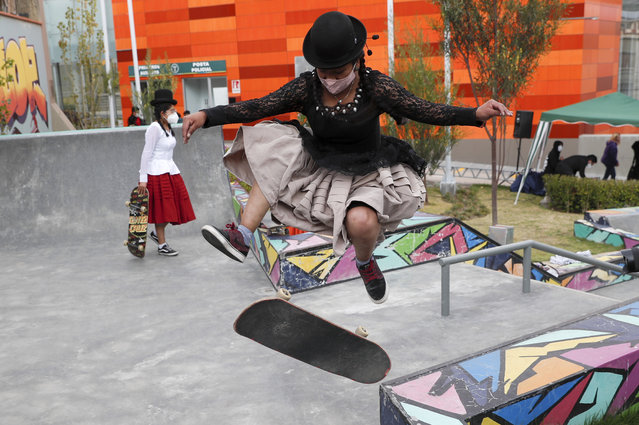
Aide Choque, wearing a mask amid the COVID-19 pandemic, jumps with her skateboard during a youth talent show in La Paz, Bolivia, Wednesday, September 30, 2020. Young women called “Skates Imillas”, using the Aymara word for girl Imilla, use traditional Indigenous clothing as a statement of pride of their Indigenous culture while playing riding their skateboards. (Photo by Juan Karita/AP Photo)

Aide Choque, wearing a mask amid the COVID-19 pandemic, jumps with her skateboard during a youth talent show in La Paz, Bolivia, Wednesday, September 30, 2020. Young women called “Skates Imillas”, using the Aymara word for girl Imilla, use traditional Indigenous clothing as a statement of pride of their Indigenous culture while playing riding their skateboards. (Photo by Juan Karita/AP Photo)
Details
10 Feb 2021 11:11:00
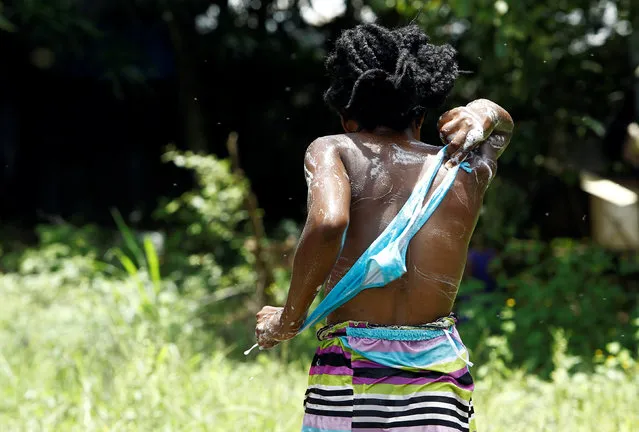
An African migrant stranded in Costa Rica bathes at a makeshift camp at the border between Costa Rica and Nicaragua, in Penas Blancas, Costa Rica, July 14, 2016. (Photo by Juan Carlos Ulate/Reuters)

An African migrant stranded in Costa Rica bathes at a makeshift camp at the border between Costa Rica and Nicaragua, in Penas Blancas, Costa Rica, July 14, 2016. Thousands of African migrants are currently stranded in Costa Rica after they were denied entry into neighbouring Nicaragua, which they have been using as a crossing point in order to reach the United States. According to the Costa Rican Red Cross, most of these people from Africa, Asia and Haiti. It has been reported that many of them paid smugglers to reach Central America. However, when they arrived at the border gates, they were denied entry and were left with nowhere to go. (Photo by Juan Carlos Ulate/Reuters)
Details
16 Jul 2016 08:17:00
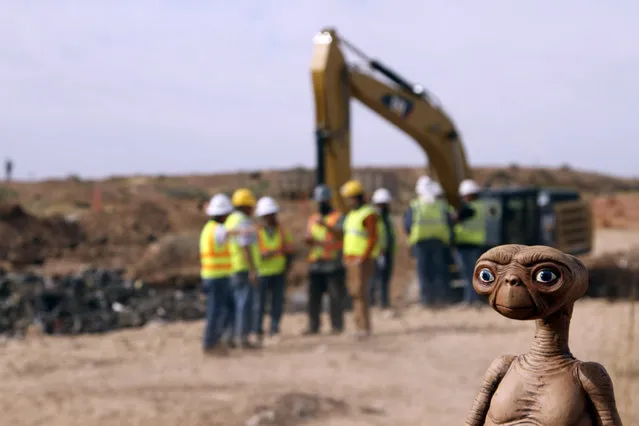
An E.T. doll is seen while construction workers prepare to dig into a landfill in Alamogordo, N.M., Saturday, April 26, 2014. Producers of a documentary are digging in the landfill in search of millions of cartridges of the Atari “E.T. The Extra-Terrestrial” game that has been called the worst game in the history of videogaming. A New York Times article from 1983 reported that Atari cartridges of “E.T. The Extraterrestrial” were dumped in the landfill in Alamogordo. (Photo by Juan Carlos Llorca/AP Photo)

An E.T. doll is seen while construction workers prepare to dig into a landfill in Alamogordo, N.M., Saturday, April 26, 2014. Producers of a documentary are digging in the landfill in search of millions of cartridges of the Atari “E.T. The Extra-Terrestrial” game that has been called the worst game in the history of videogaming. A New York Times article from 1983 reported that Atari cartridges of “E.T. The Extraterrestrial” were dumped in the landfill in Alamogordo. (Photo by Juan Carlos Llorca/AP Photo)
Details
28 Apr 2014 12:45:00
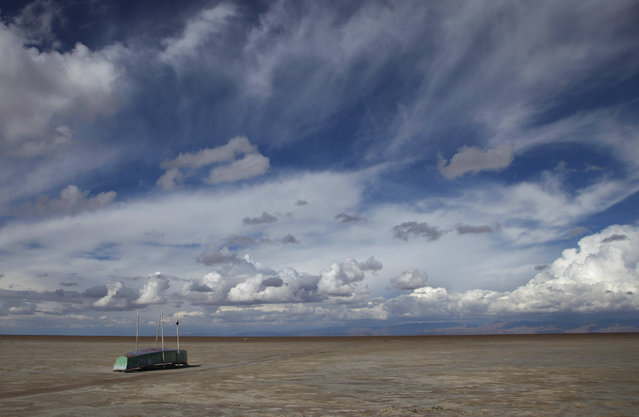
In this January 12, 2016 photo, an abandoned boat lies on the dried up lake bed of Lake Poopo, on the outskirts of Untavi, Bolivia. Drought caused by the recurrent El Nino meteorological phenomenon is considered the main driver of the lake's demise. Along with glacial melting, authorities say another factor is the diversion of water from Poopo's tributaries, mostly for mining but also for agriculture. (Photo by Juan Karita/AP Photo)

In this January 12, 2016 photo, an abandoned boat lies on the dried up lake bed of Lake Poopo, on the outskirts of Untavi, Bolivia. Drought caused by the recurrent El Nino meteorological phenomenon is considered the main driver of the lake's demise. Along with glacial melting, authorities say another factor is the diversion of water from Poopo's tributaries, mostly for mining but also for agriculture. (Photo by Juan Karita/AP Photo)
Details
21 Jan 2016 12:33:00
Illustrations Humor By Eduardo Salles

Eduardo Salles (Mexico City, 1987) is advertiser, designer, illustrator, writer and professor at the Miami Ad School. And a professional procrastinator!, he says. Ex Creative Director of Nike, Kit Kat and Red Cross Mexico. He has won awards as diverse as Cannes Lions (advertising), Walter Reuters prize (journalism) and Juan Rulfo Short Story Award (literature).
Details
02 Jul 2014 11:13:00
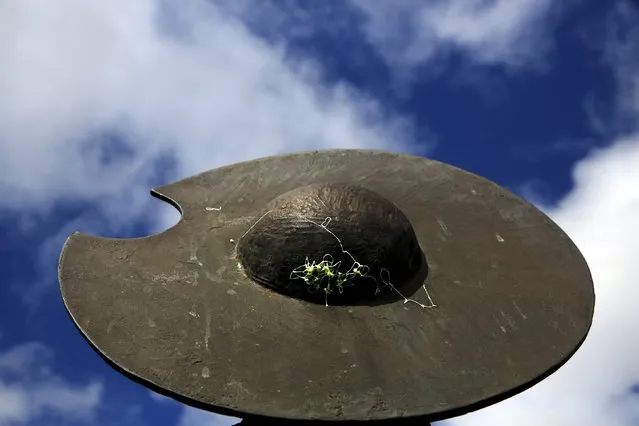
A sculpture of Don Quixote shows him wearing the basin he mistook for the enchanted helmet of the fictional Moorish king Mambrino in Alcazar de San Juan, Spain, April 5, 2016. (Photo by Susana Vera/Reuters)

A sculpture of Don Quixote shows him wearing the basin he mistook for the enchanted helmet of the fictional Moorish king Mambrino in Alcazar de San Juan, Spain, April 5, 2016. The arid central Spanish region of La Mancha is the setting for “Don Quixote”, the seventeenth-century novel by Miguel de Cervantes. Four hundred years after his death, references to the characters of Don Quixote, his loyal squire Sancho Panza and his beautiful lady Dulcinea abound in the surrounding villages from sweet treats to theatre productions involving livestock. Cervantes did not give away the name of the birthplace of Don Quixote, a middle-aged gentleman who becomes obsessed with chivalrous ideals. But many identify the village of Argamasilla de Alba as his hometown. The anniversary of Cervantes’ death is marked on the 23 April. (Photo by Susana Vera/Reuters)
Details
21 Apr 2016 12:32:00
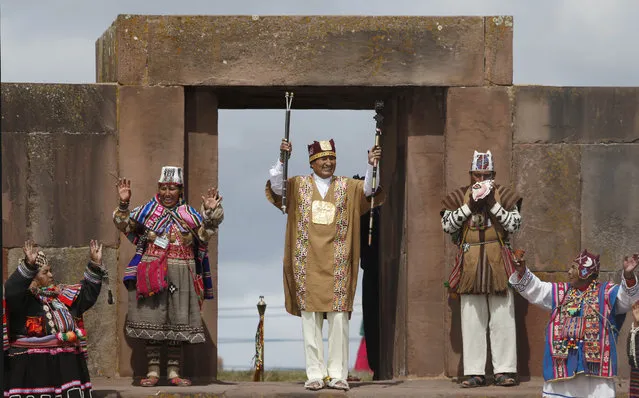
Bolivia's president Evo Morales holds his scared staffs of power during a blessing by Aymaran spiritual guides, in a traditional ceremony at the archeological site Tiwanaku, Bolivia, Wednesday, January 21, 2015. Morales is set to begin a new term Thursday, that will make him the Andean nation's longest-serving leader, riding high on a wave of unprecedented growth and stability. (Photo by Juan Karita/AP Photo)

Bolivia's president Evo Morales holds his scared staffs of power during a blessing by Aymaran spiritual guides, in a traditional ceremony at the archeological site Tiwanaku, Bolivia, Wednesday, January 21, 2015. Morales is set to begin a new term Thursday, that will make him the Andean nation's longest-serving leader, riding high on a wave of unprecedented growth and stability. (Photo by Juan Karita/AP Photo)
Details
22 Jan 2015 13:38:00