Loading...
Done
A performer takes part in a night parade to celebrate Chinese New Year in Hong Kong Friday, February 16, 2018. The Lunar New Year this year marks the Year of the Dog in the Chinese calendar. (Photo by Vincent Yu/AP Photo)

A performer takes part in a night parade to celebrate Chinese New Year in Hong Kong Friday, February 16, 2018. The Lunar New Year this year marks the Year of the Dog in the Chinese calendar. (Photo by Vincent Yu/AP Photo)
Details
19 Feb 2018 00:03:00
A Saudi police officer receives emergency calls at a call center, ahead of the Hajj pilgrimage in the Muslim holy city of Mecca, Saudi Arabia, Tuesday, August 6, 2019. The hajj occurs once a year during the Islamic lunar month of Dhul-Hijja, the 12th and final month of the Islamic calendar year. (Photo by Amr Nabil/AP Photo)

A Saudi police officer receives emergency calls at a call center, ahead of the Hajj pilgrimage in the Muslim holy city of Mecca, Saudi Arabia, Tuesday, August 6, 2019. The hajj occurs once a year during the Islamic lunar month of Dhul-Hijja, the 12th and final month of the Islamic calendar year. (Photo by Amr Nabil/AP Photo)
Details
09 Aug 2019 00:05:00
Some people prepare to catch offerings thrown by Tengger tribe people into the crater of Bromo volcano to in Probolinggo, East Java province, on June 30, 2018, as part of Yadnya Kasada festival which falls on the 14th day of the Kasada month based on the traditional Hindu lunar calendar. (Photo by Juni Kriswanto/AFP Photo)

Some people prepare to catch offerings thrown by Tengger tribe people into the crater of Bromo volcano to in Probolinggo, East Java province, on June 30, 2018, as part of Yadnya Kasada festival which falls on the 14th day of the Kasada month based on the traditional Hindu lunar calendar. (Photo by Juni Kriswanto/AFP Photo)
Details
03 Jul 2018 10:16:00
A green frog sits on a moth orchid at a local agricultural research center in Hwaseong, about 40 kilometers south of Seoul, South Korea, 03 March 2022, two days ahead of “gyeongchip”. On the lunar calendar, gyeongchip is the day when frogs awake from hibernation. (Photo by Yonhap/EPA/EFE)

A green frog sits on a moth orchid at a local agricultural research center in Hwaseong, about 40 kilometers south of Seoul, South Korea, 03 March 2022, two days ahead of “gyeongchip”. On the lunar calendar, gyeongchip is the day when frogs awake from hibernation. (Photo by Yonhap/EPA/EFE)
Details
24 Mar 2022 05:38:00
A man dresses as a Minion tries to convince a tourist to have her picture taken with him, in Times Square, in New York, April 7, 2016. The assortment of costumed characters, painted naked women and ticket sellers who make the streets of New York's Times Square their office, catering to tourists, may soon be restricted after a City Council vote Thursday. (Photo by Rickey Rogers/Reuters)

A man dresses as a Minion tries to convince a tourist to have her picture taken with him, in Times Square, in New York, April 7, 2016. The assortment of costumed characters, painted naked women and ticket sellers who make the streets of New York's Times Square their office, catering to tourists, may soon be restricted after a City Council vote Thursday. (Photo by Rickey Rogers/Reuters)
Details
24 Apr 2016 09:07:00
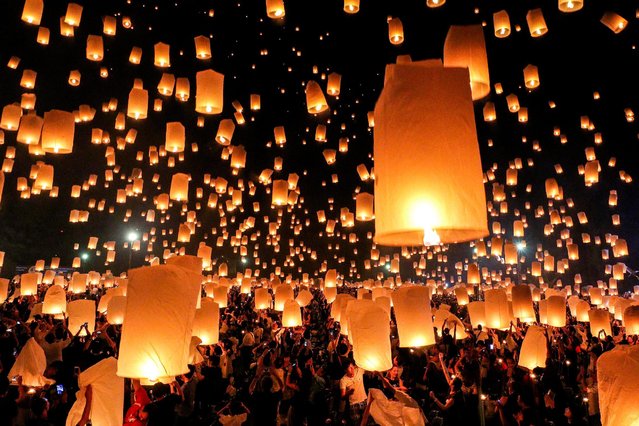
People release floating lanterns during the festival of Yee Peng in the northern capital of Chiang Mai, Thailand November 14, 2016. Yi Peng refers to the full moon day in the second month according to the Lanna lunar calendar (the twelfth month according to the Thai lunar calendar). Swarms of Lanna-style sky lanterns are launched into the air where they resemble large shoals of giant fluorescent jellyfish gracefully floating through the sky. The festival is meant as a time for tham bun, to make merit. Khom loi are made from a thin fabric, such as rice paper, stretched over a bamboo or wire frame, to which a candle or fuel cell is attached. When the fuel cell is lit, the resulting hot air is trapped inside the lantern and creates enough lift for the khom loi to float up into the sky. (Photo by Athit Perawongmetha/Reuters)

People release floating lanterns during the festival of Yee Peng in the northern capital of Chiang Mai, Thailand November 14, 2016. Yi Peng refers to the full moon day in the second month according to the Lanna lunar calendar (the twelfth month according to the Thai lunar calendar). Swarms of Lanna-style sky lanterns are launched into the air where they resemble large shoals of giant fluorescent jellyfish gracefully floating through the sky. The festival is meant as a time for tham bun, to make merit. Khom loi are made from a thin fabric, such as rice paper, stretched over a bamboo or wire frame, to which a candle or fuel cell is attached. When the fuel cell is lit, the resulting hot air is trapped inside the lantern and creates enough lift for the khom loi to float up into the sky. (Photo by Athit Perawongmetha/Reuters)
Details
15 Nov 2016 11:54:00
People dressed as a Chinese Dragon, swim in water at the Beijing Aquarium

People dressed as a “Chinese Dragon”, swim in water at the Beijing Aquarium on January 5, 2012 in Beijing, China. The new year in Chinese calendar is the year of Dragon which will fall on January 21, 2012. (Photo by ChinaFotoPress/Getty Images)
Details
06 Jan 2012 13:41:00
This image provided by NASA shoaws the comet PANSTARRS as seen from Mount Dale, Western Australia on March 5, 2013. According to NASA on March 10, it will make its closest approach to the sun about 28 million miles (45 million kilometers) away. As it continues its nightly trek across the sky, the comet may get lost in the sun's glare but should return and be visible to the naked eye by March 12. (Photo by AP Photo/NASA)

It’s time to start watching for Comet PANSTARRS, one of two comets to get excited about in 2013. Photo: This image provided by NASA shoaws the comet PANSTARRS as seen from Mount Dale, Western Australia on March 5, 2013. According to NASA on March 10, it will make its closest approach to the sun about 28 million miles (45 million kilometers) away. As it continues its nightly trek across the sky, the comet may get lost in the sun's glare but should return and be visible to the naked eye by March 12. (Photo by AP Photo/NASA)
Details
13 Mar 2013 08:03:00